The package is a Japanese slide system with 62 starting layouts
The measured 16-file checkout gives Claude Code a rulebook, a layout catalog, generation scripts, mechanical checks, and a separate review prompt. The operational material is mainly Japanese. A short English paragraph explains the premise, but an English-only operator would still need to translate the files that govern the work. The 62 layouts split into 27 frequently used parts and 35 additions for charts, matrices, roadmaps, and other less common pages.
The rules matter more than the templates. They tell the agent to put the conclusion in the title, keep one message on a slide, align table structure, define abbreviations, and connect evidence on the left to its implication on the right. There is a small documentation wrinkle: the README calls the rulebook roughly 110 items, while SKILL.md describes roughly 80. That drift does not stop use, but it shows why the files should be read rather than relying on the headline count.
The 9-step workflow forces review after generation
The 16-file checkout organizes work into 9 steps, starting with the purpose, deliverable, and scope. It then writes a title-level story, chooses a layout for each page, generates an HTML draft, replaces placeholders, runs the rule checker, renders the page, sends the deck to a separate agent, and prints a PDF for visual inspection. A 10-slide deck can skip chapter dividers. The process is prescriptive enough to stop an agent from jumping straight to decorated pages.
Within about 741 source lines, the independent review prompt is the strongest part. It asks a second agent, without creation context, to read every page and report awkward Japanese, logical jumps, number mismatches, unsupported evaluations, repeated pages, source gaps, and visual problems. The author then records each suggestion as accepted, rejected, or held with a reason. This preserves editorial judgment and avoids treating every model comment as an instruction.
What happened when we ran it
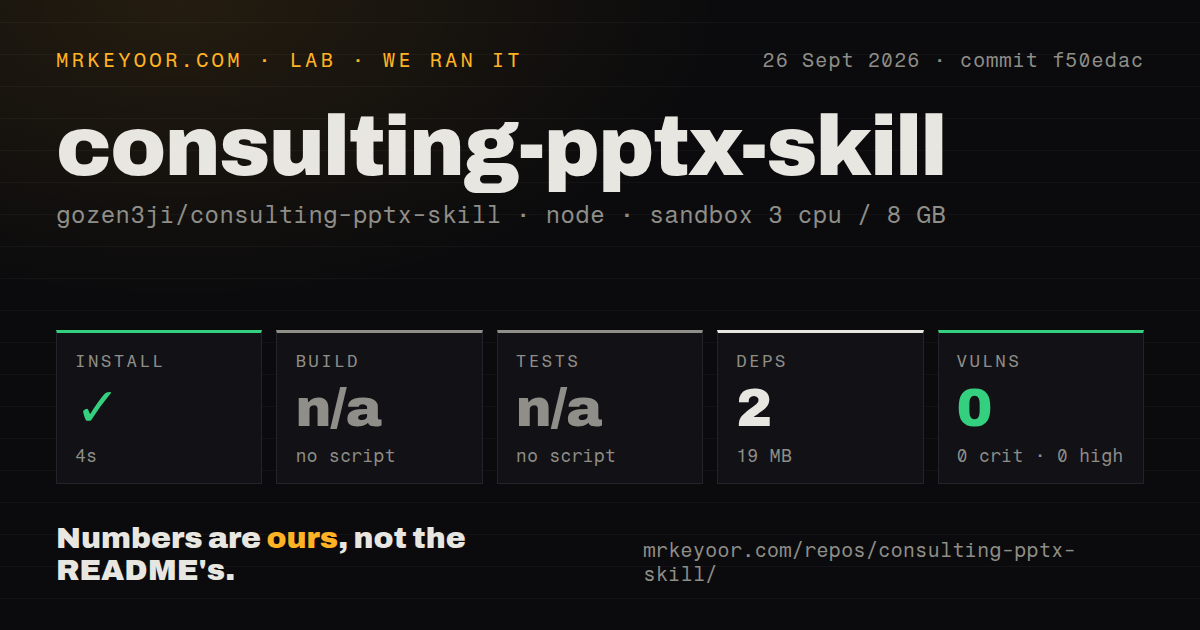
Our measurement setup installed 2 npm packages in 4 seconds, using 19 MB on disk. The measured commit was f50edac. Its checkout was 2.7 MB with 16 files and about 741 source lines. No build script or target existed, so we skipped build. No test script or target existed either, so there is no passing test result to report.
The npm audit found 0 known vulnerabilities at critical, high, moderate, or low severity. Our scan also found 0 CI workflow files, no Dockerfile, and no tests directory. Those results describe a compact collection of instructions, templates, and scripts rather than a tested application package. They do not judge whether a generated deck tells the truth or persuades its audience.
HTML and PDF are the supported outputs today
Only 2 npm packages were installed for the optional layout path. Each slide itself is one HTML section in a 16:9 document. A Python script extracts selected parts, scopes the two template styles, joins them into one deck, and renumbers pages. The HTML checker uses only Python's standard library. Rendered layout checks add Node.js, Playwright, and Chromium, while Chrome handles PDF printing. None of those paths needs an AI service key.
The 2.7 MB checkout makes editable PowerPoint the awkward edge. It includes a 62-slide PPTX catalog that users can copy by hand, and an older JSON-to-PPTX pipeline remains under an archived tag. Main-branch instructions explicitly exclude automatic HTML-to-PPTX conversion. Pull request 18 proposes such a converter and was still open on September 27, 2026. Treat it as unshipped work until it is merged and released.
Mechanical checks cannot validate the business argument
With 0 automated tests in the repository, check_deck.py is a deck linter rather than proof of the package itself. It looks for leftover placeholders, overlong titles, style violations, terminology drift, suspicious wording, and some mismatches between a numbered title and the items below it. The browser check catches footer collisions and content spilling past the right or bottom edge. Getting to 0 failures is still useful because these are tedious defects.
Those 741 source lines leave business verification outside the checker. Visual review must catch crushed bars, empty diagrams, poor page balance, and broken line wraps. A second agent checks reasoning and wording. A human still has to confirm every number, source, comparison, and recommendation. The repository supplies no factual research layer and no automated proof that a consulting claim follows from the client's data.
Brand adoption means maintaining rules and two template files
The default look uses warm cream, dark brown text, a brown accent, serif headings, and sans-serif body copy. Brand colors and fonts live in CSS variables near the top of both HTML template files. The instructions tell users to change the same values in each file. They also recommend adding every useful review correction to the slide rulebook so later sessions inherit it.
That maintenance model suits a team with a recognizable house style. It is less convenient for an organization expecting an import button for a corporate PowerPoint master. The 62 parts are prompts for composition, not a guarantee that every page type fits. The skill repeatedly tells the agent to split tables, rewrite implications, discard unsuitable layouts, and update the source templates after a useful correction.
Recent commits show activity, while releases and CI remain absent
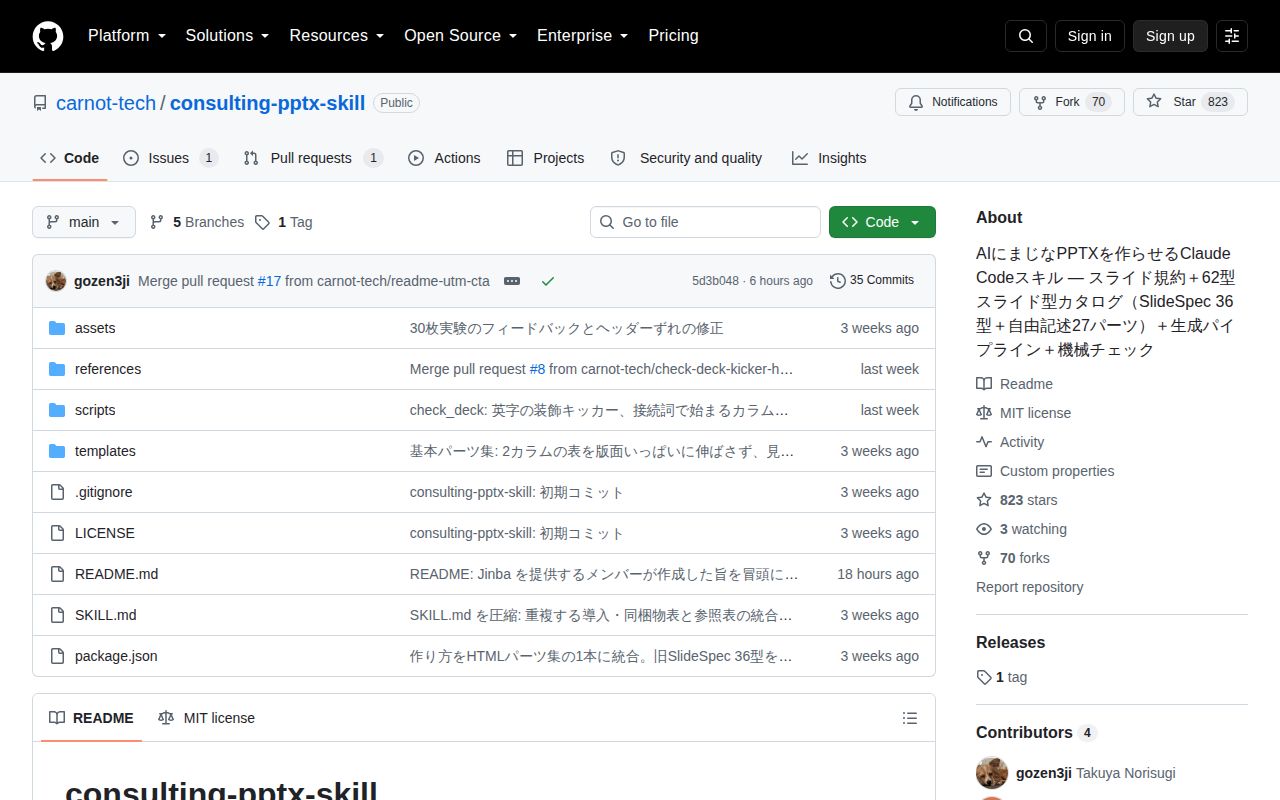
The repository moved from gozen3ji to carnot-tech, and the old URL redirects to the new owner. GitHub showed 823 stars, 70 forks, and 2 combined open issues and pull requests. The last push was September 27, 2026. One open item was the editable-PPTX conversion proposal. The other was outside feedback from an agent platform. There was no tagged GitHub release.
A 19 MB install makes this cheap for a Japanese-speaking team to trial. Start with one real 5-to-10-page deck, run both checkers, use the blind review prompt, and compare the PDF with your existing standard. If the team needs an editable deliverable, English operating material, or automated tests, settle those gaps before making the skill part of a client-production pipeline.