The public code renders prepared conditions, not a complete world
The current repository contains a Python 0.1.0 inference package for MiniMax H3 Ref2VA. It takes an RGB first frame, per-frame depth and Semantic-ID conditions, text prompts, and a seed, then prepares caches and generates a silent H.264 video. That is only the visual half of the paper's argument. The paper describes a coding agent that keeps persistent state and produces executable logic, followed by a proxy representation that guides video generation. The public tree does not contain that coding agent or the system that makes proxy conditions from an environment. Treat this as a focused inference artifact, not an installable world simulator.
What happened when we ran it
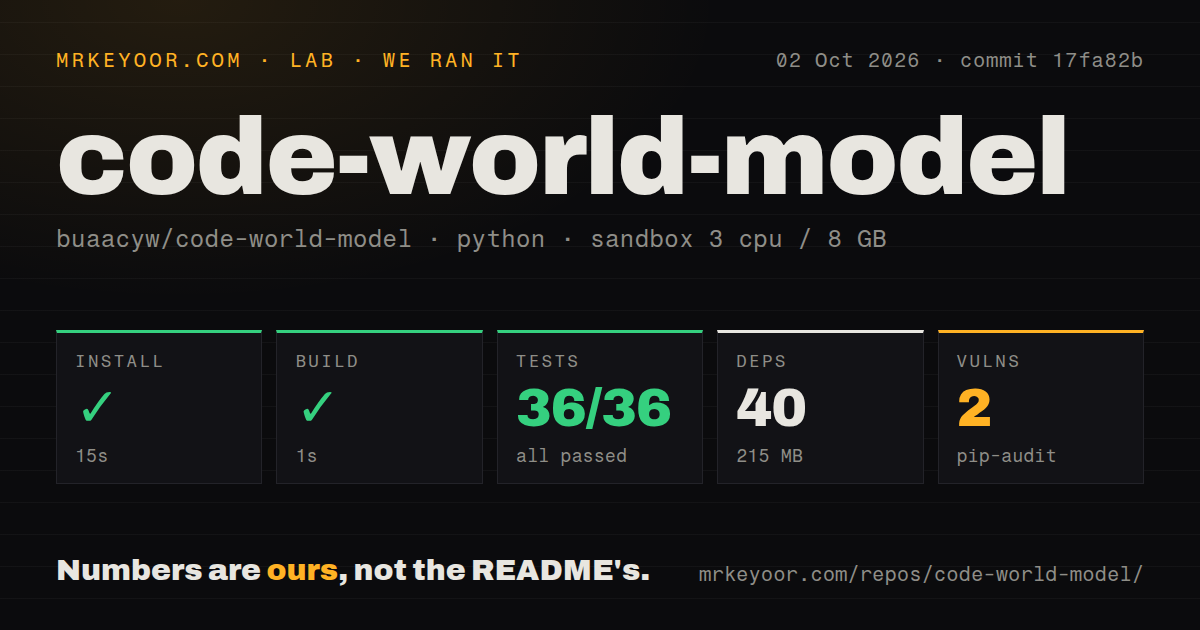
Our sandbox could not run commit 3cecdf1. We cloned that exact revision on 2026-08-27 into a fresh, unprivileged Debian container with 3 CPUs, 8 GB of RAM, and no secrets. The harness found no supported ecosystem, the repository reported no primary language, and there was no Dockerfile. We therefore did not install dependencies, build code, or execute tests, and there is no failure log to interpret. The honest result is "not run," not a failed Python setup. Python source arrived in later commits, after the revision our lab received, so the current guide should not be confused with something we verified ourselves.
The documented setup needs one H800 with 80 GB
The environment guide names Linux, Python 3.10.15, a CUDA 12.4 toolkit for building FlashAttention-3, and a PyTorch 12.8 CUDA runtime. It was tested on one NVIDIA H800 with 80 GB of GPU memory. Setup also involves checking out exact FlashAttention and Musubi Tuner revisions, applying two repository patches, obtaining the public MiniMax H3 and Qwen assets, and downloading the released LoRA plus example conditions. The asset script verifies fixed revisions and expands compact NPZ inputs into the on-disk format used by inference. This is careful documentation, but the machine requirement alone removes it from ordinary workstation territory.
The missing proxy generator blocks the advertised end-to-end loop
The environment guide says the authors built their coding-agent pipeline on an existing closed-source game-code foundation and cannot redistribute the tools that create depth and Semantic-ID proxy inputs. That missing piece matters more than any inconvenience we saw in the 3-CPU, 8 GB sandbox. The inference package can consume prepared files, but it cannot derive them from an RGB video or create a new interactive world's simulation logic. The authors suggest editing a supplied first frame and rewriting its prompts while preserving their structure. That can support controlled experiments around the examples, but it is a much narrower job than giving a coding agent an open-ended world and watching the system evolve it.
Fixed 20-step inference favors reproduction over exploration
The released configuration uses 20 Euler sampling steps, FlashAttention-3, 124 frames per window, and 90 new frames for each continuation. Inputs must follow exact shapes and ordering rules. Depth files are raw little-endian float32 arrays, Semantic-ID images use a defined class map, and successive windows advance by a fixed frame count. Cache policy is strict: change the model, LoRA, prompt, seed, anchor, or conditions and you must prepare a new cache and output path. Generation refuses to overwrite the final MP4. These constraints are useful when matching a published example, though they make casual experimentation easy to get wrong and do not answer how well altered scenes hold together.
Seven commits and zero releases make this pre-alpha research code
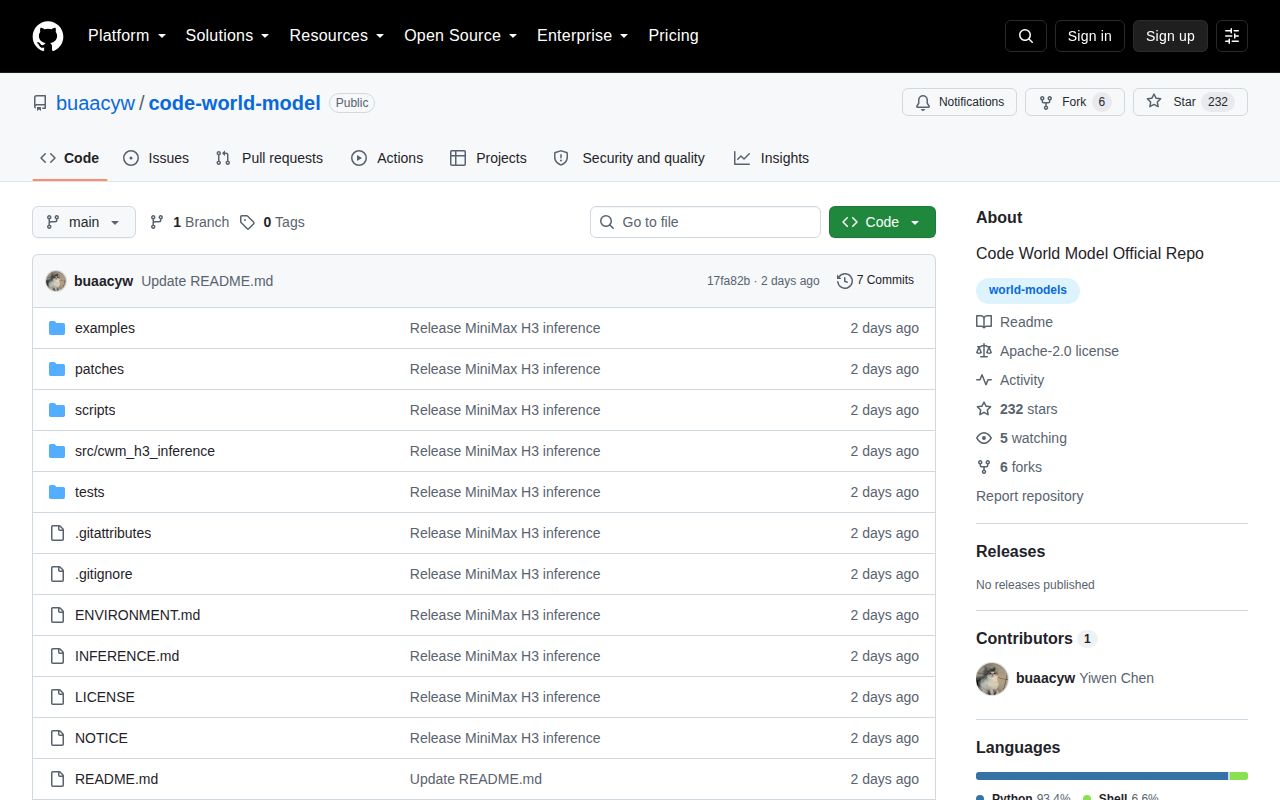
GitHub showed seven commits, 232 stars, 6 forks, and zero open issues or pull requests when fetched. The last push was 2026-08-27, one day after the repository appeared, and the releases endpoint returned no tagged release. The package itself declares a pre-alpha development status. commit 3cecdf1, the snapshot in our sandbox, preceded the Python inference drop by one commit, which explains the gap between our non-run and the current tree without turning the newer code into a tested result. The project is active in the literal sense that it was just published. It has not had enough public history to show upgrade discipline, outside contribution, or issue handling.
Code World Model is most useful as a companion to the paper and as a precise reference for the released MiniMax H3 rendering path. The docs deserve credit for naming the closed-source boundary instead of hiding it. Still, a team choosing software needs to judge what it can operate, and the public artifact stops before the part that gives the project its name. If you already have an H800-class research box and want to reproduce or alter supplied proxy-conditioned examples, it is worth reading. If you need a complete code-driven world system, wait for more of the pipeline to become public or choose a project whose input-production path you can own.