A 442,832-line plugin is closer to an IDE than a chat panel
Claudian embeds Claude Code, Codex, Grok Build, OpenCode, and Pi inside Obsidian. The 442,832-line source reflects a wide job: sidebar chat, inline editing, file search, shell commands, skills, MCP connections, session history, and provider-specific transports. A selected note or @-mentioned file becomes agent context, while the vault is the working directory. The result feels more like putting an agent-enabled terminal beside your notes than adding a question box to a writing app.
The checkout had 1,588 files and occupied 19.3 MB before installation. Users can keep several chat tabs, resume sessions, preview word-level inline edits, and switch into Plan Mode before implementation. The provider-neutral core is backed by separate adapters for Claude, Codex, Grok, OpenCode, and Pi, which explains both the reach and the maintenance burden. Each CLI has its own history, model selection, tool events, approvals, and process behavior that the plugin must translate into one Obsidian interface.
Obsidian 1.13.0 and one agent CLI are mandatory
The plugin requires Obsidian 1.13.0 or newer and runs only on macOS, Linux, and Windows desktops. At least one supported agent harness must be installed, plus a subscription or API provider that the harness can use. Claudian does not supply model access. The privacy section says prompts, attached files, images, and tool outputs are sent to the selected provider, so the account and retention policy behind that CLI still govern the conversation.
Community Plugins is the sensible installation path for most people. Source development is heavier: our run added 862 packages and 906 MB, while package.json declares Node 24. The README uses npm install and npm run build, and the repository also carries a Bun lockfile. A CLI visible in a terminal may be absent from Obsidian's GUI environment. The troubleshooting guide therefore covers explicit executable paths, custom PATH variables, and Windows native binaries instead of .cmd or .ps1 wrappers.
What happened when we ran it
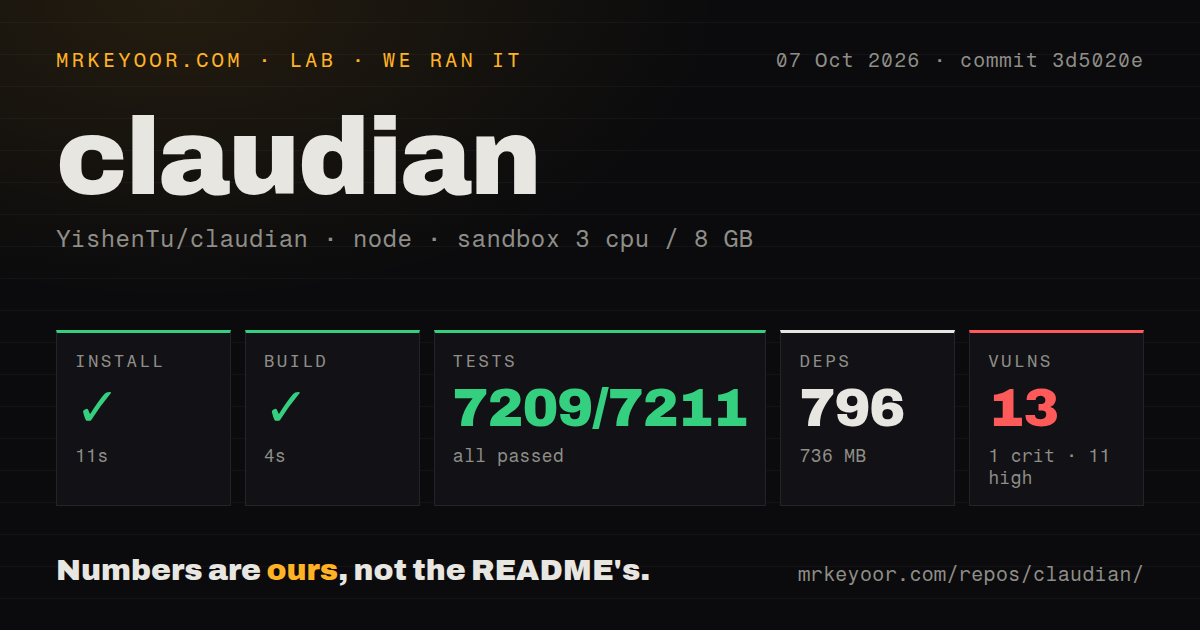
Our sandbox installed Claudian in 33 seconds, resolving 862 packages and consuming 906 MB on disk. The production build succeeded in 34 seconds. We used commit 191e7c5 in a fresh unprivileged Debian container with 3 CPUs and 8 GB of RAM. Npm audit reported 0 known vulnerabilities: 0 critical, 0 high, 0 moderate, and 0 low. The build result shows that this large TypeScript plugin can be assembled cleanly in the stated environment.
The test command did not finish before the 900-second cap. Its last visible lines continued to report PASS for unit and integration files, including LocalProjectCleanupCoordinator.test.ts and ProviderRegistry.test.ts; the log tail showed no failing assertion. That still counts as a timeout, because we never received a complete suite summary. The repository had 8 CI workflow files, no Dockerfile, and a tests directory. These measurements do not cover provider logins, an Obsidian launch, or live agent tool calls.
Whole-vault scope makes permissions a daily decision
Claudian's headline capability is also its largest risk: an agent can read, write, search, and run bash with the vault as its workspace. Plan Mode lets a user inspect a proposed approach, and inline edits show word-level changes, but many tasks go beyond one note. A 906 MB development install is merely local overhead; an incorrect shell command or path can alter the material a user cares about. Keep vault history or backups and review the provider's approval settings before routine use.
Open issue 1118 asks for a vault subfolder to become the working directory per conversation because the current default is the vault root. Issue 1137 is more serious for policy-minded users: its reporter says Claude Code SessionStart and PreToolUse hooks did not execute inside Claudian, and a write that the hook should block succeeded. The report covers one setup. Teams using hooks as a write barrier should reproduce the control before trusting it.
Version 2.2.5 is active, with provider-specific gaps still open
Release 2.2.5 arrived on August 30, 2026, and includes fixes for CodeQL findings, Windows Pi session persistence, OpenCode retries, keyboard access, and collaboration state. Fast releases are useful for a plugin following several external CLIs, though they also mean a report tied to 2.2.3 may no longer describe the newest package. Check the affected provider and version before applying an old workaround. The latest release also calls Collab Mode experimental in the README rather than presenting it as settled.
Some open reports remain directly relevant. Issue 1147 describes a Windows user-scope MCP server that worked from Claude Code in a terminal but never spawned inside Claudian 2.2.4. Issue 1230 reports escaped ampersands from linked paths being reused as literal filenames, creating duplicate folder trees. The repository's 8 CI workflows and extensive test tree show serious verification effort, yet our 900-second timeout means we cannot add a clean full-suite result to those signals.
Experimental collaboration moves Git data across the LAN
Collab Mode lets invited users work on shared projects, with Git data and authenticated coordination metadata moving directly between devices on the local network. The README says project data does not go to a Claudian cloud service through this mode. Git is required, and the feature is explicitly experimental in version 2.2.5. Host authority, transfers, conflict review, cleanup, and recovery all appear in the source tree, which is far more machinery than ordinary shared note editing. Test it with disposable vault copies first.
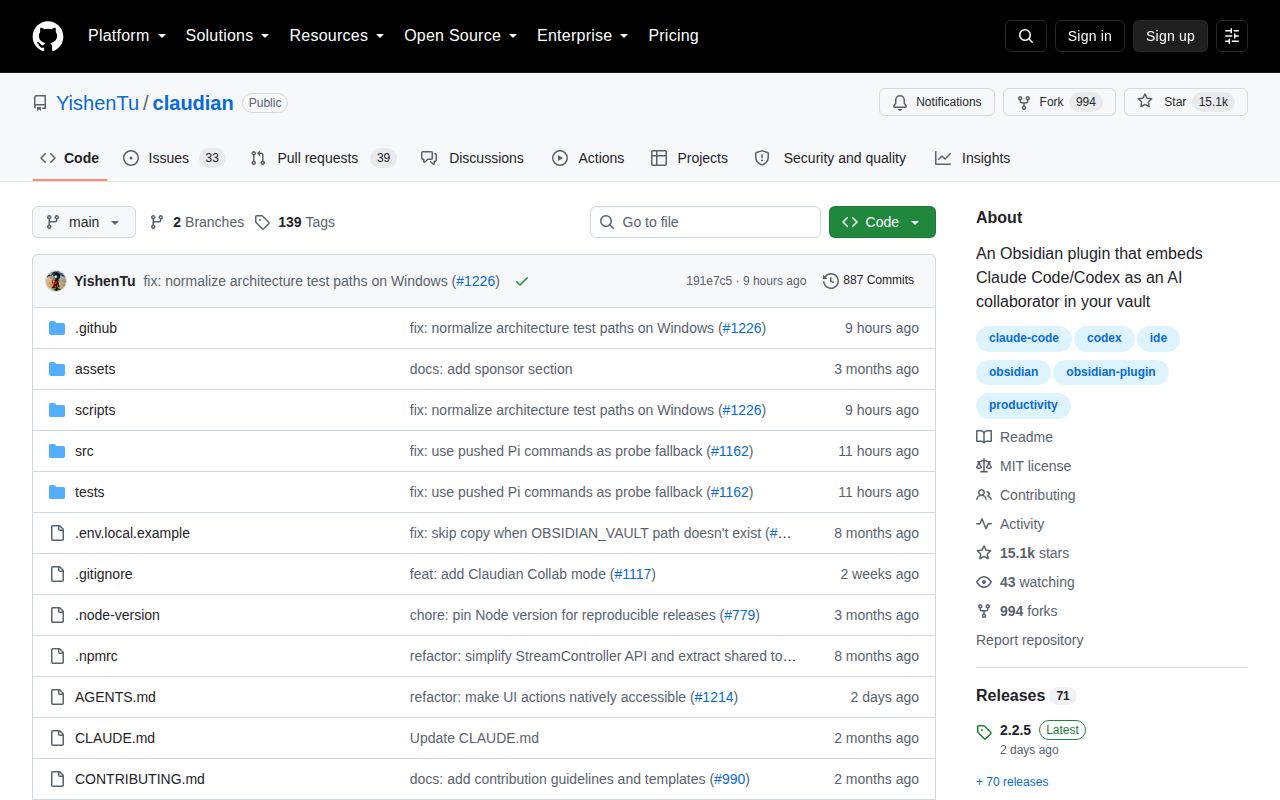
GitHub showed 15,096 stars and 72 combined open issues and pull requests on September 1, 2026. The open list contained 33 issues and 39 pull requests, while the repository was pushed that same day, two days after release 2.2.5. Maintenance is active, though provider gaps remain. Claudian is a direct way to put a coding agent inside Obsidian when desktop-only access and whole-vault authority fit. The 900-second timeout keeps maturity at 3.