A catalog with an unusual ownership model
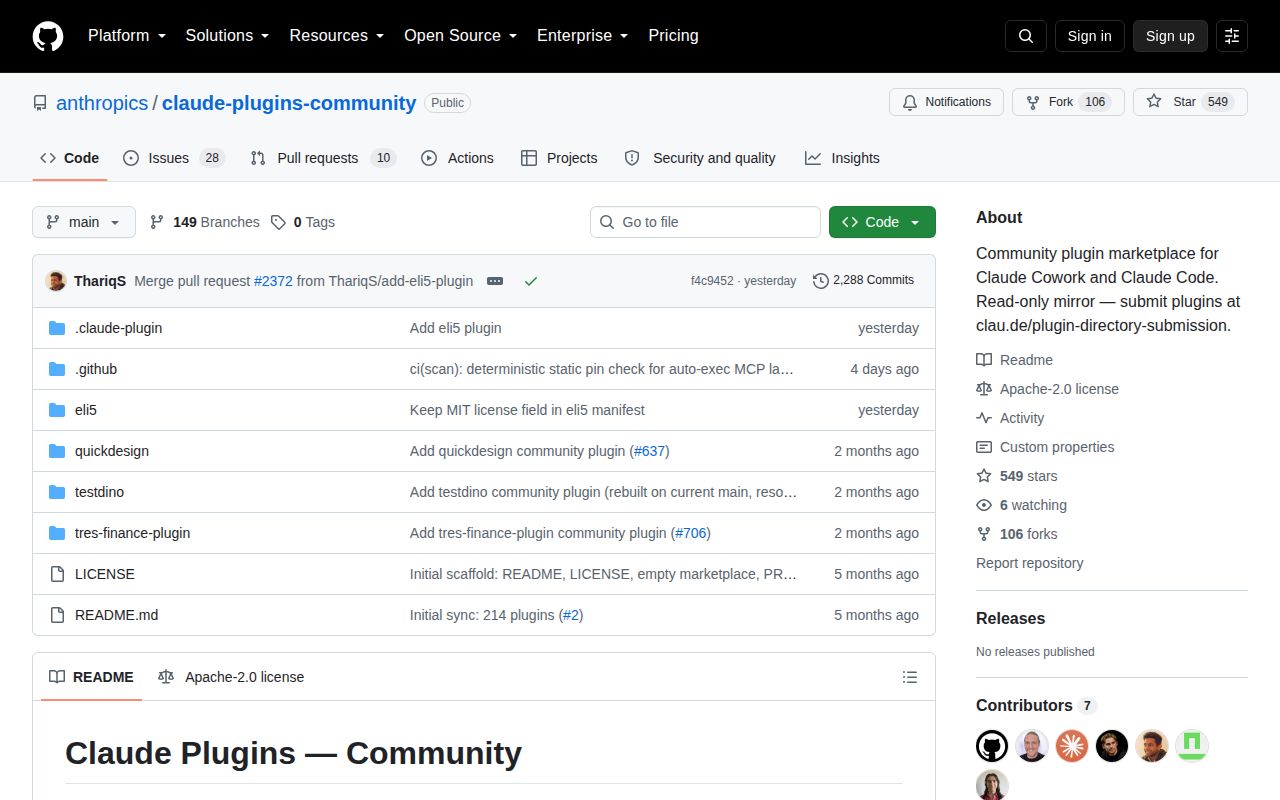
Claude Plugins Community is easier to understand as distribution metadata than as software you deploy. Its central file lists community plugins, their descriptions, upstream locations, and pinned commit hashes. Claude Code can add that catalog as a marketplace, while Claude Cowork exposes the same community through its plugin interface. The code and behavior users ultimately trust live in many third-party repositories.
Anthropic owns the mirror and its intake process, but community authors own the listed plugins. The README says each submission passes automated security scanning and approval before distribution. That is a useful screening layer. It does not turn thousands of unrelated extensions into one product with one permission model, upgrade policy, or support standard. Assess both the plugin you plan to install and the repository that points to it.
The marketplace file contained 2,282 entries when we inspected it. Some are focused skills that add instructions. Others connect to services, invoke tools, or start MCP components. A pinned source SHA makes the reviewed revision identifiable, which is preferable to fetching a moving branch. Users still need to inspect what that revision does, especially when it can run commands, read project files, or contact external systems.
What happened when we ran it
We did not run the repository in our sandbox. The lab found no supported execution ecosystem for this Python-classified repository and no Dockerfile. More importantly, the README does not present the checkout as an application with install, build, or test commands. It calls the repository a read-only mirror whose marketplace file is synchronized from Anthropic's internal review pipeline.
That means the useful trial happens in Claude Code or Claude Cowork, one plugin at a time. Claude Code users add the marketplace, then install a selected entry using its marketplace-qualified name. Cowork users go through the hosted plugin page. We did not execute either path, and we did not inspect or grant permissions to any listed plugin.
Each selection creates its own setup question. A plugin may be instruction-only, may expect a local command, or may connect to an outside account. The central README cannot promise that a particular entry will work without credentials or extra software. Read the listed plugin's upstream files and pin before accepting its requirements.
Discovery is good, trust still stays local
The main benefit is discoverability inside the product. Users do not need to collect repository URLs and teach every machine where each plugin lives. The namespace makes installation repeatable, and pinned commits give administrators a concrete revision to audit. The catalog also separates community work from Anthropic's official plugins, which helps buyers distinguish publisher identity.
The catch is easy to miss because the repository sits under the anthropics organization. A community listing is approved for distribution, according to the README, but the plugin remains community code. Teams with access to customer data, production credentials, or private source should review commands, hooks, MCP servers, requested environment variables, and network destinations. Approval is one input to that decision, not the final authorization.
Catalog scale makes maintenance difficult. Open issue 140 says one plugin SHA was not updated. Issue 869 says another entry points to a commit from before it became a plugin, resulting in an empty install. Issue 1185 describes an entry whose source type and path combination loads no agents or skills. These reports are specific failures users can encounter even when the marketplace command itself works.
Submission and update friction
Plugin authors cannot fix the mirror by opening a normal pull request. The README says those pull requests are closed automatically. New submissions go through Anthropic's directory form, then an internal review and nightly synchronization process. This central control can keep arbitrary additions out of the default feed, but it also leaves authors dependent on a pipeline they cannot operate from the public repository.
The public queue shows that cost. Issue 1716 reports a submission with no status change since July 1. Issue 2370 says no new marketplace entry had appeared since August 7 despite hundreds of intervening commits, many of them pin updates. Issue 995 says the nightly bump job can exhaust its cap before reaching entries later in the catalog. Those are reports, not proof that every submission or update stalls, but they are enough to rule out a guaranteed turnaround.
GitHub listed 38 open issues and pull requests when we checked. The repository was pushed on August 21, 2026, and a plugin addition merged that day. Other recent merged work removed unavailable sources, updated pins, and tightened source checks. Activity is current. There is no latest GitHub release, which fits a continuously synchronized catalog but gives administrators no tagged marketplace baseline to reference.
Who should use it
For an individual Claude Code user, this is the obvious place to search beyond Anthropic's own plugins. Install narrowly. Read the upstream repository, note the pinned revision, check requested access, and remove plugins that no longer earn their permissions. A long catalog is useful only if selection remains deliberate.
Organizations should treat the marketplace as an intake feed. Mirror approved entries internally if change control matters, keep a short allowlist, and review pin changes before rollout. That adds work, but current stale-pin and empty-plugin reports show why a second approval step is reasonable.
Authors get access to Claude's community distribution, with a clear submission URL and Apache 2.0 licensing for the mirror. They also accept that direct repository contributions are not the control path. If quick self-publishing and immediate corrections are requirements, maintain your own marketplace or distribute the plugin repository directly. This community mirror is best for reach, not author-controlled release timing.