A two-line HUD shows context pressure before compaction
Claude HUD uses Claude Code's statusline area below the prompt for information that usually takes another command to find. The default display includes the model, project path, Git branch, context use, and subscription limits. Optional rows show tools, skills, MCP calls, agents, todos, memory use, and session timing. It suits long coding tasks where the latest terminal line says little about overall progress.
The standard layout uses 2 lines, enough to expose a filling context window without becoming a dashboard. Context comes from Claude Code's reported token data rather than an estimate. The bar scales to the supplied window size, including a 1M context session. A visible percentage lets you split work or save state before compaction changes what the session can recall.
Local inputs keep the core display contained
Claude Code sends statusline JSON on standard input, and Claude HUD returns the rendered line on standard output. Tool and agent activity comes from the session transcript; repository details come from the workspace. The README says the plugin makes no network requests, scrapes no credentials, and calls no undocumented Claude API.
The supported floor is Claude Code v1.0.80 and Node.js 18. Bun can replace Node on macOS and Linux, while Windows requires Node. Installation has 3 stages: add the plugin marketplace, install Claude HUD, then run setup after reloading plugins. Full, Essential, and Minimal presets preview and write the statusline setting.
What happened when we ran it
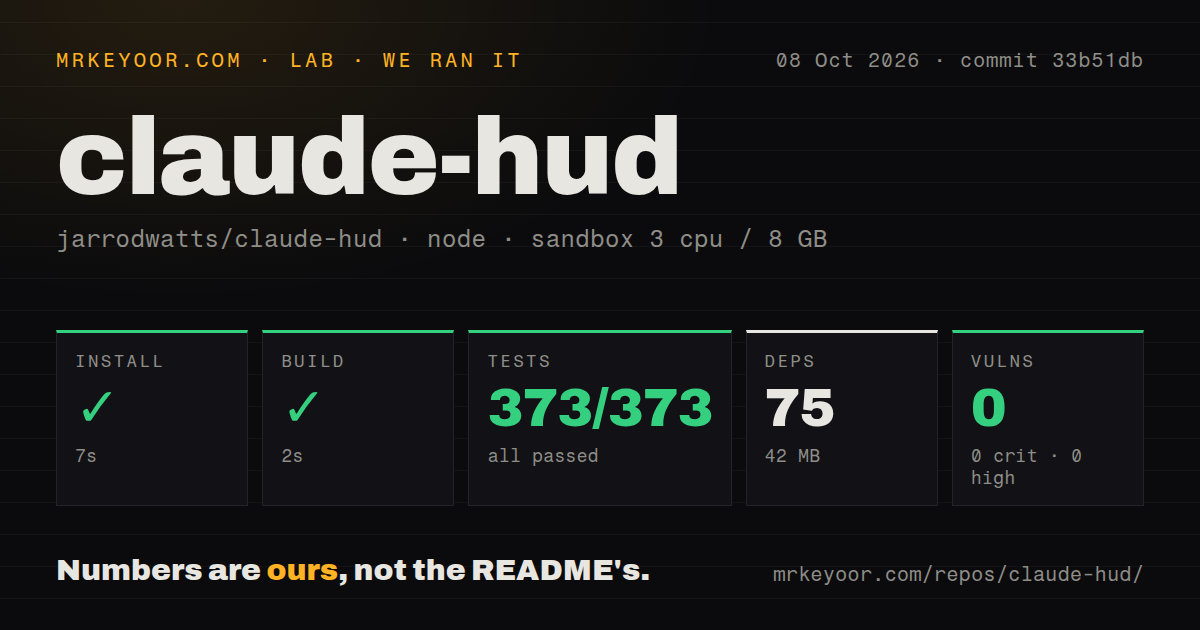
Our sandbox installed 75 npm packages in 5 seconds and used 42 MB on disk. The build completed in another 5 seconds. The test command then finished in 10 seconds with 1,073 passed and 0 failed out of 1,073. npm audit reported 0 known vulnerabilities across critical, high, moderate, and low severity. Those results came from commit ef5f1c8 in a fresh unprivileged Debian container with 3 CPUs and 8 GB of RAM.
The checkout had 133 files, about 28,272 lines of source, and a 1.6 MB footprint before installation. It included a tests directory and 4 CI workflow files, but no Dockerfile. That fits a local Claude Code plugin rather than a container service. The clean run matters because the statusline repeatedly touches transcripts, settings, and repository metadata.
Quota bars depend on the kind of Claude session
Usage limits appear only when Claude Code supplies subscriber rate_limits data. API-key-only users do not get those windows. Bedrock hides usage, while cost estimates for Bedrock and Vertex stay off by default because provider billing differs. Claude HUD can read a fresh local snapshot as a fallback, but it will not fetch missing data itself.
Claude Code normally repaints the statusline after interactions, so a countdown can freeze while the terminal is idle. The README recommends a 5-second refreshInterval and warns that 1 second reruns the command more often. Version 0.8.0 shows prompt-cache expiry as a clock time. Issues 719 and 727 question the timer's anchor and wording.
Frequent Git polling has a concrete Windows risk
Issue 726 reports that Claude HUD v0.8.0 can leave a zero-byte .git/index.lock on Windows when git diff --numstat exceeds the 2,000 ms timeout and is killed. The reporter reproduced it with a 5-second refresh in a repository containing 663 tracked SQL files. Git writes then failed until the lock was removed. The report identifies a missing --no-optional-locks flag; the issue remains open.
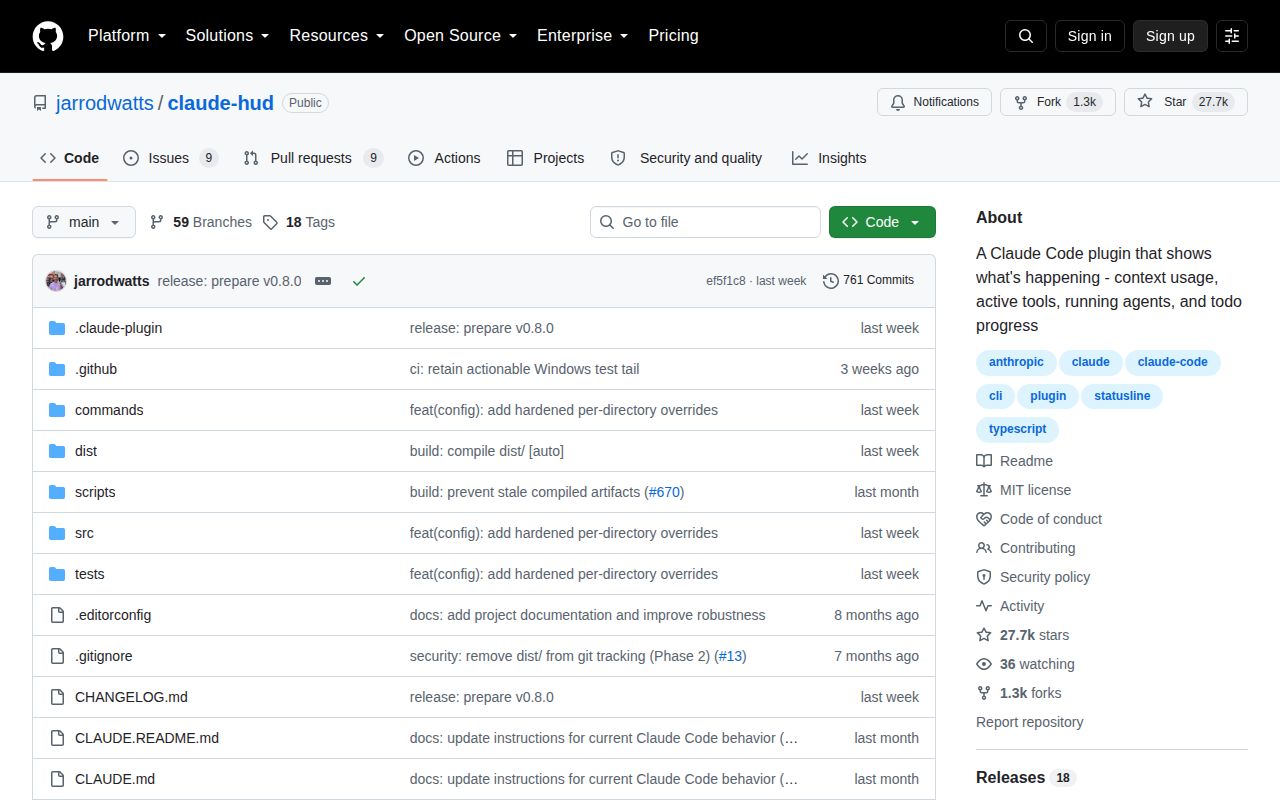
GitHub recorded the last source push on August 18, 2026, and v0.8.0 was released that day. The repository had 27,655 stars and 18 open issues and pull requests when fetched. Activity continued after release, including the Git lock report on August 23. The combined count is not a bug count, but the dates show an active queue.
Deep configuration is useful until it becomes terminal clutter
Options cover path depth, colors, compact layouts, Git file counts, Jujutsu state, cost, memory, cache expiry, and usage windows. Most are off by default. Start with the 2-line view, then add a row only if it replaces a command you run often. Invalid manual JSON falls back to defaults without an on-screen error, so keep a known-good copy.
The --extra-cmd option runs a shell command with the user's privileges on statusline refreshes. It is disabled unless CLAUDE_HUD_ALLOW_EXTRA_CMD is explicitly enabled. Leave it disabled for copied configurations. POSIX cache files get private permissions, but the process still reads local session and repository data by design.
Pick Claude HUD for activity, or a narrower statusline for less machinery
Claude HUD fits users who want context pressure and agent activity in the statusline. sirmalloc/ccstatusline goes further into themes, Powerline layouts, and widgets. Haleclipse/CCometixLine uses a Rust binary and includes optional Claude Code patching utilities. nilbuild/claude-statusline is a smaller shell setup that depends on jq, curl, and Git. Install Claude HUD if its transcript-aware view will earn those 2 terminal lines.