One CLI installs Claude Code components from a very large catalog
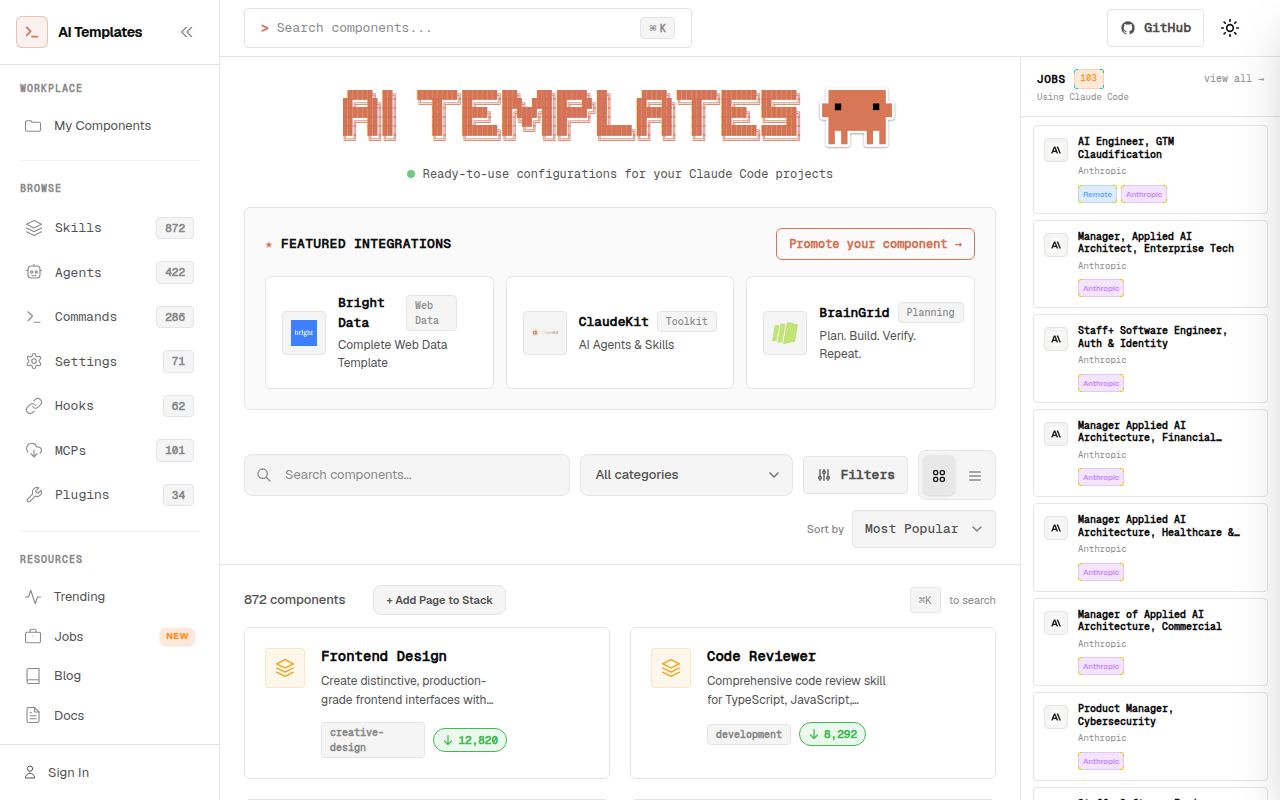
The main command can browse interactively or install named agents, commands, settings, hooks, skills, and MCP integrations. A user can assemble a frontend agent, test command, and GitHub MCP in one invocation. The project also runs dashboards for analytics, conversations, health checks, installed skills, and plugins. This is closer to a package manager and catalog than a single set of prompts.
The checkout reflects that breadth: our commit f45d7ee copy had 9,221 files, about 249,431 lines of source, and occupied 105.9 MB. The README attributes large groups of skills and agents to Anthropic, K-Dense, Obra, wshobson, and other community collections, each retaining its original license. Provenance varies by component, so the repository's MIT license is not a substitute for checking an installed item's source and terms.
Hooks and MCP servers deserve code review before --yes
A prompt-only command can still influence an agent, but hooks and MCP servers cross a more concrete boundary. Hooks can trigger local actions around Claude Code events. MCP configurations connect the agent to external programs and services, sometimes with credentials. The README's examples use --yes, which removes the interactive pause. That flag is convenient after review and risky as a default for an unfamiliar bundle.
Issue 535 records an automated audit that found invalid tool names, duplicate skill names, missing referenced scripts, and one agent file containing an unsigned third-party curl | sh installer. Some fixes were submitted, and the issue is not proof that every listed defect remains. It does show the sort of mistake possible in a collection this large. Read the exact files to be installed, including referenced scripts and hook commands.
What happened when we ran it
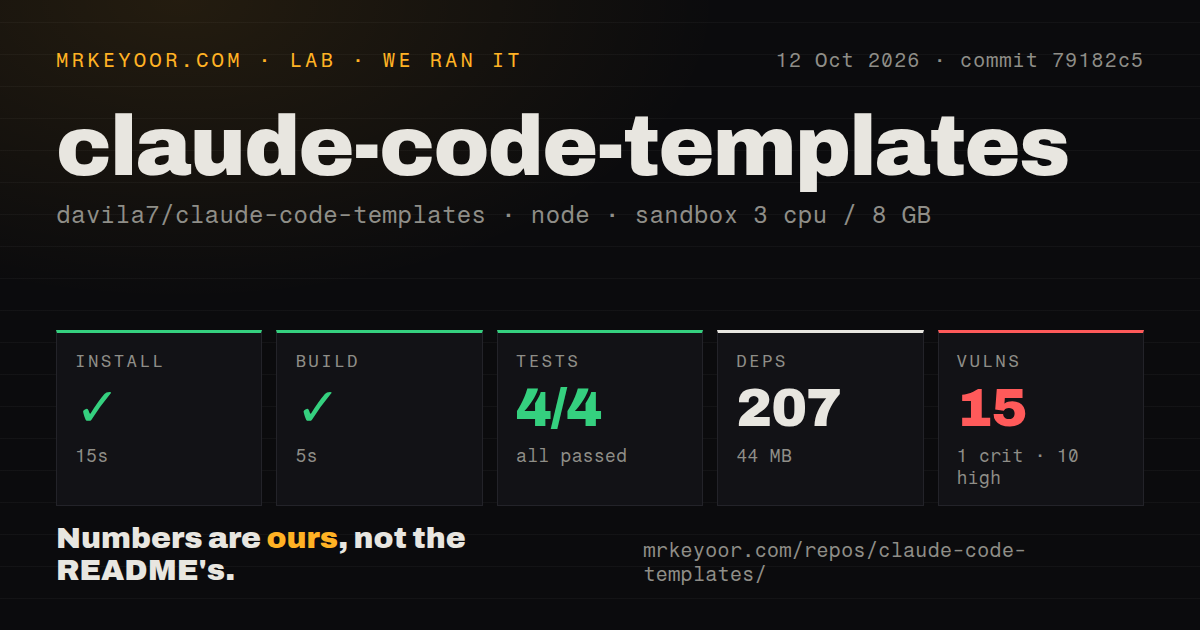
Our sandbox installed 207 npm packages in 11 seconds and used 44 MB on disk. The build succeeded in 7 seconds. The configured test command also returned success in 7 seconds. We ran commit f45d7ee in a fresh Node 22 Debian container with 3 CPUs, 8 GB of RAM, no secrets, and no connected Claude Code account or external MCP credentials.
Npm audit found 12 known vulnerabilities in the installed dependency tree: 8 high severity and 4 moderate, with 0 critical and 0 low. These are the only dependency-vulnerability figures we use for this checkout. The finding does not say which application paths are exploitable, but a tool that opens local dashboards and can expose chat monitoring through a tunnel should not ship into a sensitive environment without tracing and resolving the affected packages.
The passing test result needs context. Our scan found 15 CI workflow files but no tests directory, and package.json defines npm test as an echo of No tests specified. The build script likewise prints a completion message. Both commands passed exactly as measured, yet neither exercised installation, catalog paths, hook execution, dashboards, tunnels, MCP connections, or Claude Code compatibility.
The catalog has validation gaps that affect trust
Open issue 776 reports a workflow-ordering defect for contributions from forks. A reporting step tries to comment with a read-only token, receives HTTP 403, and stops the job before SkillSpector's enforcement gate. The reporter cites merged fork pull requests where red checks did not distinguish a clean scan from a flagged one. Until that flow is fixed and verified, a security badge or workflow file is weaker evidence than reviewing the component diff itself.
Catalog consistency has separate open findings. Issue 769 says a scan of 894 SKILL.md files found 59 frontmatter violations and 139 bodies beyond the skill-authoring guideline of 500 lines. The reporter carefully labels these as documented-rule differences rather than confirmed load failures. Issue 274 reports 28 missing marketplace paths across 6 plugins. Both findings argue for testing the exact item instead of assuming a catalog listing guarantees installation.
Local dashboards widen the tool beyond templates
The analytics command watches Claude Code sessions and presents performance information. The chat monitor offers a mobile-oriented view and can create a Cloudflare tunnel for remote access. A health check inspects the local setup, while plugin and skills dashboards enumerate installed sources. These features can be useful for one developer, but they introduce local web servers, file watching, process state, and possibly remote reachability into a tool originally chosen for templates.
Treat those dashboards as separate applications in a security review. Determine which interfaces they bind to, whether they expose prompts or responses, how authentication works, what the QR code points to, and what happens when the process exits. Our 7-second echo test did not answer any of those questions. If the only need is to copy one agent file, running an analytics server or tunnel adds no value.
Active commits matter more than the old release tag
GitHub returned v1.28.3 from November 15, 2025 as the latest formal release, while the checked-in package reported version 1.29.4. That tag gap is not abandonment. The last push was August 26, 2026, and pull requests that week added or revised skills, MCP entries, plugins, research agents, and documentation. GitHub listed 30,413 stars and 237 combined issues and pull requests.
Claude Code Templates is useful when approached like an app store without a trusted-store guarantee. Search it for ideas, inspect provenance and permissions, install one component at a time, and keep an approved locklist for team use. The fast 11-second install makes experimentation cheap. The 8 high-severity advisories, empty behavioral test command, and fork-scan gap make unreviewed bulk installation hard to justify.