Checkstyle turns style policy into a repeatable build check
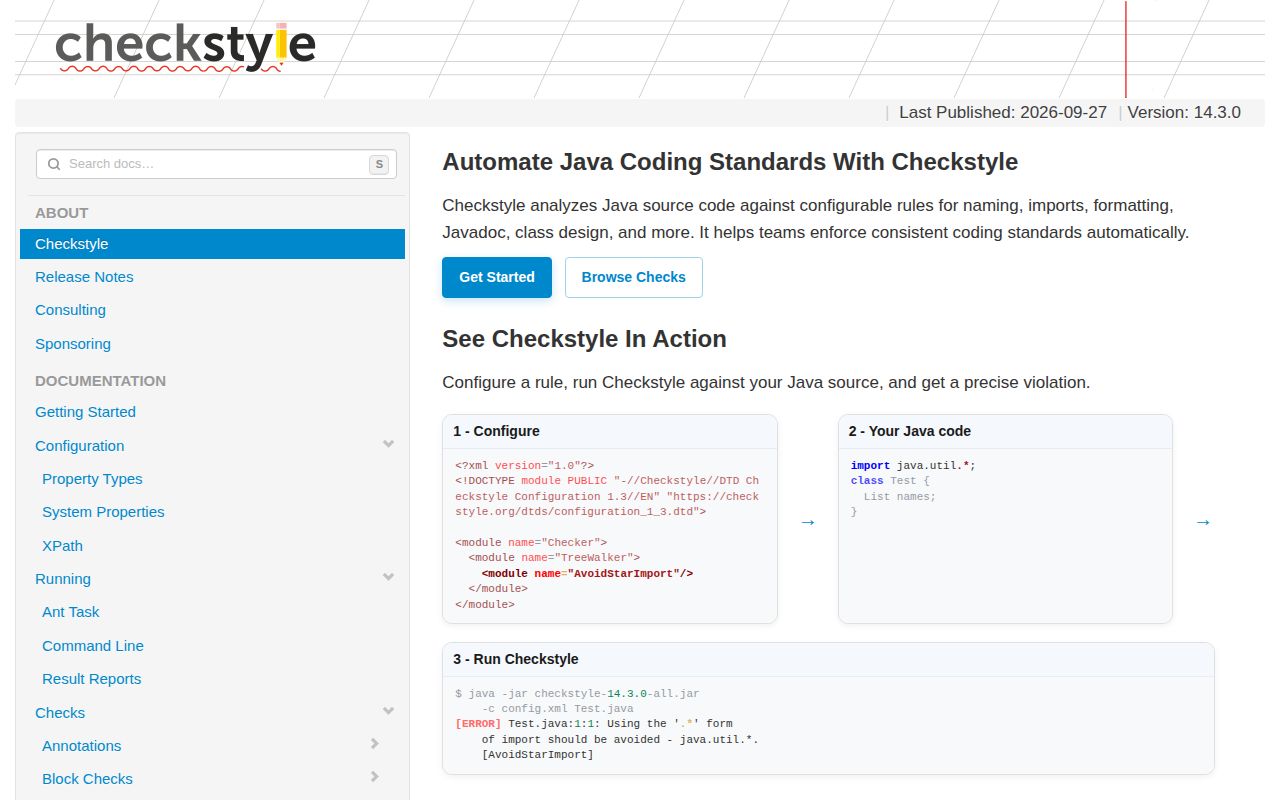
Checkstyle solves a familiar Java-team problem: a written style guide is only as effective as its enforcement. The project checks source against a configured standard or set of best practices and reports violations with file and line locations. The README's FallThrough example makes the model concrete: define checks in XML, run the JAR against Java source, and receive an error where a switch branch falls through.
The project looks established rather than merely popular. It has 9,111 GitHub stars, uses the LGPL-2.1 license, and publishes artifacts through Maven Central as well as GitHub releases. Version 14.0.0 arrived on August 18, 2026, and the repository was pushed again on August 30, 2026. Those dates together matter: the release is recent and development continued afterward.
What happened when we ran it
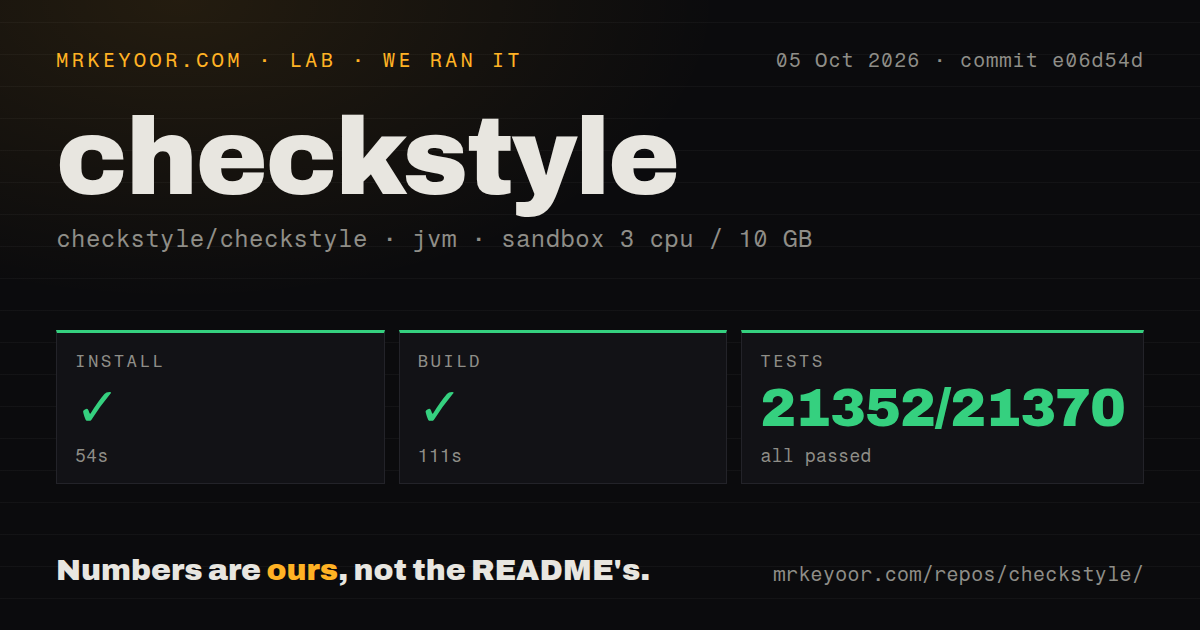
On our box, installation succeeded in 65 seconds and the build succeeded in 102 seconds. We cloned commit 47b4b77 into an unprivileged fresh Debian container with 3 CPUs, 10 GB of RAM, Java 21, and no secrets. The checkout occupied 44.6 MB. Those results support the README's claim that this is a conventional JVM project that can be acquired and built without private infrastructure. They do not establish runtime performance on a real codebase, and we did not invent a lint-speed benchmark to fill that gap.
The full test command failed after 325 seconds, despite Maven Surefire reporting 20,607 passed, 0 failed, 6 skipped, and 12 collection or setup errors out of 20,625. The visible log points to GUI-test setup, not assertion failures in the rule engine. MainTest could not load libawt_xawt.so because libXext.so.6 was missing, while MainFrameTest and TreeTableTest could not initialize CacioExtension. The quick start is enough for users running the tool, but a contributor reproducing the complete suite in a clean container needs GUI-related system support not described in the shown README section.
The rule model is explicit and fits normal Java delivery
Checkstyle's strongest quality is that policy stays visible. A configuration names checks such as FallThrough under Checker and TreeWalker, so a team can review rule changes alongside application code. The command-line path is documented, configuration has its own guide, individual checks have HTML documentation, and Javadoc is linked for API consumers. Distribution through a runnable JAR and Maven Central lets teams call it directly, attach it to a Maven build, or place the same configuration in CI.
The repository also shows substantial engineering discipline. We found 38 CI workflow files, and the README displays checks covering multiple CI services, coverage, dependency monitoring, security scanning, mutation testing, link checking, and release notes. Our measured build success and 20,607 passing tests provide evidence that the project exercises a large surface. Support routes are explicit too: GitHub Discussions is preferred for usage questions, Stack Overflow is available, contributors have Discord, and Google Groups carries a warning that responses may be slow.
It enforces rules, but it does not replace a formatter or bug finder
The main weakness is conceptual friction. Checkstyle tells you that code violates policy, but many style problems are better removed automatically by a formatter. Teams can create sprawling XML configurations that encode historical preferences without improving correctness. Every enabled rule becomes a maintenance decision during Java language changes and Checkstyle upgrades. A thoughtful baseline and gradual rollout are safer than flooding an existing codebase with findings.
Its scope is narrower than the phrase code quality may suggest. The 3 alternatives illustrate the boundaries. PMD is the natural comparison when you want broader static rules or multiple languages. SpotBugs fits when likely correctness defects in compiled Java are the priority. google-java-format fits when the desired outcome is automatic formatting to one fixed style rather than a configurable violation report. The supplied evidence does not support treating Checkstyle as a replacement for security scanning or compilation.
Active maintenance offsets the crowded issue tracker
The 766 open issues are the clearest community caution. That number can represent bugs, feature requests, rule proposals, and long-running discussions, so it should not be read as 766 confirmed defects. Adopters should search the tracker before assuming unusual behavior is unique to their project. The healthier counterweight is current activity: version 14.0.0 was released only 12 days before this review, and the last push was on the review date. Combined with 9,111 stars and multiple support channels, the evidence points to a busy mature project, not an abandoned one.
It belongs beside compilation, formatting, and deeper analysis
In a real stack, put Checkstyle early enough that feedback is cheap. Developers should run it locally or through the build, then CI should enforce 1 shared configuration before merge. Keep the XML ruleset in the repository, pin the tool version, explain deliberate suppressions, and upgrade in a reviewable change. For a large existing codebase, establish a clean baseline or introduce rules in batches rather than turning old violations into permanent noise.
The sensible toolchain uses at least 3 distinct layers: a formatter for mechanical layout, Checkstyle for team-specific source policy, and a defect analyzer or compiler for correctness signals. Checkstyle earns its place because its rules are explicit, its distribution is ordinary, and its maintenance is visibly current. The failed GUI setup in our run lowers setup confidence for contributors, but it does not erase the successful install, successful build, or the scale of the passing suite. For Java organizations that intend to maintain coding standards, it is an easy recommendation with one condition: treat the configuration as product code, not as a forgotten file copied from somebody else's repository.