The template gives typed chat tools, not a finished chat product
The useful part of chatbot-template is its compact example of the Vercel AI SDK message model. Responses stream into a Next.js client, markdown is rendered through shadcn/typeset, and each tool result gets its own component. Web search shows sources, a GitHub lookup renders repository facts, and ask_user pauses for an answer in the interface before the model continues. That is enough code to study the whole request path without opening a large application.
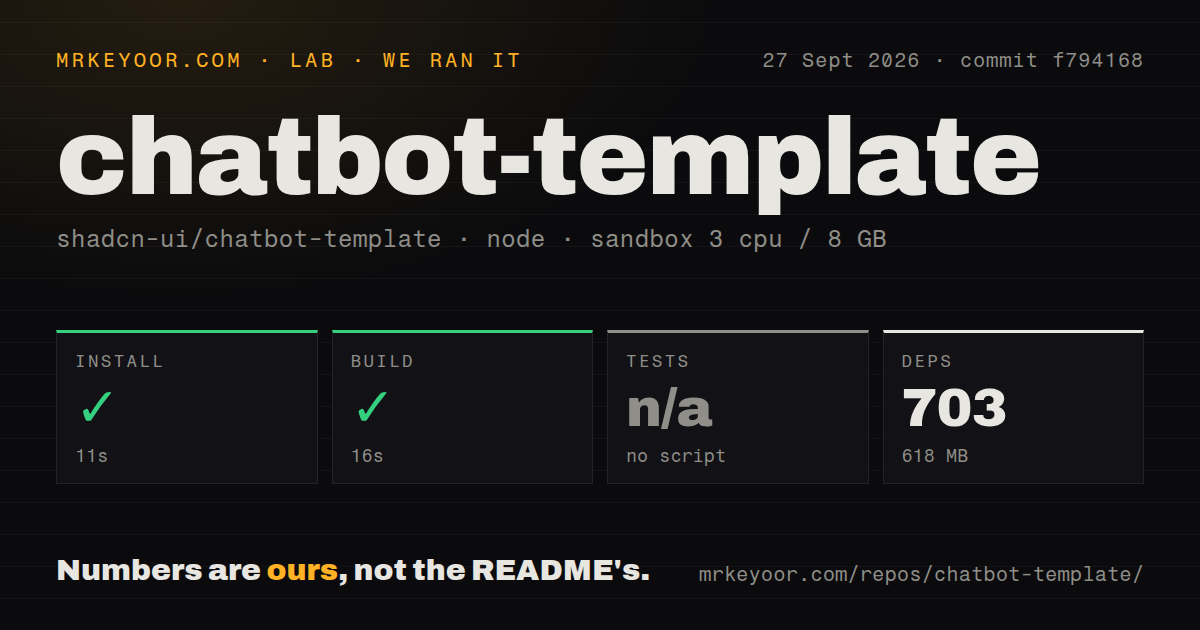
The checkout measured only 61 files and about 2,948 source lines, yet its pnpm install pulled 686 packages and used 601 MB. Most of the weight comes from the modern Next.js and AI SDK environment rather than business features. There is no user system, database, conversation archive, billing layer, or admin view. Treat the repository as an implementation reference with a polished screen, not as a small SaaS waiting for a logo.
A public route can spend gateway credits without authentication
The README is unusually direct about the main deployment hazard. /api/chat accepts public requests without authentication, and every accepted request uses the owner's AI Gateway credits. Request validation, an allowed-model list, an output-token cap, a tool-step cap, and cancellation on disconnect limit one request. They do not stop a caller from making many valid requests. The project tells adopters to add rate limiting, a spend ceiling, and authentication where the bot is private.
That work sits outside the 21-second build we completed. A production team needs to decide who may call the route, where identities live, how quotas are counted, and what happens when a budget is reached. Vercel Firewall or an external rate-limit store are suggested paths, but neither is installed here. Copying the deploy button before making those decisions exposes a paid model endpoint whose own documentation says it is open.
What happened when we ran it
Our run at commit 8d39394 installed 686 pnpm packages in 28 seconds. Installation succeeded and occupied 601 MB on disk, while the repository itself was only 0.4 MB checked out. The production build then completed successfully in 21 seconds inside an unprivileged Node 22 Debian container with 3 CPUs and 8 GB of RAM. No secret was present during these repository checks.
Tests were skipped because package.json contains no test script or target. Our scan also found no tests directory and no CI workflow file. A successful build proves that TypeScript and Next.js could produce the application under the measured conditions. It does not prove tool-call behavior, browser interaction, request validation, provider search, or the questionnaire flow. Those paths need tests after a team turns the example into a product.
Gateway setup is short, while model behavior remains provider-specific
A deployment on Vercel can authenticate to AI Gateway through OIDC, using the team's gateway credits without placing an API key in the project configuration. Local development needs AI_GATEWAY_API_KEY, either created in the dashboard or pulled after linking the directory with the Vercel CLI. The 28-second dependency install and single environment variable make the documented local route easy to reproduce before sending a paid request.
The model list is a TypeScript array, and its first entry becomes the default. Tool availability can vary with that model ID because the web-search helper selects a provider-native tool. A recent commit fixed a questionnaire follow-up that had omitted the selected model and silently returned to the default provider. That fix is a useful warning for extensions: every automatic continuation must carry the same model choice and request context as the initial message.
Typed parts make custom tools easier to inspect
Each tool has a Zod input schema, optional server execution, and a matching message-part renderer. The GitHub example enforces an owner/name shape, sets a 5-second timeout, and returns either typed repository data or an error. The questionnaire omits server execution because the browser supplies its result. Type inference connects those definitions to the UI, so renaming a tool field can become a build error instead of an unexplained empty component.
August commits show attention, while releases offer no upgrade markers
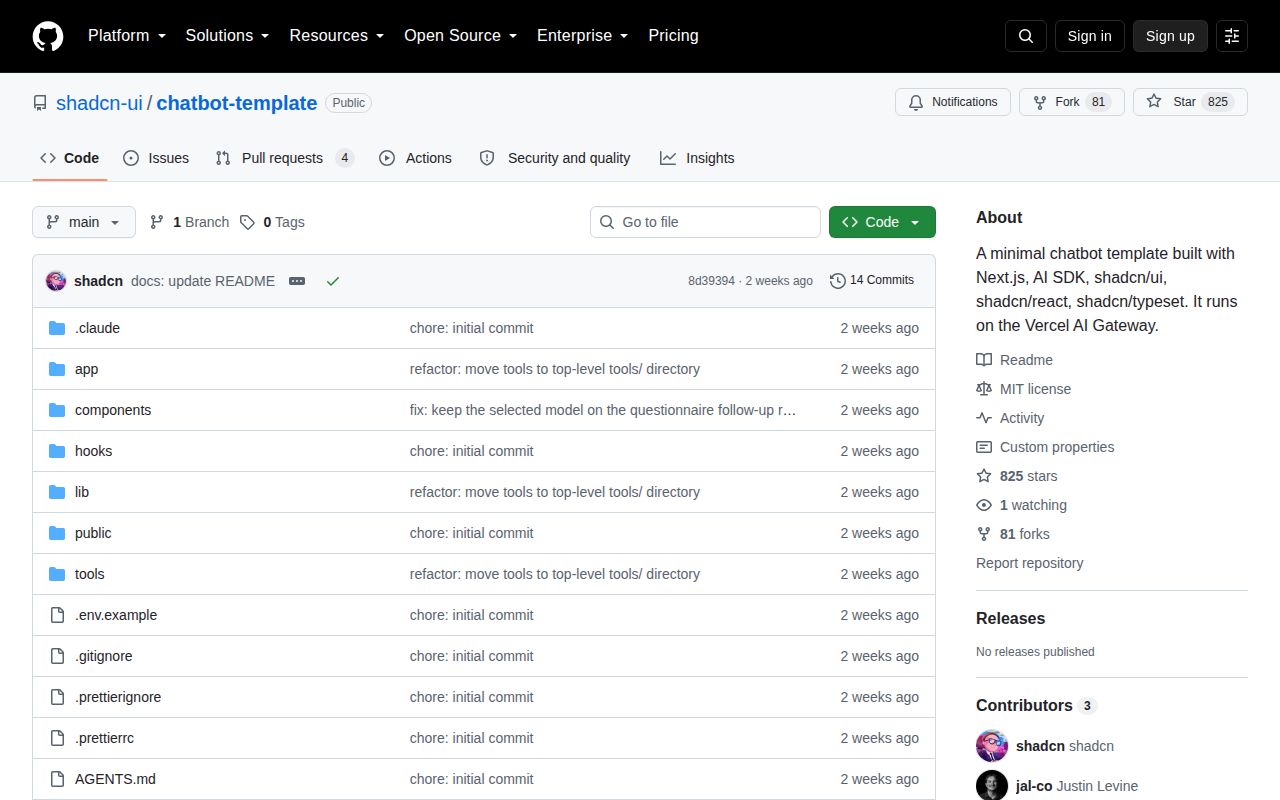
GitHub recorded the last push on August 11, 2026, and showed 825 stars plus 4 combined issues and pull requests when fetched. The issues endpoint returned no open issues among that combined total. Recent commits covered documentation and preserved the selected model across a questionnaire follow-up. Those facts show recent work and a small discussion queue, although they do not say how often future changes will land.
GitHub returned no latest release, so there is no tagged version to pin as an adoption milestone. The package is private and labeled 0.0.1 in its manifest. For a starter, commit-based consumption is common, but a team should record the exact revision it copied. Our commit built in 21 seconds; later commits need their own build and interaction checks, especially when the AI SDK message protocol or provider tools change.
Use it to learn the pattern, then own the missing product layers
chatbot-template is strongest as readable source for streaming messages, model-aware tools, citations, and a human response inside the tool loop. The 2,948-line size keeps those ideas visible. Its 601 MB install, public paid route, absent persistence, and missing automated tests set the boundary just as clearly. A developer can understand the core in an afternoon, but launching it safely is a separate engineering task.
Our successful 28-second install and 21-second build justify cloning it for a prototype or internal spike. They do not justify an unchanged public deployment. Add identity, quotas, spend alerts, storage if conversations matter, and tests around every tool state. If those pieces are already firm requirements, Vercel Chatbot starts closer to the destination; if the interface must live inside an existing app, assistant-ui may be the cleaner dependency.