Claude stays in charge while other models take assigned jobs
CCG installs into Claude Code and makes it the coordinator for Codex, Grok, Kimi Code, and Antigravity. A request such as adding authentication is classified by type, complexity, area, and risk. The selected strategy determines whether Claude works directly, asks one external model for analysis, launches two in parallel, or brings in Agent Teams for implementation. The model responses feed a persistent task rather than appearing as unrelated chat transcripts.
That structure addresses a common failure in improvised multi-model work: nobody owns the decision. CCG says Claude owns intent analysis, planning, approvals, implementation control, and the final report. External CLIs supply another analysis or review path through codeagent-wrapper, a compiled Go bridge. This is useful when different models catch different defects, provided a developer still checks what each one claims. More reviewers can also produce more noise and contradictory advice.
Ten strategies keep small fixes out of the full ceremony
The engine documents 10 built-in strategies. A direct fix or quick implementation can stay inside Claude, while complex features may use dual-model analysis and parallel builders. Separate paths cover debugging, refactoring, research, optimization, audit work, and Git operations. This matters because forcing every typo through a plan, approval gate, multi-agent build, and cross-review would make the plugin unbearable.
Medium and larger jobs create a .ccg/tasks/<name>/ directory containing task state, requirements, a plan, selected context, research, and review results. The full collaboration example stops after producing the plan and waits for approval. That is the right default for meaningful edits. The files also make it possible to inspect what the orchestrator believed before accepting a patch, rather than reconstructing decisions from a long terminal session.
What happened when we ran it
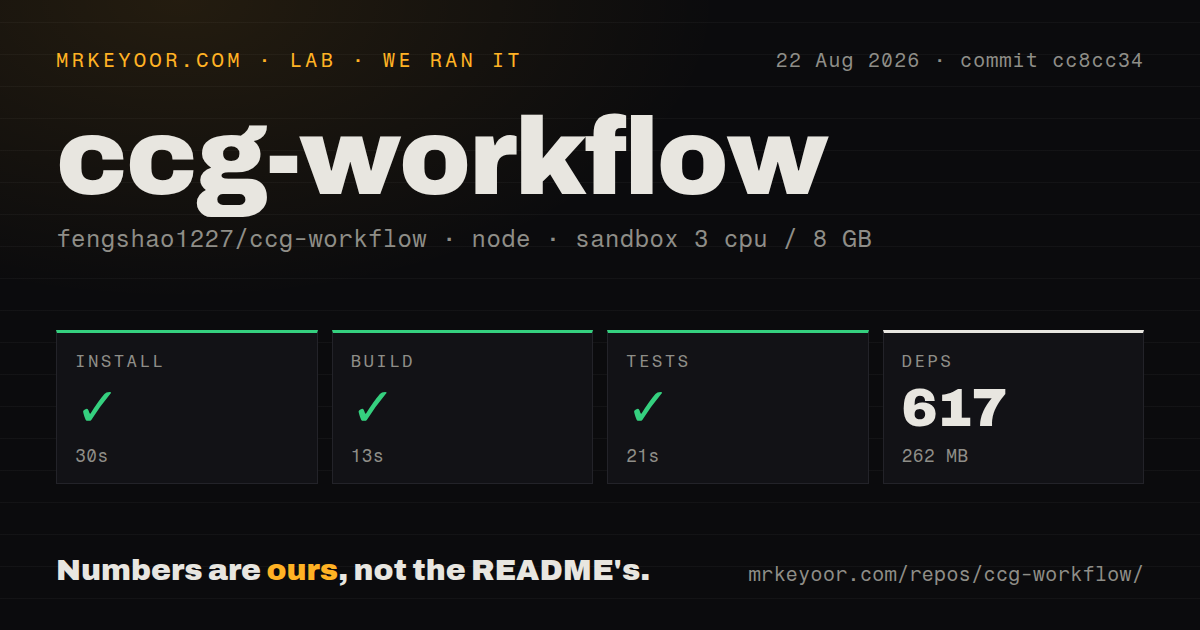
Our sandbox cloned commit cc8cc34 and installed 617 pnpm packages in 30 seconds. Dependencies occupied 262 MB on disk. The build passed in 13 seconds, then the available tests passed in 21 seconds. The checkout itself contained 369 files, about 29,090 source lines, and used 7.9 MB. Four CI workflow files were present, while the repository had no Dockerfile or tests directory.
The successful commands show that the package could install, compile, and pass its exposed test target in a fresh unprivileged Debian container. They do not prove that Claude, Codex, Grok, Kimi Code, or Antigravity can authenticate and cooperate on a real repository. Our run had no secrets, and the supplied measurements contain no model task, cost, latency, or patch-quality result. Those questions need a trial with the exact providers and approval policy your team uses.
Four hooks restore state after compaction and agent spawning
CCG's hook engine injects workflow state on every turn, restores context at session start or after compaction, puts relevant specification material into spawned agents, and routes domain knowledge based on keywords. The README describes 4 JavaScript hooks for those duties. Persistent breadcrumbs carry the task name, current phase, strategy, and gate, which reduces the chance that a compacted session resumes with the wrong job.
The installer also adds more than hooks. Its documented layout includes 13 default commands, quality skills, routing rules, model prompts, strategy files, configuration, and over 100 domain knowledge files. That is a substantial opinionated layer inside ~/.claude, and keyword-based knowledge injection can influence how an agent frames a task. Review the installed rules and prompts, keep them under change control, and use the supplied uninstall command if the workflow does not earn its footprint.
Multi-model use means multiple CLIs, credentials, and failure modes
Node.js 20 or newer and Claude Code are the base requirements. Other model CLIs are optional, which means CCG can still run simpler Claude-only strategies. The headline benefit appears only after the desired backends are installed, authenticated, and routable. Configuration under ~/.claude/.ccg controls models, MCP settings, performance, and prompts. The documented wrapper timeout defaults to 7,200 seconds, so a stuck or expensive external call deserves monitoring.
Agent Teams adds another condition: CLAUDE_CODE_EXPERIMENTAL_AGENT_TEAMS=1. Teams that ban experimental features will not get that parallel implementation path. Provider outages, quota exhaustion, incompatible CLI updates, and conflicting output now enter one workflow. CCG can report and route these components, but it cannot make their accounts or policies uniform. Start with one external reviewer before enabling every backend listed in the architecture.
Windows reports make the wrapper the first compatibility test
Issue 157 describes CCG 3.4.0 on Windows 11 refusing to run codeagent-wrapper.exe. Issue 64 shows a Windows Codex backend invocation exiting with status 1. A macOS report in issue 136 says Codex-led mode produced hook errors and did not support the requested Antigravity CLI path. These are specific reasons to run doctor and a disposable task before installing CCG across a mixed operating-system team.
The project offers status, health-check, update, Codex-mode install, and uninstall commands. Those controls are welcome because the software modifies a user-level agent environment rather than staying inside one repository. Still, a green package build does not settle native binary compatibility. On Windows especially, prove the wrapper, quoting behavior, paths, and each selected CLI with the same shell developers will use daily.
Current pushes matter more than the absent GitHub release
GitHub showed 5,851 stars, 3 combined issues and pull requests, and a push on August 26, 2026. The repository did not return a latest GitHub release, although the README identifies itself as v3.5.0 and points users to the npm installer. That combination means the project is active, but GitHub release pages are not the source of version history a buyer might expect. Pinning the npm version is safer than assuming an unqualified npx run stays unchanged.
CCG fits developers who already trust Claude Code with repository work and want a recorded, approval-based way to consult other models. Its passing 34 seconds of build and test work lowers the cost of evaluating the code. Adoption should depend on a real trial that checks wrapper compatibility, prompt volume, provider cost, and whether dual reviews find useful issues instead of merely multiplying text.