The native port needs your own US game ROM
CBFD-Recompiled turns Conker's Bad Fur Day into a native desktop application using N64Recomp and the RT64 renderer. The README describes widescreen presentation, remappable controls, mouse and gyro aiming, and a launcher with graphics and mod settings. The attraction is a game-specific PC experience. You still need your own legally obtained US ROM, because neither the repository nor its release packages include the game's data.
Our checkout occupied 521.7 MB across 18,018 files and about 2,972,763 source lines. That is a substantial development tree for someone who only wants to replay Conker. The README offers downloadable desktop packages, so ordinary players have a route that avoids compiling the repository. Contributors face the larger task of understanding the game code, runtime, renderer, and the patches connecting them. Those are different reasons to download this project.
What happened when we ran it
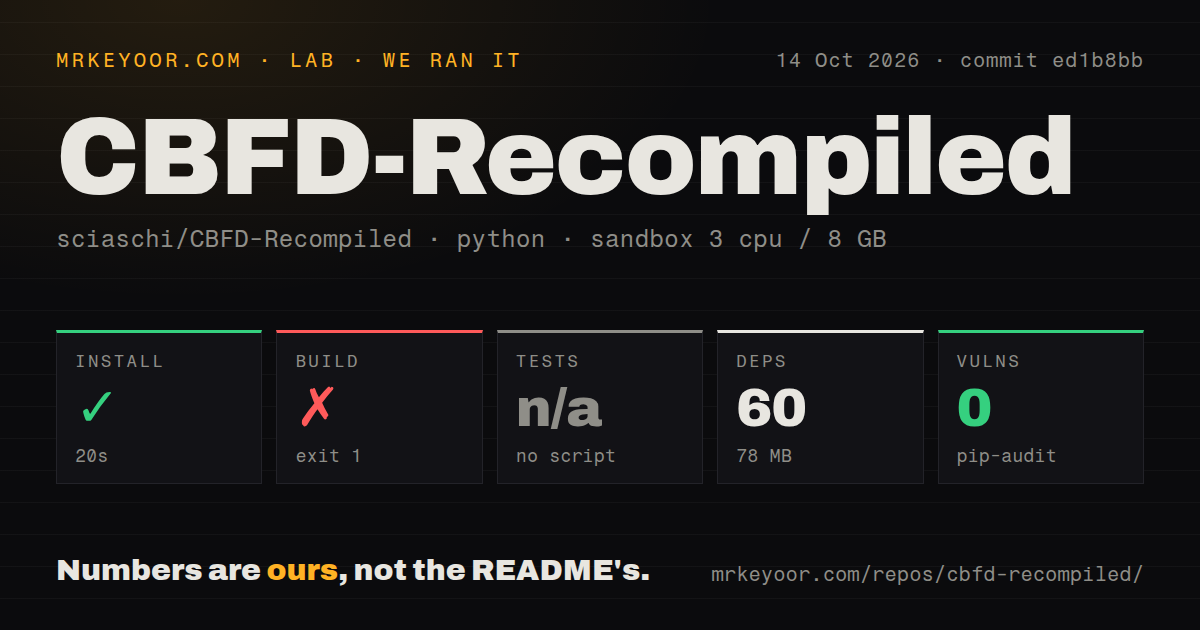
Our sandbox installed commit ed1b8bb's Python environment in 20 seconds, adding 60 packages and using 78 MB on disk, then failed the build after 4 seconds with exit 1. The October 14, 2026 run used the uv Python 3.12 Bookworm image with 3 CPUs and 8 GB of RAM. It was an unprivileged Debian container without secrets. Pip-audit reported 0 known vulnerabilities in the environment it inspected.
The supplied build-log tail contains Python SyntaxWarning messages about invalid escape sequences. They appear in bundled tomlplusplus header-generation code, metal-cpp's header generator, spirv-cross shader tooling, and zstd scripts. The excerpt does not contain a decisive error explaining exit 1. Blaming the warnings, a missing ROM, or an absent system library would go beyond the evidence. The concrete result is that this sandbox attempt did not produce a successful build.
No test script or target was found, so the harness skipped tests. It recorded 2 CI workflow files, no Dockerfile, and no tests directory. The harness selected a Python ecosystem even though GitHub identifies the repository's primary language as C. Read the result as a failed harness-selected path through a mixed native project. It does not establish that the documented desktop build scripts or downloadable releases fail in their intended environments.
Installing 60 Python packages does not prepare the native toolchain
The 60 packages in our run cover the measured Python setup, not a complete native game environment. The documented build recursively checks out submodules, processes the supplied ROM, builds the recompiler, generates native game functions, and compiles the host with CMake. The README also warns against apostrophes in the checkout path because some renderer build steps break on them. Choose the source route because you intend to modify the port.
Linux needs a Vulkan driver and native development tools including Clang, CMake, Ninja, and SDL libraries. Windows uses Visual Studio's C++ tooling. A macOS source build needs full Xcode for Metal compilation, while the downloadable Mac package targets Apple Silicon. The README says Intel Macs have not been tried and does not claim a confirmed full macOS playthrough. Those are concrete platform limits to consider before treating the port as your default way to play.
US-only support excludes other regions and code-changing ROM hacks
The launcher accepts the supported US ROM and certain asset-only modifications. The README explicitly refuses other regions, including Europe, and hacks that change the game's code. That restriction is a practical reason to stay with an emulator if your existing copy or preferred modification falls outside the supported set. An asset translation and a code-altering hack can look similar to a player while taking different paths through this recompiled application.
The 4-second failed build gives us no basis for judging actual play quality, controller behavior, or frame pacing. The port's documented options are still attractive: its mod menu supports function patches, and its graphics controls include texture packs. Begin with an unmodified supported ROM before adding replacements. If a problem appears only after a modification, preserving that distinction will make a bug report more useful than describing every combination as the base game.
V0.1.6 acknowledges missing dialogue and a modified-audio softlock
Release V0.1.6, published October 13, 2026, adds save states and local achievements while listing intermittent missing cutscene dialogue as a known issue. It also acknowledges a Rock Solid cutscene getting stuck with some modified-audio ROMs. The release says that fix awaited further checking. Those are reasons to keep your existing way of playing available, especially if uninterrupted story playback matters more than the port's new controls.
Issue 99 concerns the dialogue problem and includes a Linux report with mods enabled. It is a user report rather than a failure reproduced in our sandbox. A separate current report, issue 138, describes widescreen artwork being cut off on Steam Deck. Neither report proves every player will encounter the problem. Together with the release's own caveats, they show why an advertised feature list cannot substitute for checking your preferred scenes and settings.
October 14 activity makes this a live project with unresolved defects
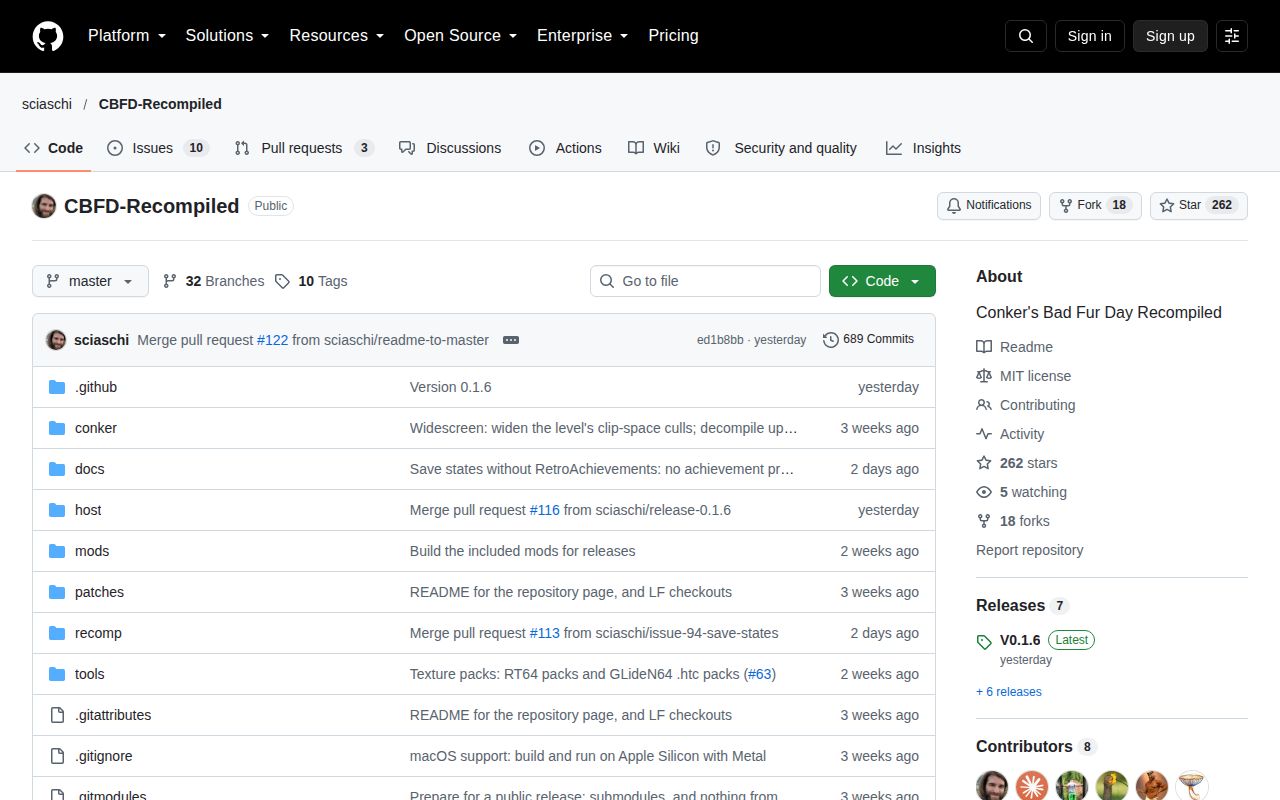
The last push was October 14, 2026, and GitHub reported 262 stars with 13 open issues and PRs on October 15. Recent reports address audio, aiming, and widescreen presentation, while the new release describes fixes prompted by players. That is evidence of active maintenance and an unfinished compatibility picture. Our clean Python audit does not certify the native runtime or erase those gameplay reports.
Use Gopher64 or Mupen64Plus when a general N64 emulator better fits your library or ROM choices. Try CBFD-Recompiled's release package when its Conker-specific controls and presentation justify checking for regressions. Build from source when contributing is the goal, with the native prerequisites and supported ROM ready. Keep a copy of your saves before experimenting, and make a successful launch on your own machine the next decision point.