It teaches algorithms as standalone C++17 programs
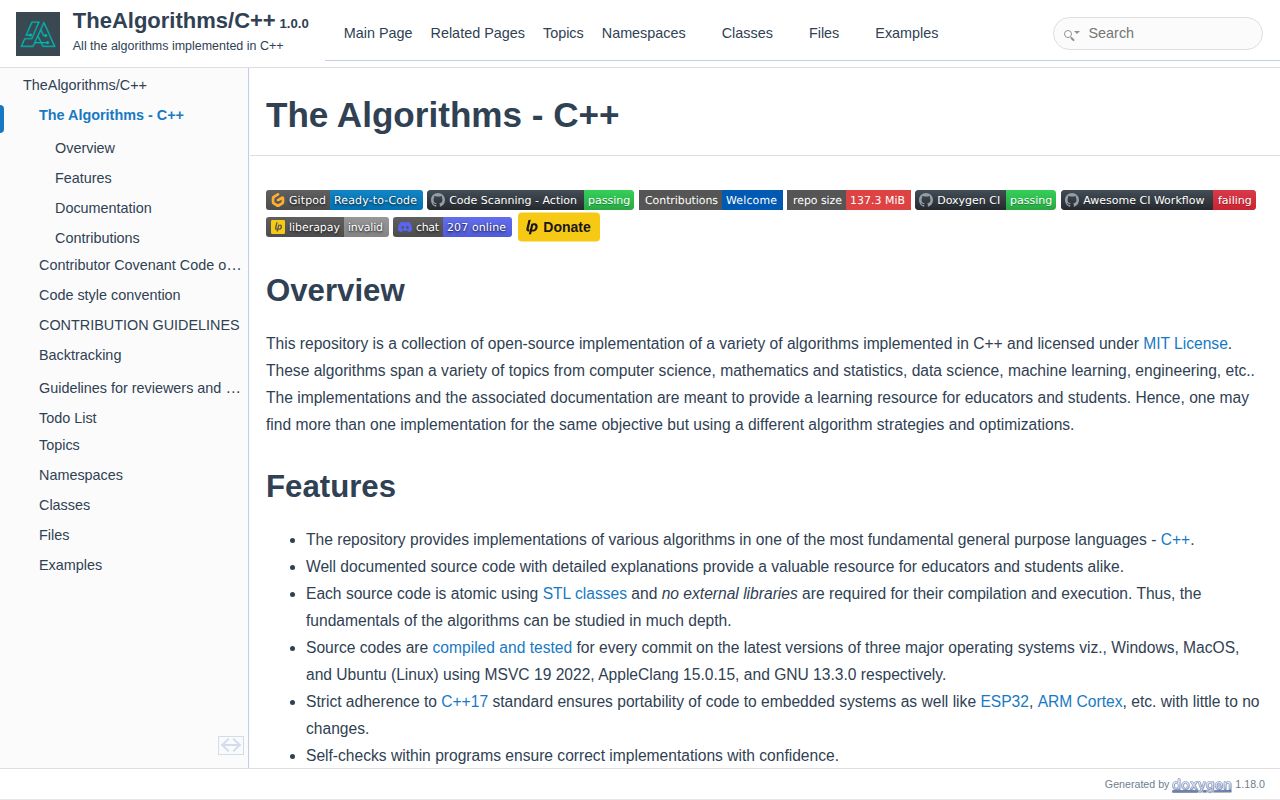
TheAlgorithms/C-Plus-Plus is a C++17 shelf of small programs for reading, compiling, and changing. The folders cover sorting, graphs, ciphers, dynamic programming, numerical methods, machine learning, physics, and more. Each source file is intended to be atomic, use the standard library, and explain one implementation without pulling in third-party packages. That is a different job from providing one polished library API.
That shape works well for a student asking a narrow question such as how quicksort partitions an array or how a graph traversal keeps state. The README says duplicate goals are acceptable when the strategy or optimization differs. Instead of hiding the mechanics, the repository leaves the implementation in view. Its CMake configuration includes 24 topic directories in the root build.
Across roughly 60,687 source lines in our measured checkout, documentation lives beside the code. Doxygen turns file comments, equations, links, and source into the hosted reference site. The contribution guide asks every new program to explain its algorithm, cite background material, and include examples plus assertion-based self-tests. That gives a learner more context than a folder full of unexplained interview answers.
The collection is easier to read than to import
Across 24 topic directories, CMake creates separate executables from the source files. There is no single public library target with a stable set of headers, semantic releases, or one namespace designed for application code. GitHub's latest-release endpoint returned Not Found. Copying one implementation into your own project may be reasonable after review, but adding the entire repository as a production dependency would leave you to define the supported surface yourself.
Open issue 2456 says several older algorithms do not meet the current contribution guidelines and names files that need clearer documentation or tests. The current rules prohibit bits/stdc++.h, require snake_case names and Doxygen comments, and prefer assertions over interactive input. Those rules are sensible. Their existence does not make every older file conform to them.
The measured checkout was only 2.2 MB, which makes browsing cheap. Reuse still deserves a code review. Check integer bounds, complexity, iterator assumptions, and behavior on empty or malformed input before moving an example into an application. For cryptography in particular, an educational implementation is a poor substitute for a security library with a documented threat model, release process, and maintenance policy.
What happened when we ran it
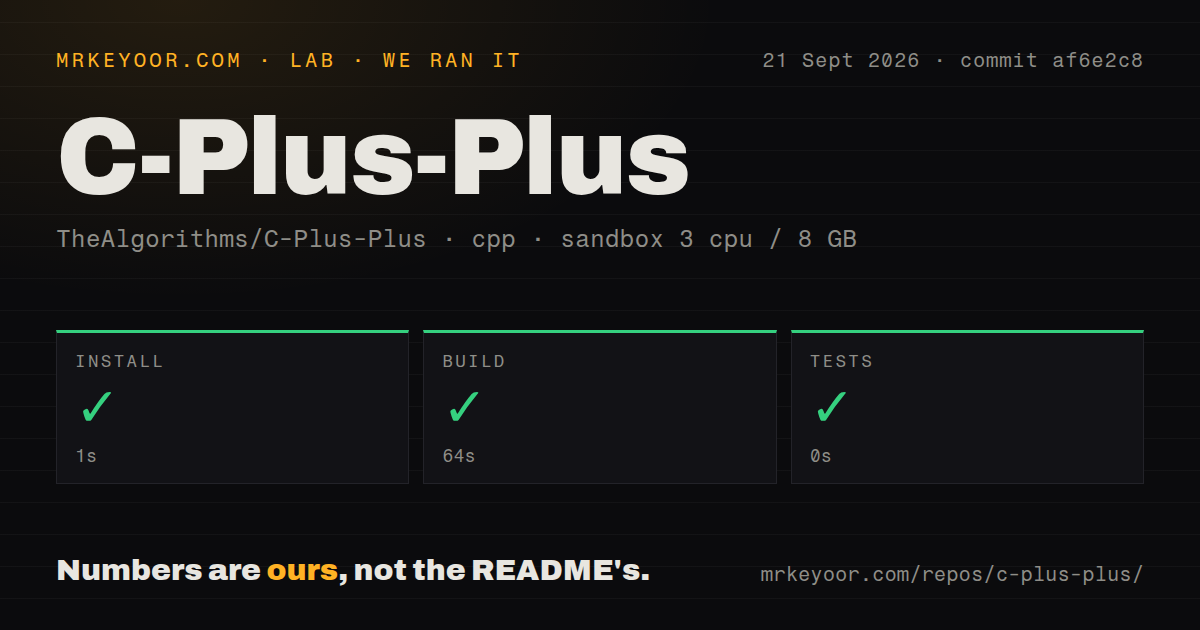
Our 3-CPU, 8 GB sandbox installed the checkout in 1 second, built it in 64 seconds, and completed the available test step successfully in 0 seconds. The repository at commit af6e2c8 occupied 2.2 MB before dependencies, with 431 files and about 60,687 lines of source. All three recorded steps returned success in the fresh unprivileged Debian container.
The structure explains the instant test result. Our scan found no tests directory, while the contribution guide puts assert() checks inside each program's main() function. The checkout had 6 CI workflow files and no Dockerfile. The README says the project compiles commits across Ubuntu, macOS, and Windows using GNU, AppleClang, and MSVC, so a container image is not presented as the standard route.
A passing Debian build does not settle every compiler combination. Open issue 3203 reports that Clang 21 on FreeBSD rejects specializations of std::is_integral and std::is_arithmetic in the custom 128-bit integer code. An open pull request addresses that problem. Our measured commit still built successfully on the stated lab image, so the tested Linux setup passed while the reported FreeBSD setup did not.
Same-day activity helps, but it does not make every file equal
GitHub showed a last push on September 21, 2026, the day we checked, along with 34,681 stars and 23 open issues and pull requests combined. Recent work included a proposed AVL tree fix, documentation repairs, a logistic-regression addition, and the Clang 21 fix. The same-day push shows current maintenance rather than only old popularity.
Contributions add new subjects while other pull requests repair older explanations and implementations. Issue 2456 has remained open as an umbrella for bringing legacy files up to current rules. A same-day push is good evidence of activity, but it cannot certify hundreds of independent programs as one quality level. Read the file, its assertions, and its open issue history before reusing it.
Across 24 topic folders, the generated docs link back to source and the MIT license permits adaptation. Community size also means many examples receive attention. Still, the repository's strongest promise is educational access. It does not promise benchmark leadership, one uniform API, or release-backed compatibility.
Choose a narrower project when the job is shipping code
Three narrower projects cover different slices of this 431-file collection. CP-Algorithms is the better companion when you want contest-oriented explanations, proofs, and snippets arranged as articles. KACTL fits teams preparing a compact competition notebook. Boost Graph is the more natural choice when a C++ application needs reusable graph components rather than a teaching program with its own main().
For learning, TheAlgorithms/C-Plus-Plus earns its place because the friction is low and the breadth is high. Our 64-second build proves the measured checkout can be compiled as a whole on the stated Debian setup. The smart boundary is to study one file at a time, run its self-checks, and carry only reviewed code into your project. If you need a dependency with versioned releases and compatibility guarantees, choose one that makes those promises explicitly.