Bytebase turns database work into a governed workflow
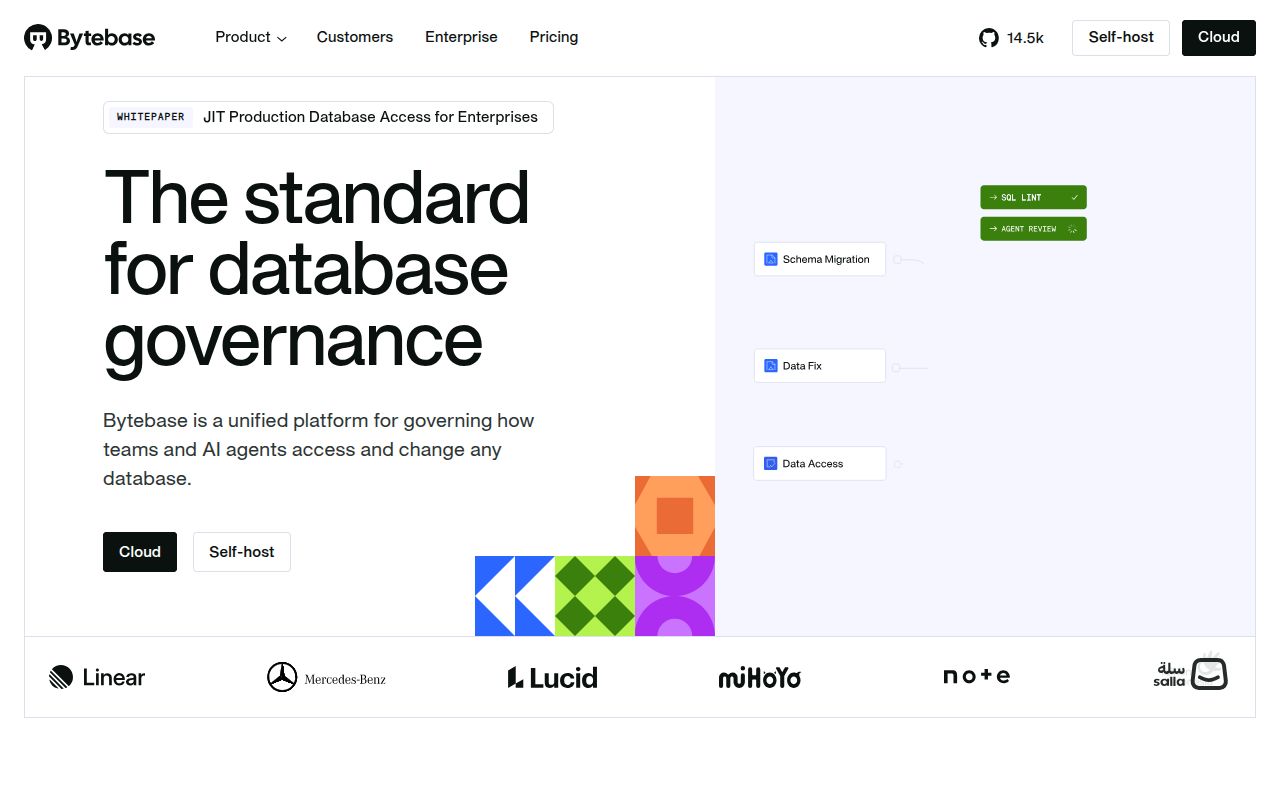
Bytebase sits between people or AI agents and the databases they need to change or query. Its premise is practical: schema migrations, SQL clients, access requests, and ticket approvals often become separate systems with incomplete context. Bytebase puts those activities into one control plane where a request can be reviewed, executed, and recorded. The repository is substantial at 5,139 files and roughly 972,186 lines of source, which matches the breadth promised by the product rather than the shape of a small migration utility.
That breadth matters most in organizations where database work crosses team boundaries. Developers can propose changes, DBAs can enforce rules, and security teams can inspect an audit trail without passing screenshots between 3 different tools. Bytebase supports PostgreSQL, MySQL, SQL Server, Oracle, MongoDB, Redis, MariaDB, TiDB, Snowflake, ClickHouse, Spanner, and OceanBase, among others. It also presents integrations for infrastructure as code, identity, collaboration, IT service management, log streaming, secret management, and AI-oriented workflows.
What happened when we ran it
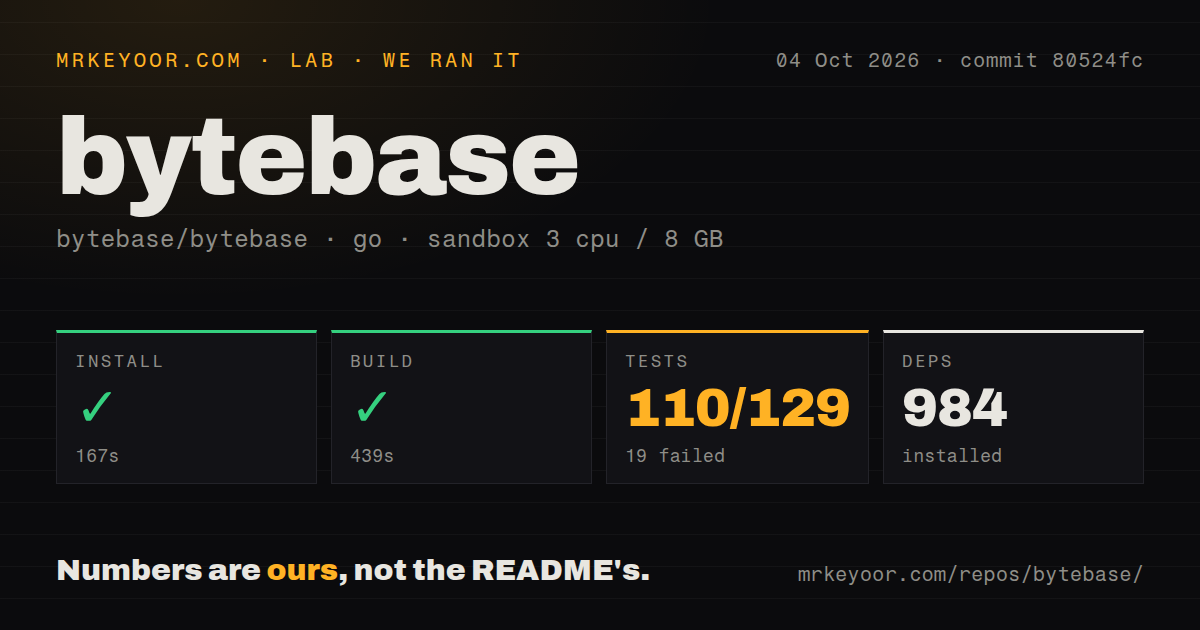
Our run used commit ece9290 in an unprivileged Debian container with 3 CPUs and 8 GB of RAM. Installation succeeded in 190 seconds and installed 983 packages. The build then succeeded in 385 seconds. Those are encouraging outcomes for a checkout measuring 50.3 MB, but they also show that source setup is not the same experience as copying the README's single Docker command and opening port 8080. This is a sizeable Go application with a frontend and a meaningful dependency graph.
The test step failed after 188 seconds. We measured 91 passing Go test packages and 29 failing packages out of 120. The final log names failures in backend/store and backend/tests, including TestVCSProviderUserTouchStoresEmptyPayloadWhenNil, TestDeleteExpiredVCSProviderUsers, TestCreateWorkspaceInitializesDefaults, and TestListWorkspacesByEmailEvaluatesBindingConditions. We cannot tell from those lines whether the problem is environment-specific or a repository defect, so the honest conclusion is narrower: the supplied checkout did not pass its test suite on our box.
The repository contains 19 CI workflow files, which suggests serious automation around development and release work. At the same time, our scan found no Dockerfile and no tests directory. Neither fact means container images or tests are absent: the README points users to the published bytebase/bytebase image, and Go tests can live beside source files. Still, contributors should expect to learn the repository's conventions rather than infer a simple root-level build layout. A clean build is useful evidence, but the failed tests make local validation a required investigation, not a checkbox.
Its strongest features solve organizational problems
Change management is the clearest reason to adopt Bytebase. The web workflow covers requesting, reviewing, deploying, and rolling back changes, while native GitHub and GitLab integration supports database-as-code practices. More than 200 SQL lint rules can turn team standards into repeatable checks before risky statements reach production. That combination is stronger than a basic migration runner when approvals, separation of duties, and consistent policy matter across several teams.
Access control is similarly concrete. Bytebase advertises project-level and workspace-level RBAC, just-in-time grants with automatic revocation, and role-aware dynamic masking at the column level. Those features address common operational gaps: permanent access that nobody revisits, sensitive values exposed in routine queries, and unclear ownership across environments. Audit logging, data classification, Terraform-managed policy, and an API extend the same governance model beyond the console, giving security teams evidence while allowing platform teams to automate it.
The AI features are relevant rather than decorative. An MCP server lets agents and IDEs connect through the Model Context Protocol, text-to-SQL assists within the editor, and a page agent can guide or execute plain-language workflows. The important distinction is that these capabilities live behind the same review, access, and recording mechanisms used for humans. In a system that controls production databases, that governed placement is more persuasive than adding an isolated chat box, although teams should still test permissions and approval boundaries themselves.
The rough edges are cost, complexity, and validation
Bytebase is not a drop-in replacement for one migration script. Running a central service creates another availability, upgrade, backup, authentication, and policy surface. Its 166 open issues are not alarming beside 14,443 stars, but issue count alone cannot show response quality or whether your database's edge cases are settled. The license metadata supplied for this review is NOASSERTION, so organizations with strict legal review should confirm the applicable repository and feature licensing before committing to a rollout.
The documentation path looks thoughtful: there are dedicated installation, tutorial, Terraform, API, supported-database, and self-host-versus-cloud resources. Yet the contributor snippet also expects PostgreSQL, Go, pnpm, and separate backend and frontend commands, while our full install took 190 seconds. Operators evaluating the product should distinguish the quick packaged trial from source development, then test upgrades, rollback behavior, identity integration, masking, and audit export against their own controls. Our failed suite makes that proof especially important.
It belongs between delivery systems and production databases
In a real stack, Bytebase should receive change intent from engineers, Git repositories, CI/CD, Terraform, or MCP clients, then govern what reaches database engines. It does not remove the need for backups, monitoring, database-native permissions, secret storage, or incident procedures. Its value is coordinating those existing layers through one approval and policy surface. Start with 1 noncritical project, model roles and review rules, and verify that the generated audit evidence satisfies both operators and compliance stakeholders.
Project activity is a positive signal. Version 3.22.0 was released on August 28, 2026, and the last push was August 29, only 1 day later relative to this review. Combined with 19 CI workflows and visible adoption, that looks actively maintained rather than merely popular from an old spike. The remaining question is fit: large teams with recurring database-control problems can justify the operational weight, while small teams will often get clearer value from Liquibase, Flyway, or Atlas and their narrower migration focus.