Keyboard events change your Go model
Pressing the down arrow in Bubble Tea's shopping-list tutorial changes a cursor stored in a Go struct. The framework then draws the view from that state. That division is the reason to choose Bubble Tea for a custom terminal application: you can follow a user's action through your own code without managing each screen redraw. It suits an interactive deployment picker or log browser whose behavior needs more thought than its first menu.
Our checkout occupied 3 MB across 230 files and roughly 14,853 lines of source. That is a manageable repository to inspect when the framework's behavior surprises you. The core handles the application loop and rendering. The README points to separate Bubbles components for text inputs and viewports, and Lip Gloss for styling and layout. Budget time to compose those pieces, particularly when focus must move between several controls.
What happened when we ran it
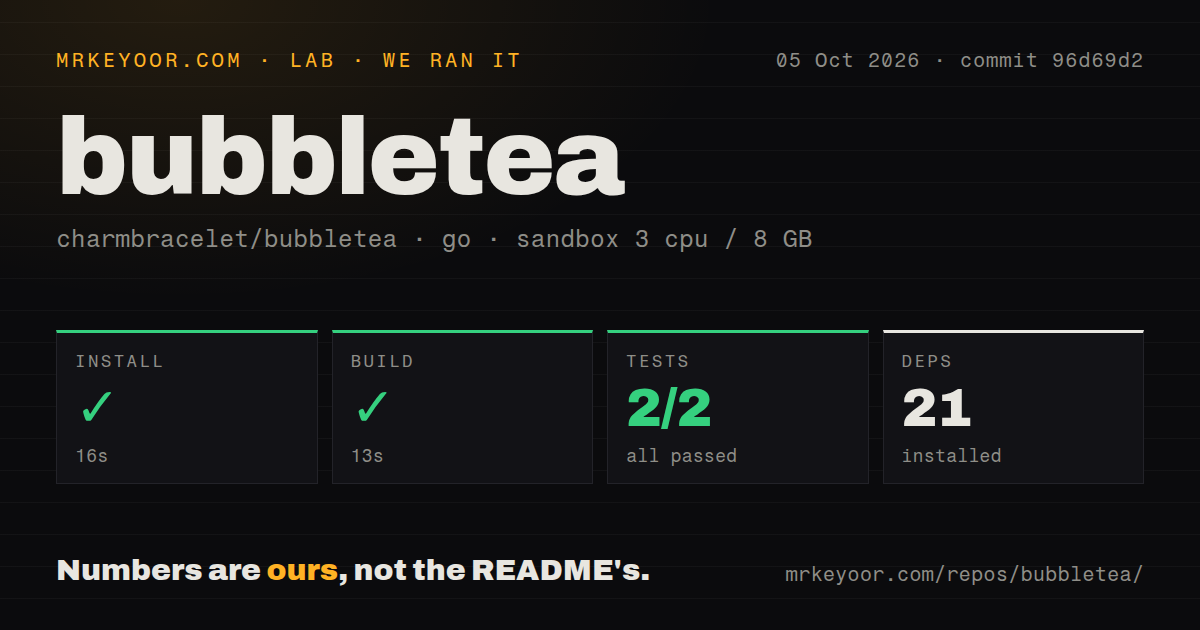
Our sandbox installed Bubble Tea commit 96d69d2 in 16 seconds, adding 21 packages, and built it successfully in 13 seconds. We ran it on October 5, 2026, in an unprivileged Debian container using the golang:1.24-bookworm image, with 3 CPUs, 8 GB of RAM, and no secrets. Those results support trying the repository without a large setup commitment. They describe this checkout and environment, rather than every downstream application.
The test step succeeded in 4 seconds. The supplied go test summary reported 2 passed and 0 failed out of 2. Our scan also found 7 CI workflow files, no Dockerfile, and no tests directory. A missing directory named tests does not contradict a successful Go test command. These measurements establish that the reported steps passed. They provide no typing-latency benchmark or evidence about a particular terminal emulator's behavior.
The v2 API needs matching examples and a newer Go toolchain
The v2 upgrade guide changes the import to charm.land/bubbletea/v2, replaces a string-returning View with tea.View, and changes keyboard handling to tea.KeyPressMsg. Alternate-screen and mouse settings move into view fields. If you already have a v1 application, that is source migration work. Copying an older tutorial into the current API will leave you reconciling types and removed calls before you reach your own interface.
The measured image was golang:1.24-bookworm, while the module file at commit 96d69d2 declares Go 1.26.0. Our supplied summary does not identify the compiler actually used or explain how that requirement was satisfied. Treat the successful run as the recorded outcome, not proof that an offline Go 1.24 environment is sufficient. Check your toolchain policy before adopting this revision, especially if your organization disables automatic toolchain retrieval.
Network work belongs in commands, and logs need another destination
The commands tutorial makes an HTTP request in a command and sends its result back as a message. Commands run asynchronously, so the update method can handle the result alongside keyboard events. This is a useful discipline for a dashboard that waits on remote services. You still write the loading state and error handling. A request finishing successfully does not decide what should happen if the user has already changed selection.
Our install added 21 packages and needed no secrets in the sandbox. Bubble Tea itself does not demand an account or hosted backend, though your application's data sources may. The development gotcha is local: the README says the UI occupies stdin and stdout. It recommends file logging and a debugger running headlessly, connected from another terminal. A team accustomed to scattering print statements through handlers will need to change that habit.
Open reports describe shells left in raw input mode
Issue 1849, opened October 9, reports that a second interrupt or termination signal during shutdown can kill the process before terminal restoration. Issue 1850 reports early runtime error paths with the same cleanup consequence. Both were open when checked on October 14. Raw mode here means the user's shell can be left without normal input echo. These are specific upstream reports, separate from failures observed in our lab.
The 2 passing results in our test summary do not settle those interactive shutdown cases. Before shipping an operator tool, exercise repeated interrupts and startup errors in the terminals your team uses. That matters more than a decorative demo: a deployment picker that leaves the shell awkward to use has failed part of its job. If terminal restoration is a release requirement, resolve these reports against your chosen revision before adopting it.
October maintenance supports a trial, while simpler jobs have other choices
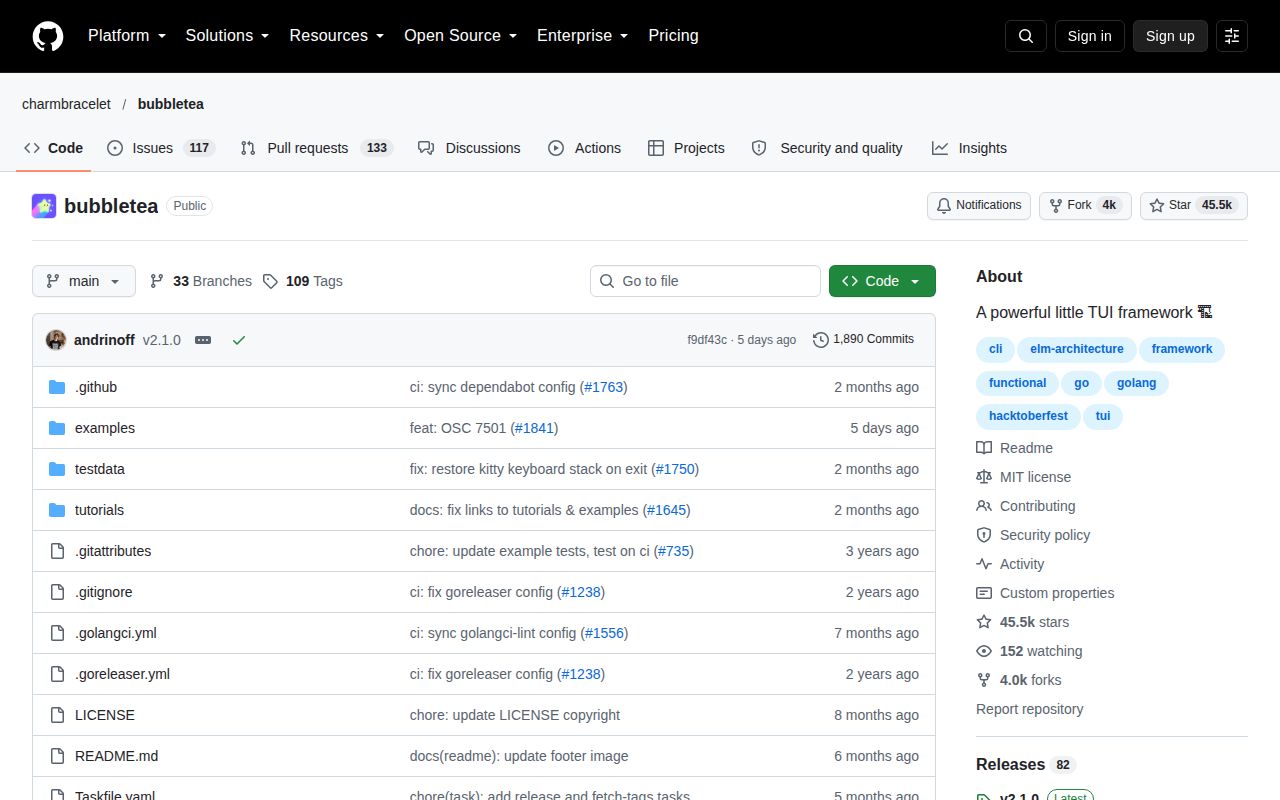
The last push was October 8, 2026, and v2.1.0 shipped that day with terminal-size fallback and shutdown-deadlock fixes. GitHub returned 45,459 stars and 250 open issues and PRs. Issue and pull-request updates continued through October 13. Those dates show current work, while the cleanup reports show unfinished work. The v2.1.0 release notes should be read alongside the issue tracker when selecting a revision.
The 7 CI workflow files accompanied our successful run, but framework choice still starts with the interface you need. Choose tview's ready-made tables and trees when those widgets dominate a Go app. Choose Huh's forms and accessible mode for a guided questionnaire. Textual's Python widgets suit a Python team. For Bubble Tea, start with the hardest interaction: change selection while a request is pending, then quit while it completes. Make that behavior right before styling the screen.