What book-to-skill is trying to fix
Technical books and internal manuals are valuable precisely because they contain more context than a short note. That same depth makes them awkward during daily work. Search can locate a phrase, but it rarely turns a chapter into a decision rule or reminds you that a relevant framework exists elsewhere in the book. book-to-skill takes a pragmatic approach: convert the source into an Agent Skills directory that a compatible coding agent can inspect when a question comes up.
The generated structure is more useful than a single giant summary. The main SKILL.md is intended to hold core mental models and a chapter index, while chapter files stay separate and are loaded only when relevant. The tool also creates a glossary, a patterns file, and a cheat sheet. That layout gives an agent several routes into the material without forcing the entire book into every conversation. The README claims a 24 to 51 times token reduction compared with putting a whole book into context for one question. That is the project's own measurement, and the truncated material here does not provide enough methodology to independently judge it, but the underlying design clearly aims to reduce repeated context.
What it does well
Input coverage is a major strength. The CLI accepts a file, folder, glob, or collection of sources, and the documented formats include PDF, EPUB, DOCX, Markdown, HTML, RTF, MOBI, plain text, reStructuredText, and AsciiDoc. This is not limited to published books. The README sensibly points to ADRs, runbooks, onboarding guides, research papers, specs, standards, and brand systems as plausible inputs. The analyze-only, generate-from-analysis, and update modes also suggest a workflow that can grow beyond a one-time conversion.
The extractor design is refreshingly explicit about tradeoffs. It tries multiple tools by format and uses the first available option. A text-heavy PDF can go through pdftotext, pypdf, or pdfminer.six, while code-heavy or table-heavy documents can use Docling. EPUB, DOCX, HTML, and RTF have optional packages or fallbacks, and MOBI or AZW relies on Calibre. The --check command is a good practical inclusion because it gives users a way to inspect capability before blaming a failed conversion on the source file.
Local processing is another meaningful advantage. The project says files are not uploaded by the converter, which is attractive for company documentation and purchased material. Its copyright guidance is also unusually direct: process material you have a right to use, treat the output as structured notes rather than a reproduction, and do not redistribute generated skills from copyrighted works. The MIT license covers the converter, not the input book.
Host support is focused but useful. The same open skill format is presented as working with GitHub Copilot CLI, Amp, and Claude Code, and the installer copies files into their expected skill directories. That is a simpler artifact to inspect and version than an opaque database.
Rough edges and unanswered questions
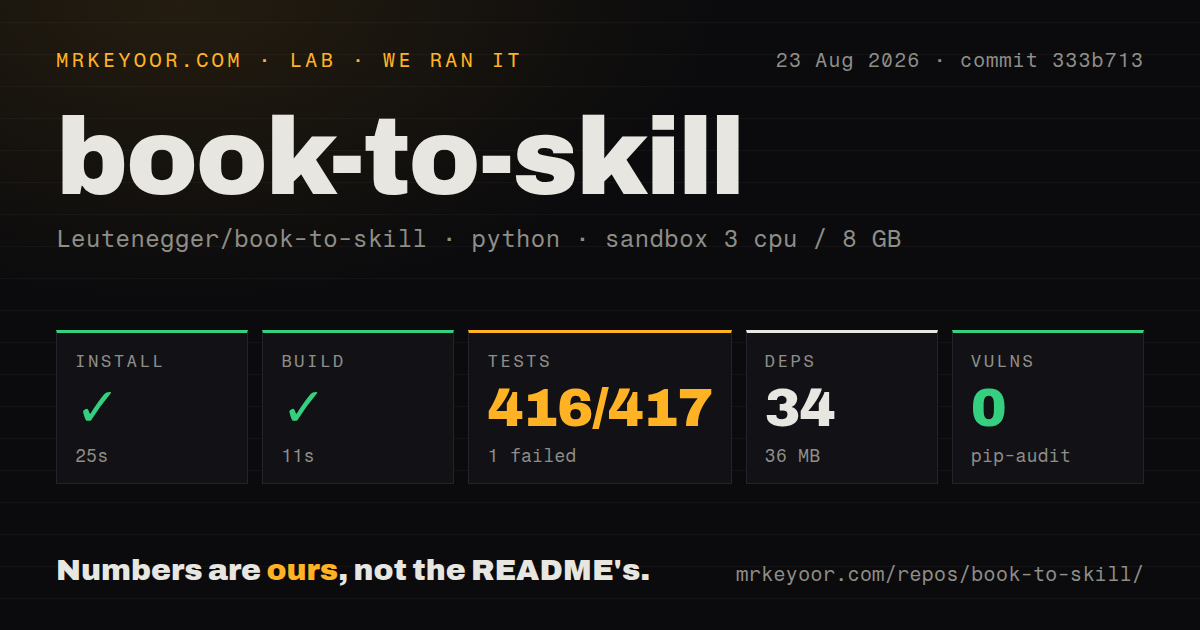
The three-command quick start hides real prerequisites. pip install -e . is a developer-style installation from a checkout. Many documents will require extra Python packages or system programs, and scanned PDFs require a separate OCR pass. Extraction quality will vary with columns, footnotes, diagrams, code blocks, tables, and malformed ebooks. A successful command does not prove that the resulting chapter boundaries or rules are accurate.
The bigger limitation is epistemic. Turning prose into frameworks and takeaways necessarily compresses and interprets the source. The README promises answers from real content and says "no hallucination," but a structured derivative cannot guarantee that on its own. Users should retain the originals and verify consequential answers. The described output also emphasizes chapter references rather than page-level quotations and citations, so this is not the obvious choice for legal, academic, or compliance work that requires an auditable trail back to exact passages.
There are product-polish concerns too. Automatically unpacking and launching a GUI on the first two CLI runs is surprising behavior for a command-line utility. There is no listed release, so users lack a stable version marker and conventional upgrade path. The approximate token sizes for generated files are helpful targets, but the provided README excerpt does not establish quality tests across formats, deterministic generation, failure recovery, or compatibility guarantees as agent hosts evolve.
Community and project health
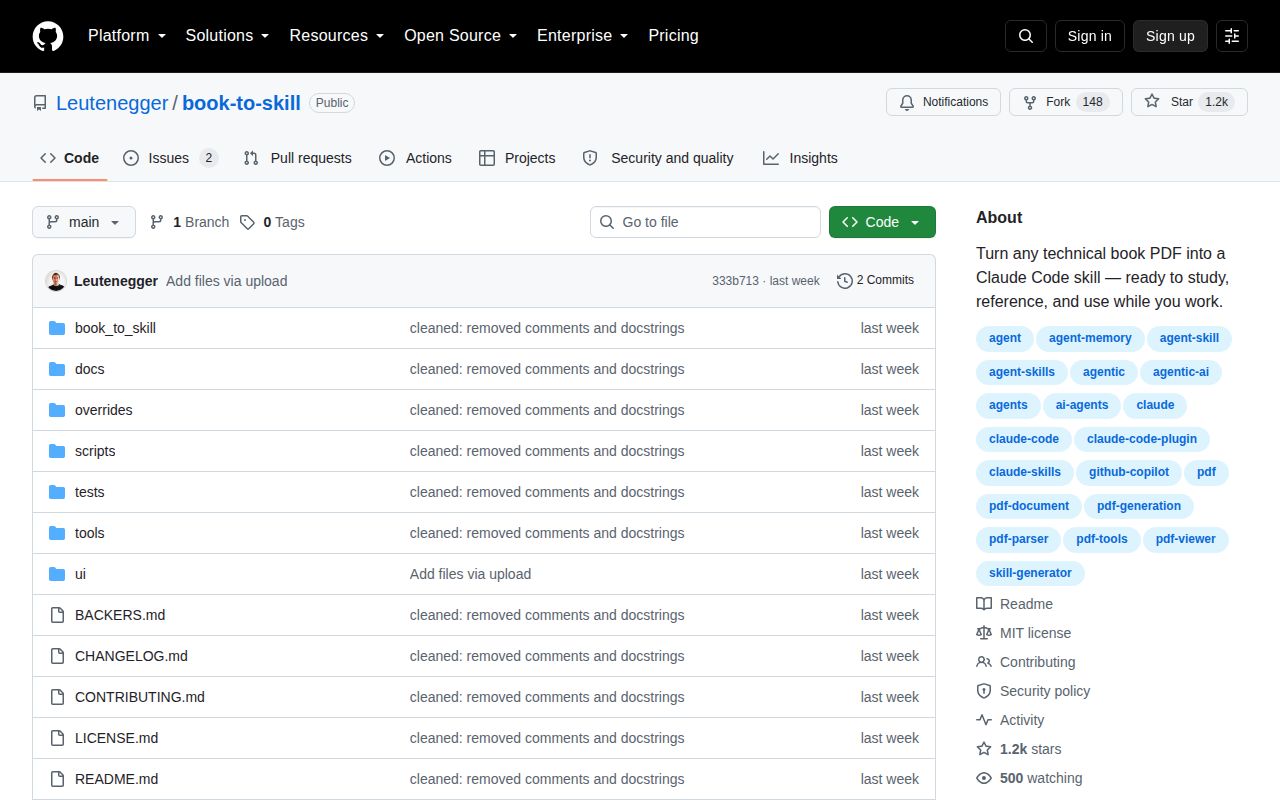
The repository has 1,189 stars, only two open issues, and a last push on August 14, 2026. A community item says it was created on August 13, which makes the adoption burst notable but also makes long-term conclusions impossible. Low issue volume in a repository this young is not the same as a proven maintenance record. There are no listed releases, and there has not been enough time to observe response speed, contributor diversity, regression handling, or release cadence.
Recent code activity is a positive signal, and the documentation already links usage, architecture, performance, FAQ, and changelog pages. Still, this is an early project with visibility, not a mature community. The sensible score is average for community momentum and below average for maturity.
Where it fits in a real stack
book-to-skill fits best between a local document library and an interactive coding agent. Use it for a small number of high-value sources that you revisit, commit the generated skill privately if licensing permits, and review changes when sources are updated. Keep the original files available for verification. Teams should add spot checks for chapter coverage, terminology, and critical decision rules before treating output as shared guidance.
It is less suitable as a central enterprise knowledge base. If multiple users need permissions, synchronized ingestion, exact citations, monitoring, and a shared retrieval service, a dedicated document retrieval platform is a better architectural fit. This project is appealing because it stays lightweight: its best role is as a personal or small-team reference layer, where transparent Markdown files and on-demand loading matter more than administrative controls.