More than 20 skills cover publishing and visual work
Baoyu Skills packages repeatable workflows for AI agents. The collection covers Xiaohongshu cards, infographics, SVG diagrams, cover art, slide decks, comics, article illustrations, translations, Markdown cleanup, HTML conversion, image compression, transcripts, and social posting. Many entries contain scripts, references, configuration rules, and checks around generated output. The repository targets Claude Code, Codex, Cursor, and other agents that can read files and run commands.
A writer can pass an article through a cover skill, add illustrations, convert it to WeChat-ready HTML, then stage it for publishing. A developer can install only the diagram skill and ask Claude to write a self-contained SVG. Named skills save the procedure that would otherwise be repeated in a long prompt. They do not supply provider accounts or guarantee the quality of the final artifact.
What happened when we ran it
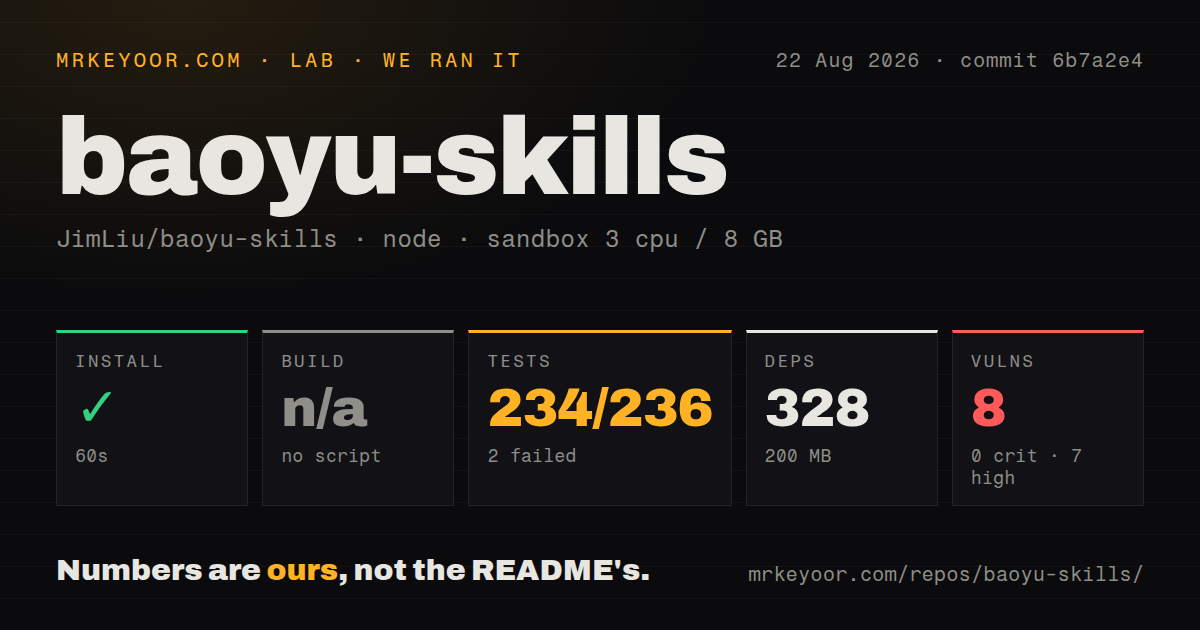
Our run cloned commit 6b7a2e4 into an unprivileged Node 22 Bookworm container with 3 CPUs, 8 GB of RAM, and no secrets. The checkout contained 835 files, about 60,435 lines of source, and occupied 23.5 MB. Bun installed 328 packages in 60 seconds and used 200 MB on disk. The repository exposed no build script or target, so no build ran.
The test script finished with exit code 1 after 29 seconds. Node's runner reported 236 tests: 234 passed and 2 failed. The log tail only contained aggregate counts and error: script "test" exited with code 1; it did not name the failed cases or their causes. npm audit found 8 known vulnerabilities, comprising 7 high-severity findings and 1 low-severity finding.
The repository has 2 CI workflow files, workspaces, no Dockerfile, and no tests directory. A test script clearly exists despite that directory signal. Before adopting commit 6b7a2e4, inspect the complete failure output and the 7 high-severity advisories. Our measurements do not show whether either failed case affects the skill selected for use.
Selective installation avoids permanent context cost
The README lists Node.js and the ability to run npx bun as prerequisites, then offers npx skills add jimliu/baoyu-skills. Claude's plugin marketplace and project-level Codex directories are documented too. ClawHub installs skills individually. The README warns that loading the whole collection adds unnecessary context on every agent run, advice that should be treated as the default installation policy.
Codex users can copy full skill directories into .agents/skills for one project. The WeChat example recommends only the cover, illustration, and posting skills, since the posting skill already includes Markdown conversion. That kind of minimal bundle is easier to review and version. Credentials can be scoped to a project through .baoyu-skills/.env; the README explicitly says not to commit that file.
Visual options are specific enough to repeat
The infographic skill names information structures such as funnels, comparison tables, timelines, and priority quadrants, then pairs them with documented visual treatments. The cover generator separates type, palette, rendering, text, and mood. Xiaohongshu cards have their own style and density controls. Preview grids let a user choose a direction before spending a provider request.
The diagram skill is different because Claude writes SVG code directly instead of calling an image model. It supports flowchart, sequence, structural, illustrative, and class diagrams, with an embedded style for dark mode. Issue 196 asks for light and monochrome themes because dark output does not suit some professional documentation. The request was still open when checked, so teams with strict brand templates should inspect generated SVG or maintain their own theme rules.
WeChat automation keeps a necessary approval step
The social skills make a sound safety choice: X and Weibo browser flows fill the editor but leave final publishing to the user. WeChat supports API, browser, and remote API methods. Its API route needs credentials and an allowlisted IP. Browser mode keeps a QR-login session, while a remote route can use an SSH SOCKS5 tunnel. Each path has a different secret and failure model.
Issue 197 describes hidden or stale nodes in the newer WeChat editor that can break menu, editor, or save-button selection. It also reports saves occurring before image uploads finish on slow networks. The author of the report had 8 local tests passing for a proposed patch, but the upstream issue remained open. Keep the manual checkpoint, inspect every uploaded image, and confirm the draft exists before treating a run as successful.
Release 2.5.2 fixed false image reuse evidence
Version 2.5.2 arrived on June 18, 2026. Its main fix stopped a Codex image-generation path from accepting an unrelated existing image as evidence that a new image tool call occurred. That is a meaningful correction because a successful-looking file was not proof of the requested action. The same release documented project-level Codex installation and user-versus-project WeChat credential scopes.
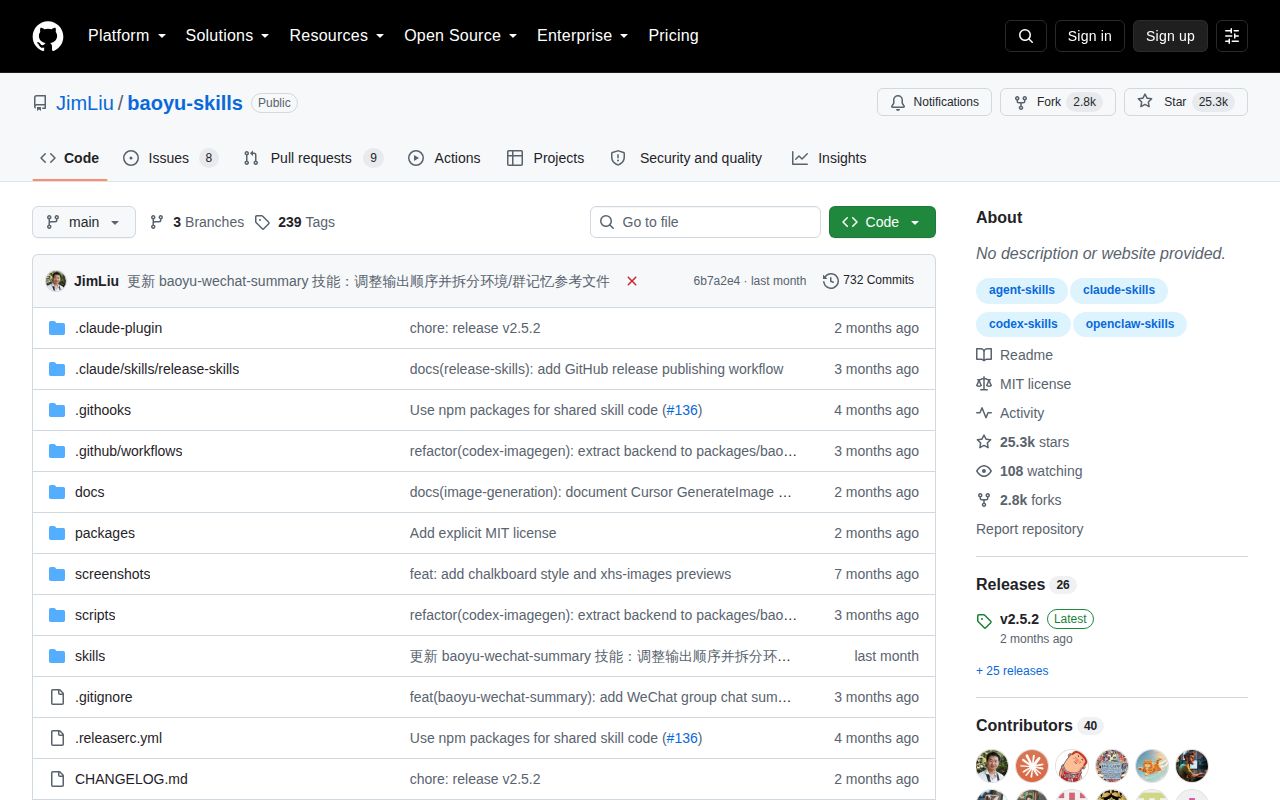
GitHub recorded a last push on July 4, 2026, 25,339 stars, and 17 open issues and pull requests combined. Those figures show strong attention and recent maintenance, while the 2 failing tests and browser-editor report keep the maturity score grounded. A wide collection must follow changes across model providers, agent clients, and social platforms that move independently.
Baoyu Skills works best as a shelf of inspectable tools. Our 60-second install and 234 passing tests make it credible to trial, but 7 high-severity audit findings deserve resolution before a sensitive workstation install. Select one workflow, pin the files, test the generated artifact, and require a person to approve anything headed to a public account.