Backpass learns from seven local transcript stores
Backpass reads sessions from Claude, Codex, Pi, OpenCode, Grok, Cursor CLI, and Hermes. It ties a session to a repository using its working directory, a sibling clone with the same remote, a recorded Git remote, or a best-effort path match. The project README explains which metadata each collector trusts. That matters because a useful proposal depends on feeding the analysis the right work history, not every chat on a developer's machine.
The checkout we measured was compact for a tool that understands seven transcript formats: 144 files, about 27,780 lines of source, and 1.3 MB at commit b8942cd. Collection is incremental, with scan decisions cached by path, modification time, and size. Backpass also tags and excludes the sessions it creates during its own analysis, which prevents the tool from learning from its generated prompts. Missing or changed transcript formats produce a warning and the affected collector is skipped.
New instructions need two sessions and a human decision
A new instruction needs quotes from at least two independent sessions before it can enter a proposal. One run normally proposes no more than five edits, and every negative finding is classified as harm, noncompliance, or irrelevance. Synthesis edits a staging copy, then Backpass measures the resulting diff instead of trusting the model to describe its own changes. backpass apply shows the diff and supporting excerpts so a reviewer can accept or reject each item.
The 49 MB install is small. Transcript privacy deserves separate scrutiny. Raw stores remain on the machine during collection, and deterministic distillation removes tool noise before model calls. The code's redactor covers common API key, token, JWT, private-key, and secret-assignment shapes. Its own comment calls the filter coarse and says it cannot guarantee coverage. Distilled text still goes through acpx to an agent provider you already use. Security-sensitive teams should inspect saved prompts before adopting it.
What happened when we ran it
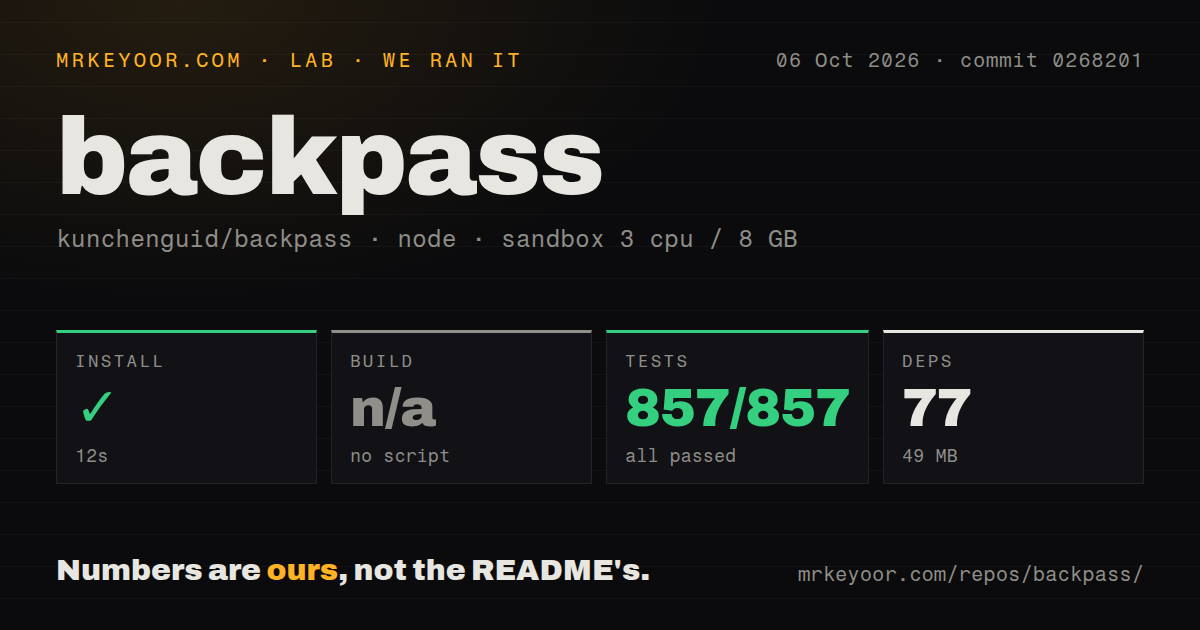
Our sandbox installed Backpass in 15 seconds, adding 77 packages and occupying 49 MB. We used commit b8942cd on August 31, 2026 in an unprivileged lab-node:22 container with 3 CPUs, 8 GB of RAM, and no secrets. Installation completed without an error. The repository uses pnpm workspaces and had four CI workflow files, a tests directory, and no Dockerfile.
There was no build script or build target, so the lab skipped that step rather than inventing one. The node:test suite completed in 54 seconds: 472 tests passed and 0 failed out of 472. Those results cover repository checks in our fresh Debian sandbox. They do not test whether a configured Claude, Codex, or other agent can analyze a real transcript store, because the container had no secrets or authenticated agent accounts.
Node 22.5 and acpx are the real prerequisites
The command-line package needs Node 22.5 or newer and acpx on PATH. A useful run also needs an installed, logged-in agent and local sessions associated with the current repository. The default model ladders probe several agents, cache durable availability results, and fall through when a candidate cannot serve the requested model. Pinning an agent removes that fallback, so a bad pin stops the run with an error.
Our 15-second install therefore measures only the easy part. backpass init creates .backpassrc.json and adds .backpass/ to the repository's local Git exclude. Analysis can make many provider calls, one for each selected transcript plus synthesis, and the default sample cap is 100 transcripts. The README documents a 5,000-token budget for the always-loaded memory file and skill descriptions. Teams should run backpass scan first to check association quality before paying for analysis.
Windows remains outside the verified path
Open issue 92 reports that backpass apply can loop forever on Windows before writing a byte because Git and Node return the repository root with different path separators. The issue reproduces on Backpass 0.1.15 and current source at the reported commit. Apply is the only path that writes accepted edits, so the hang blocks the only step that turns review into saved changes.
Passing 472 tests in our Linux sandbox does not clear that report. Open issue 91 describes Windows file contention when the default four analysis jobs update acpx session state, with a one-job run completing in the reporter's comparison. Issue 40 also reports that configuring .claude/skills can redirect extractions to .agents/skills; the source we inspected still treats that exact configured path as the canonical case instead of an explicit target.
The August 31 release is active and too new to prove stability
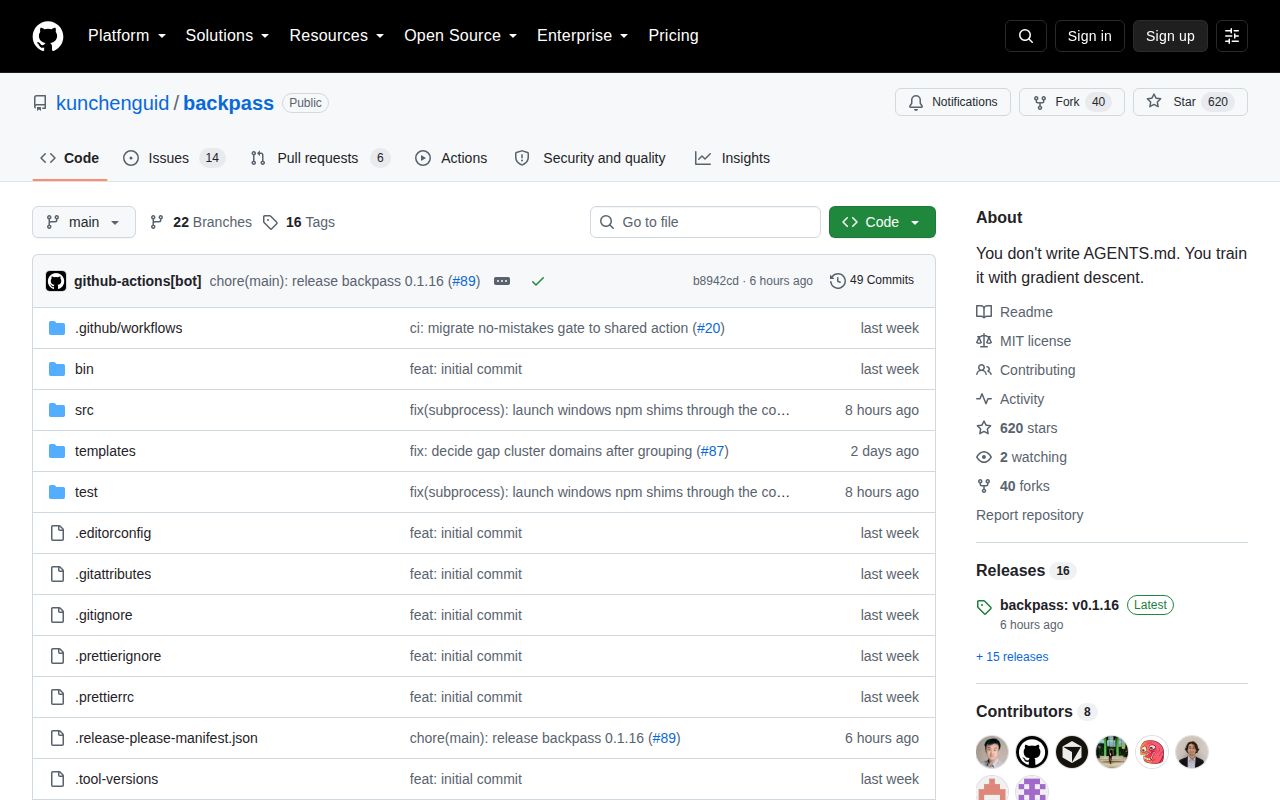
GitHub recorded the last push and v0.1.16 release on August 31, 2026. The repository was created on August 21 and had 620 stars, 14 open issues, and 6 open pull requests when fetched. The v0.1.16 notes list fixes for model-provider selection, OpenCode effort variants, and Windows npm shims. Same-day issue updates show active maintenance, while the short history leaves little evidence about upgrade stability.
Backpass is a focused 1.3 MB codebase with 472 passing tests and unusually explicit write gates. That makes it worth a controlled trial on macOS or Linux when a repository has enough session history to reveal repeated mistakes. Start with scan, review the distilled prompts, keep the first proposal small, and inspect the Git diff after apply. Windows users and teams that cannot send transcript excerpts to an existing provider should wait or choose a different memory design.