675 entries provide discovery without verification
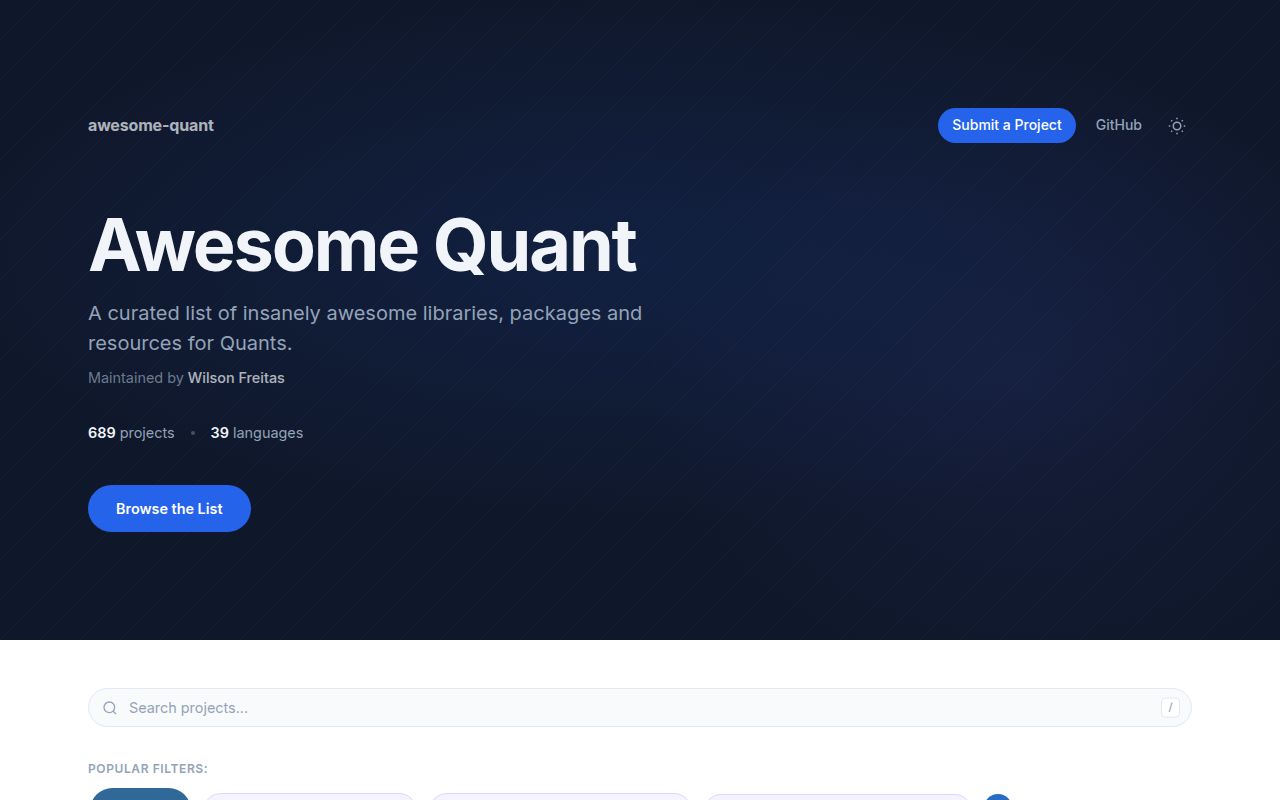
commit e7e5410 has 675 catalog entries under 18 category headings. The subjects range from numerical arrays and derivatives pricing to backtesting, portfolio risk, market data, spreadsheets, and books. Python is prominent, but R, Julia, Java, Rust, TypeScript, and cross-language projects also appear. Awesome Quant works best at the beginning of a search, when the question is which projects exist and what vocabulary to use.
The repository is much smaller than the list it points to. Our checkout contained 43 files, about 4,559 source lines, and 1.5 MB before dependencies. README.md is the source of truth, a parser enriches entries with package and GitHub metadata, and a generator produces the static website. Each result remains a one-line catalog entry whose description and links need separate checking before adoption.
65 commercial entries extend the catalog beyond public source
The README puts 65 entries under Commercial & Proprietary Services. Contribution rules allow a repository-less service only when it has a meaningful permanent free tier without payment details, public limits, and public documentation or methodology. Projects with substantive public implementations are preferred. A thin SDK, integration, example set, or marketing repository does not qualify a hosted product for a functional section. That policy is clearer than many community lists, although applying it to hundreds of existing entries is unfinished work.
Coverage is broad enough to become noisy. Trading and Backtesting has 150 entries, while Market Data and Data Sources has 131 at commit e7e5410. By comparison, Quant Research Environments has 3. The imbalance does not make the large sections worse, but it means alphabetical scanning is a weak selection method. Use the directory to create a shortlist, then inspect licenses, release activity, data rights, tests, and realistic examples in each target repository. Awesome Quant does not perform that project-level evaluation for you.
What happened when we ran it
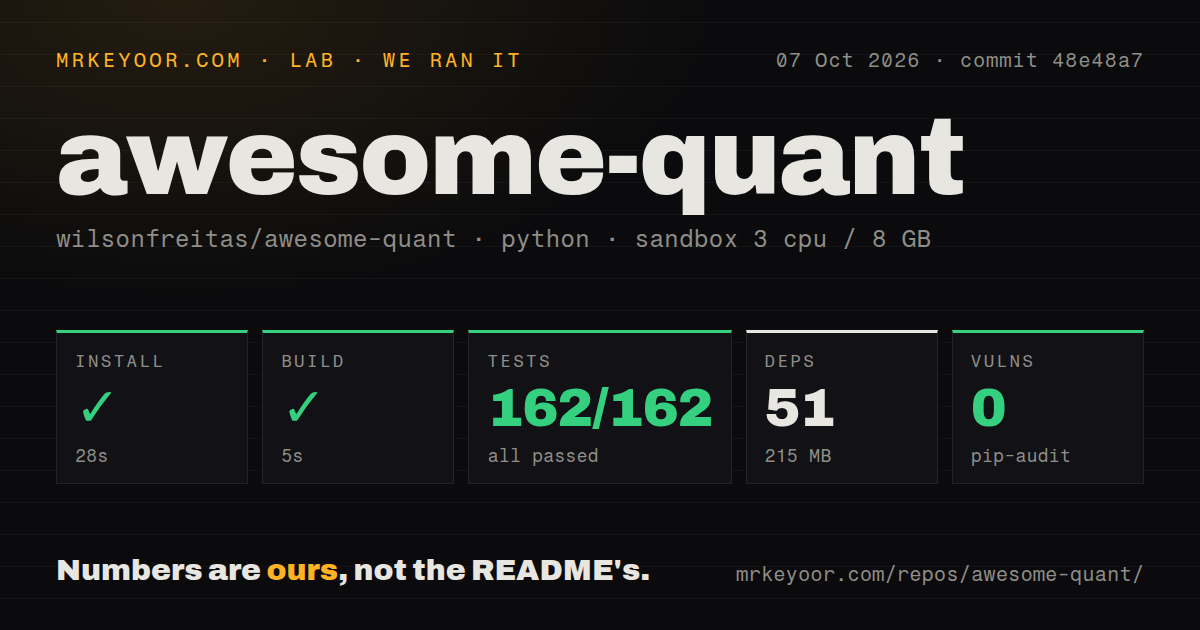
Our sandbox installed 51 packages in 23 seconds, consuming 215 MB on disk. The build completed in 5 seconds. The measurement setup used commit e7e5410, 3 CPUs, 8 GB of RAM, Python 3.12 on Debian, an unprivileged container, and no secrets. This was a clean result for the catalog's own Python tooling and generated-site path, with no failed install or build step in the supplied run.
Pytest finished in 7 seconds with 70 passed and 0 failed of 70. Pip-audit found 0 known vulnerabilities in the installed Python environment. The tests exercise pull-request review behavior such as duplicate detection, URL safety, repository eligibility, README formatting, and the workflow's read-only permissions. They do not import every listed library, reproduce its calculations, or verify every external service. Passing all 70 says the contribution machinery worked in our sandbox, not that 675 entries were individually approved.
The repository scan found 3 CI workflow files, no Dockerfile, and a tests directory. One workflow builds and deploys the site on README changes and a daily schedule. Another validates added entries and generates the site for pull requests. The absence of a Dockerfile is not a serious obstacle for this small Python project, but teams mirroring the catalog internally will need to create their own pinned runtime around the 51 installed packages and GitHub API access.
70 tests protect new changes more than old entries
The 70-test suite pays close attention to new pull requests. It rejects duplicate names or URLs, insecure links, archived or stale repositories, missing READMEs, malformed tags, and changes outside the catalog file. URL checks also refuse private, multicast, and other unsafe network targets before making a request. The review workflow has read-only repository permissions. Those controls reduce obvious submission problems and make the automated review safer to run on outside contributions.
Full-list handling has a softer boundary. The project instructions say legacy format, duplicate, and URL problems are warnings by default, while strict errors apply to new lines in pull requests. Open issue 571 records a baseline of 656 parsed entries that still need full link, commercial-status, and section review; our later commit contains 675 catalog entries. A current green build therefore cannot stand in for a current catalog audit.
Python 3.11 and one token produce the enriched site
The project metadata requires Python 3.11 or newer and declares PyGithub, pandas, and mypy as direct dependencies. The normal local install uses uv. Running parse.py against GitHub needs a GITHUB_ACCESS_TOKEN, because it enriches the catalog with repository metadata. The site generator has a lower-friction fallback: it can read an existing site/projects.csv or parse README.md directly. Readers using the hosted page do not need any credentials.
Local setup is easy in the narrow sense measured by our run: 51 packages arrived in 23 seconds, the build took 5 seconds, and the 70 tests needed 7 seconds. Maintaining a trustworthy mirror is more work because GitHub state, package pages, redirects, and commercial pricing can change independently. The daily site workflow refreshes metadata, but issue 571 calls for recorded evidence and manual review where link failures, redirects, source availability, or commercial classification are ambiguous.
29,363 stars coexist with an unresolved license question
GitHub showed 29,363 stars and a last push on September 2, 2026. Pull requests for new resources and link updates were active on September 1, so current issue activity supports the fresh push date. The repository had 47 combined issues and pull requests. That queue is mostly visible curation work, not a count of defects in one executable package, and it includes the full-catalog audit that should matter to serious downstream users.
GitHub reported no license, the root listing had no LICENSE file, and the project had no releases. The missing release history does not imply abandonment because commits and pull requests are current. The missing license is a separate adoption problem for anyone who wants to redistribute the catalog, generated site, or code. Browse Awesome Quant freely as a discovery tool, but obtain legal clarity before incorporating its dataset into another product and verify each shortlisted finance project on its own terms.