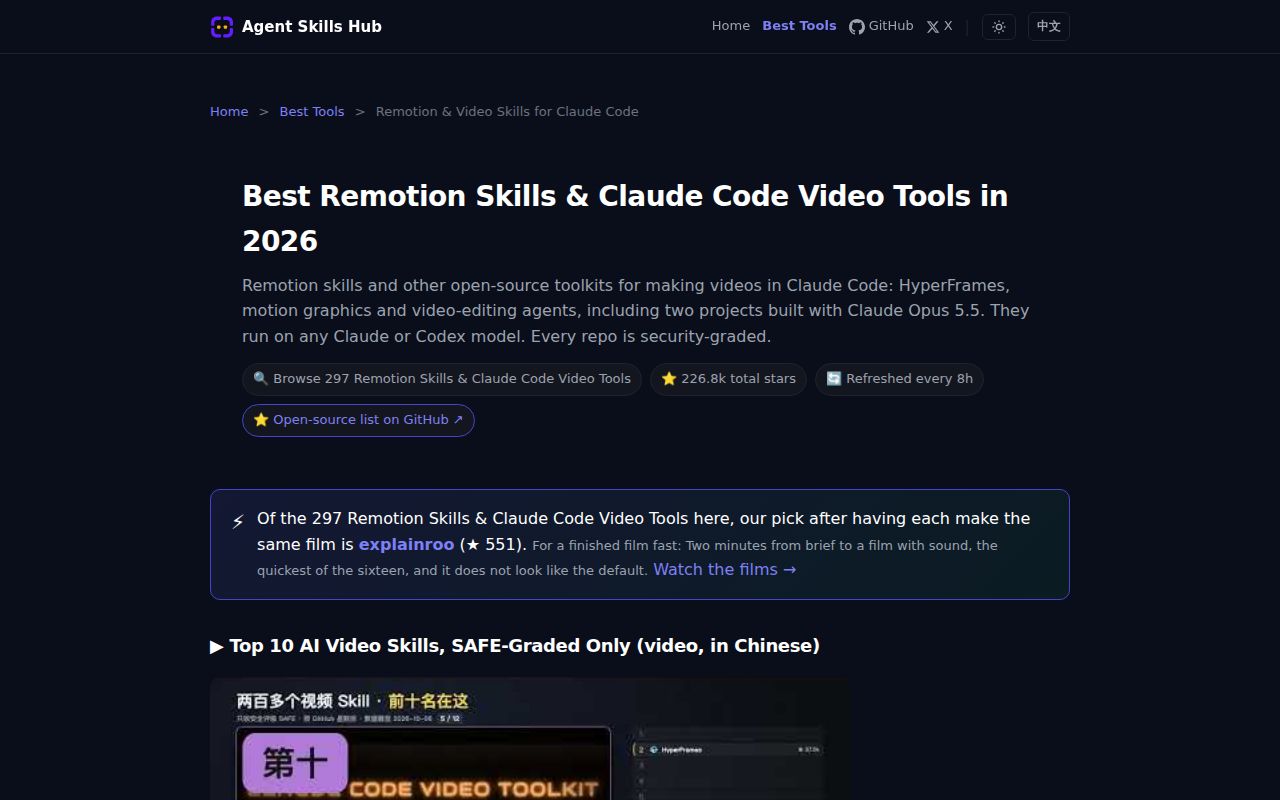
A “SAFE” badge beside a video skill is easy to read as permission to install it. Awesome Claude Video Skills gives that label a narrower meaning: Agent Skills Hub grades the project's README and installation steps. That's the distinction I'd keep in mind while browsing this directory. Its previews and categories can help you find a candidate quickly, but choosing a renderer still requires reading the project you intend to use.
The directory sorts video tools by the job you have
The README advertises 295 repositories, grouped into categories including explainers, editing, avatars, and motion graphics. An editor with existing footage can start in a different section from someone making an animated product announcement. Selected entries have visual previews, while the tables link to source repositories and grading pages. This is useful discovery work, especially when similar project names conceal very different inputs and outputs.
Both English and Simplified Chinese READMEs are available. Individual project descriptions sometimes retain their original language, so an English catalog doesn't guarantee English instructions at the destination. The repository also includes a machine-readable catalog with fields for category, license, and security grade. That makes it possible to inspect or filter candidates yourself instead of scrolling through the entire README whenever your requirements change.
What happened when we ran it
We did not run commit 15e2f4b in our sandbox on 2026-10-15: the lab found no supported ecosystem, recorded the language as null, and found no Dockerfile. Our fresh Debian container had 3 CPUs and 8 GB of RAM, held no secrets, and ran without elevated privileges. The lab therefore skipped execution. It did not attempt a video export through any listed project.
The 3 CPUs describe our sandbox, not a recommended machine for the tools in this directory. The supplied lab record cannot establish their resource requirements or whether their instructions work. The directory links to example films and a separate comparison published by its maintainer, but those remain upstream material. We have no independently reproduced rendering result to attach to a recommendation from this list.
Selection depends on stars and automated README judgments
Repositories with at least 50 stars can qualify on topic alone, according to the inclusion rules. Smaller projects face an additional README quality bar and generally need at least 5 stars, with an exception for projects naming a particular Claude model. Those are explicit discovery filters. They give popular projects an easier route into the directory, so inclusion doesn't mean every entry cleared the same documentation standard.
A decision model reads the READMEs and answers the selection questions. The maintainer acknowledges that a project near a cutoff can fall on either side and asks readers to report misclassifications. I appreciate that disclosure. Still, if you're searching for a narrowly specialized editor, I'd use the category as a starting point and check the actual supported workflow before deciding that a nearby entry is a substitute.
Security grades cover a smaller surface than the badge suggests
The README defines its security column as a grade of a repository's README and install steps. It also explains that a pending label means grading hasn't happened yet. Neither definition promises a source-code audit or an examination of everything an agent might execute. For a tool that asks a coding agent to invoke commands, that gap deserves attention before you give it access to private footage or credentials.
The JSON catalog is dated 2026-10-14 and carries license information alongside its grades. Those fields are convenient for narrowing a shortlist, but the directory's own license file tells readers to check each project's terms before reuse. I'd follow the link to the selected repository and read its current scripts and permissions. A directory entry can help you find that work; it cannot make the permission decision for you.
Pricing is missing from the main comparison tables
Issue 5, opened on 2026-10-12, asks the maintainer to add pricing to the repository table. The tables currently show descriptions and security grades rather than a consistent cost breakdown. That omission matters because the list mixes local code-based workflows with tools involving outside services. If avoiding accounts or paid generation is part of your brief, the catalog doesn't answer that requirement uniformly across its entries.
The preview notice also limits what you can infer from a thumbnail: these are reduced copies of pictures from project READMEs. Treat them as leads for visual direction rather than evidence that your own brief will produce the same result. The list's CC0 dedication covers its selection, grouping, and original text. Project descriptions and media retain their respective ownership and licensing, so copying a preview into a client deck needs separate consideration.
October updates show an active catalog, with requests still open
The last push was 2026-10-14, and GitHub showed 636 stars on 2026-10-15. The open queue contained 5 issues and PRs, including the pricing request and submissions proposing additional tools. There was no published release returned by the latest-release endpoint. For a directory refreshed through source changes, the recent push and ongoing submissions tell us more about maintenance than the absence of a release tag.
If you've already chosen Remotion, its own agent-skills repository is a more direct starting point. Digital Samba's Claude Code Video Toolkit is another option when you want a production workspace with documented rendering and generation workflows. Use this directory while the choice is still open. Before adopting a candidate, open its README and identify where your footage goes and which services you'll pay for.