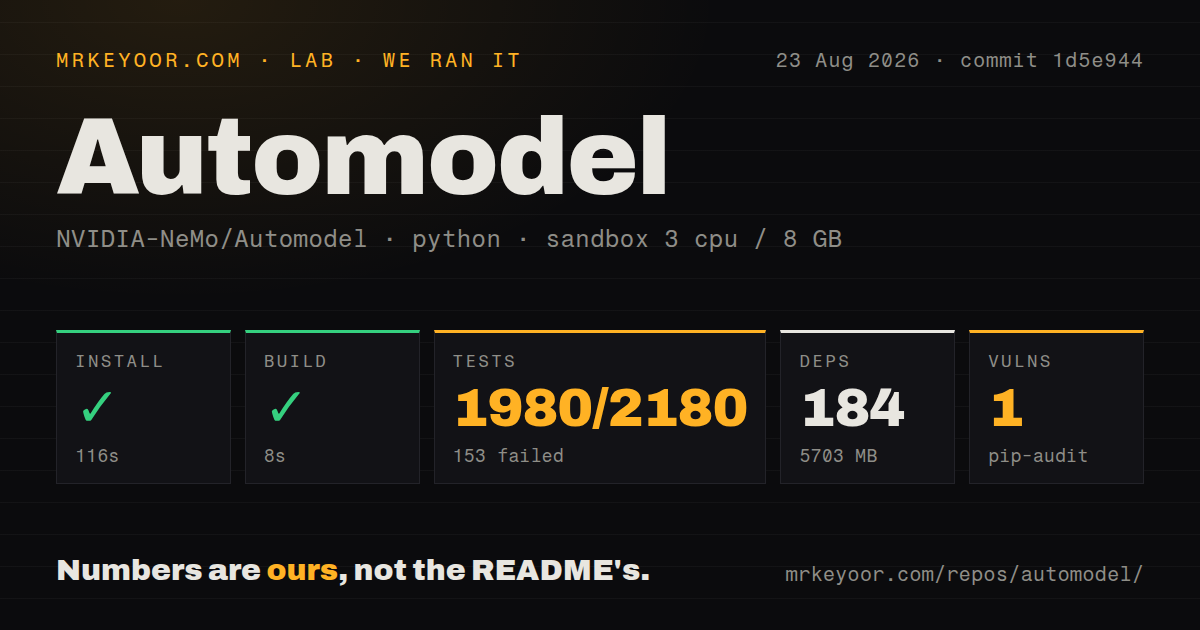
184 packages consume 5,703 MB before model weights
NeMo AutoModel is a serious training stack from the first install. Our default environment added 184 packages and occupied 5,703 MB, before downloading a Hugging Face checkpoint or dataset. The repository supports pretraining, supervised fine-tuning, LoRA and QLoRA, knowledge distillation, diffusion, retrieval, and speculative-drafter training. That range is useful for a platform team, while it also means the base package sits beside many model-specific and hardware-specific branches.
The README recommends uv sync --frozen for standard LLM recipes. Separate extras cover VLMs, media decoding, CUDA components, source-built CUDA dependencies, and the complete option set. The checkout itself was 36.7 MB with 2,686 files and roughly 566,445 source lines. Picking an example YAML is the beginning of environment design, since model family, media needs, attention kernel, precision, and GPU topology decide which dependencies and launch path belong in the job.
One YAML recipe can describe one GPU or many nodes
Recipes name the training class and its parameters, while command-line overrides change fields without editing Python. The project builds on PyTorch DeviceMesh and DTensor concepts for data, tensor, sequence, context, expert, and pipeline parallel arrangements. FSDP2 and sharded checkpoint paths sit alongside Hugging Face model loading. That is the main appeal: teams can work near familiar PyTorch and checkpoint formats while configuring distribution around the model.
The promise still assumes capable hardware and operators. README examples include a single-GPU VLM job and an 8-process LLM launch, while Slurm scripts hold nodes, GPUs, partitions, mounts, and container settings for clusters. Our 3-CPU, 8 GB sandbox did not run a training recipe, download weights, initialize CUDA, or measure throughput. Any performance figure needs the exact model, sequence length, GPU type, mesh, kernels, and precision, none of which our lab run supplied.
What happened when we ran it
Our sandbox installed commit 1d5e944 in 116 seconds. The 184 packages used 5,703 MB on disk, and the build completed in 8 seconds. Pip-audit found 1 known vulnerability in the installed environment. The provided result does not identify its package or severity, so the safe conclusion is limited: the audit was not clean, and an adopter should inspect the current report before approving an image.
Pytest ran for 293 seconds and returned exit code 1. It reported 1,980 passed, 153 failed, 173 skipped, and 47 collection/setup errors out of 2,180. The suite stopped after reaching 200 combined failures and errors. A large passing majority shows substantial test coverage, but the command still failed. Teams cannot reduce that outcome to a harmless optional test without sorting failures against the extras and recipe they intend to use.
Missing diffusers caused errors visible at the end of the log
The final reported errors came from tests/unit_tests/_diffusers/test_diffusers_patches.py. Each shown case ended with ModuleNotFoundError: No module named 'diffusers', including idempotence, fixed-upstream, missing-operation, and patch-independence checks. That establishes that these tests could not import one expected module in our installed environment. It does not establish the causes of the other 153 failures or all 47 errors.
The README's extras make dependency selection part of the product. A default LLM environment differs from diffusion, vision, video, FlashAttention, or MoE work. Our run installed 5,703 MB and still lacked diffusers for those tests. Pin the selected extras in the training image, then run the subset for the actual recipe plus the shared checkpoint and distributed tests. Installing every extra may solve some imports, though our log does not prove that it resolves the suite.
Checkpoint and router correctness are active work
Checkpoint handling spans Hugging Face SafeTensors, PyTorch distributed checkpoints, sharded layouts, consolidated exports, merging, and reshaping for a different mesh. Issue 3576 tracks current work on correctness, load memory, model-family conversions, precision transforms, saving, and observability. The issue calls the listed pull requests concrete steps rather than a completed architecture. That matters because a training run is only useful if it can resume and export a faithful model.
Issue 3650 documents a router-precision audit across 188 training, fine-tuning, and benchmark YAML files. It reports 9 router families matching all four audited stages, 23 mismatched or recipe-dependent, and one family lacking an independent public reference. The issue argues against one global precision rule because reference models differ. For a mixture-of-experts job, validate checkpoint conversion and router behavior on the named model instead of reading broad MoE support as universal parity.
Version 0.6.0 is active and still changing quickly
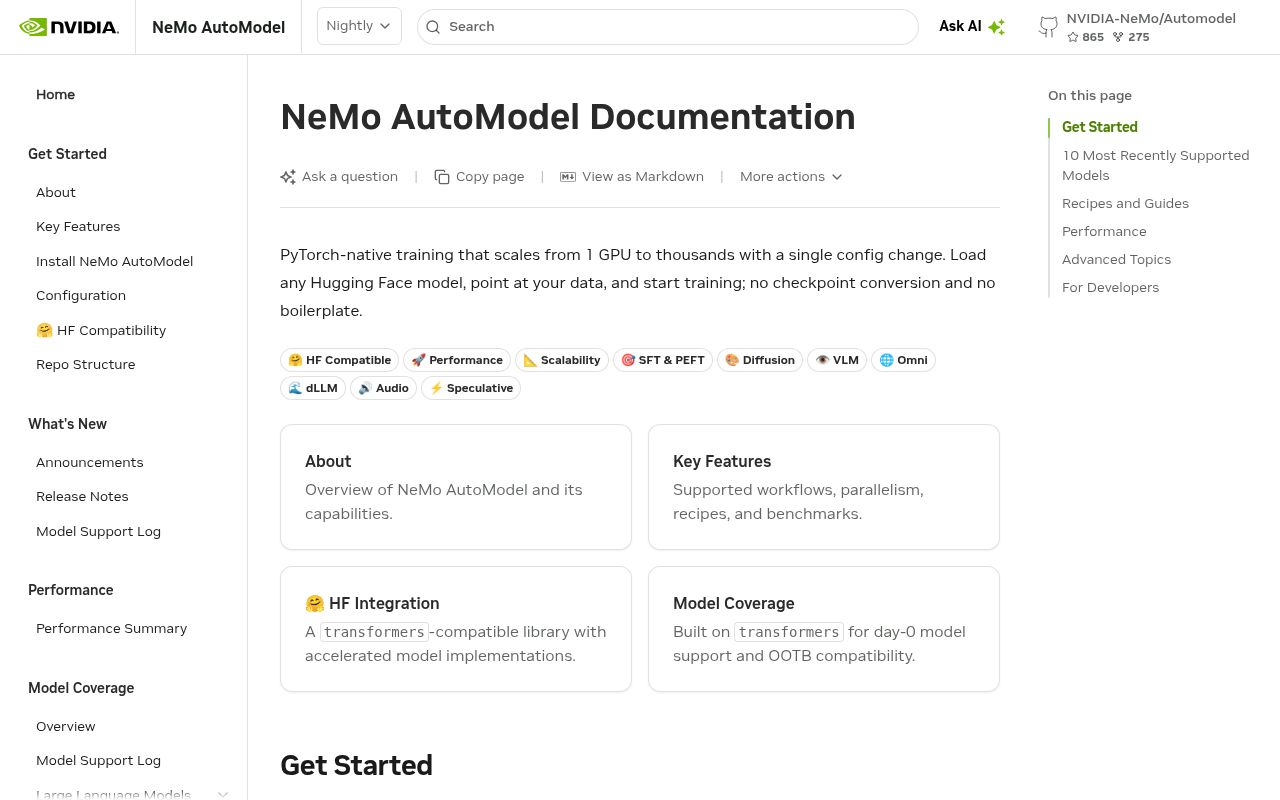
GitHub recorded 865 stars, 380 combined issues and pull requests, a last push on August 26, 2026, and v0.6.0 released the same day. The repository has 22 CI workflow files and a tests directory. Current development touches new model families, checkpoint memory, router precision, LoRA dtypes, sequence packing, and distributed sampling. This is clearly maintained, and the volume of open work also signals a wide moving surface.
AutoModel makes sense for an NVIDIA-centered team willing to certify one recipe at a time. Its documentation, YAML catalog, PyTorch distribution model, and Hugging Face interoperability can save engineering work once the target is supported. The buying condition is evidence on your own path: install the exact extras, clear relevant tests, inspect the single audit finding, run checkpoint round trips, and then benchmark on the intended GPUs. Our 1,980 passing tests are encouraging; the 153 failures prevent a blanket recommendation.