Atlas links agent sessions to the commits they produced
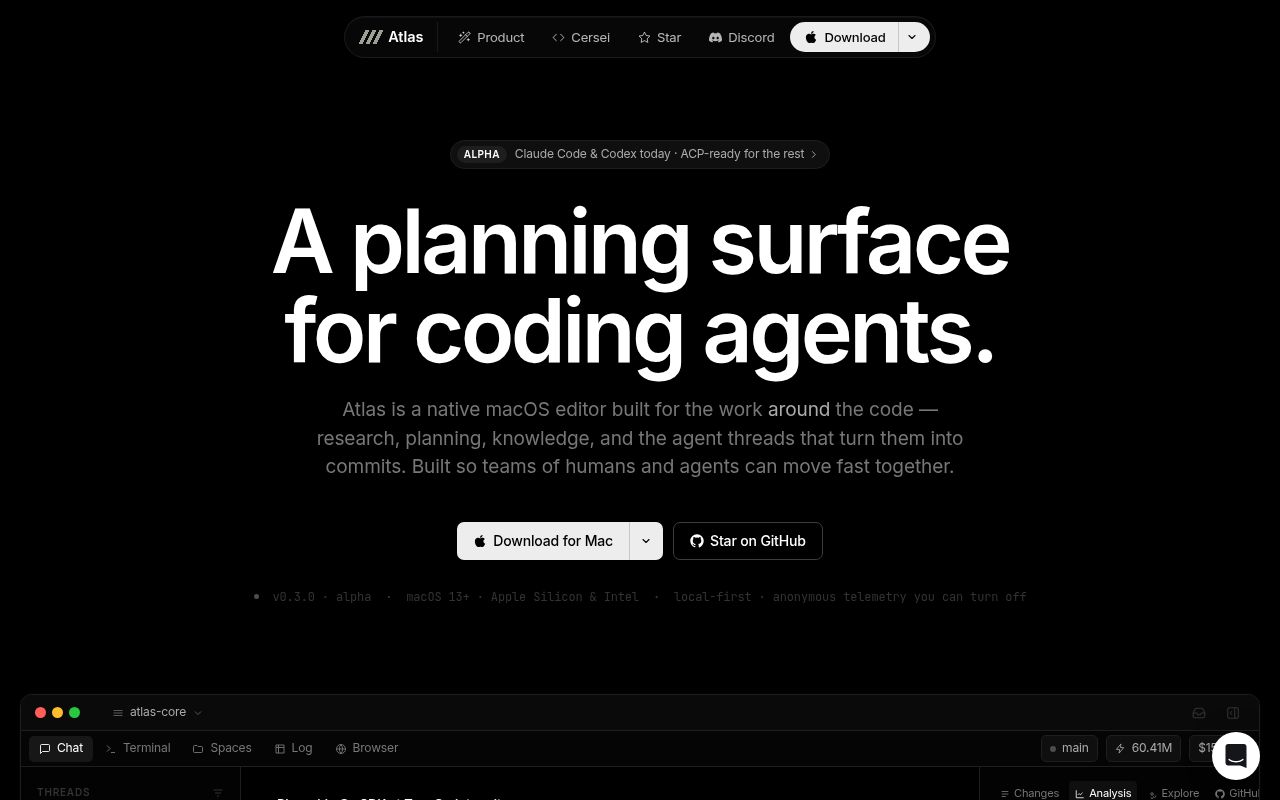
Atlas treats an agent session as part of source history. When a commit appears, it links that commit to the session that produced the changes, including prompts, tool calls, affected files, and patches. Those checkpoints survive ordinary amend and rebase operations through patch reconciliation. If a squash makes the source ambiguous, Atlas says it orphans the link instead of guessing. That is a useful rule for reviewers who care about provenance more than a polished summary written after the fact.
The project wraps this history in a full desktop workspace. It has an editor, Git graph, staged changes, terminals, Markdown knowledge notes, research-paper search, browser tabs, split views, and an activity log. The commit link itself lives in a gitignored SQLite database under .atlas, while sessions use local storage and notes remain normal files. A developer can close Atlas and keep working in another editor, though the extra context is easiest to inspect inside the application.
Claude Code and Codex share one local memory index
Atlas runs Claude Code and Codex as external subprocesses over the Agent Client Protocol. Its native agent runs in process, and other ACP registry agents can be installed automatically. Before each message, Atlas resolves explicit file or note mentions, retrieves semantic matches from an on-device index, attaches active plans and decisions, and supplies a handoff from the prior session. This lets a Codex session see a decision previously recorded by Claude Code, even though the 2 tools do not read each other's native history directly.
The model is practical when agents have different strengths. A developer can keep one repository open, run separate sessions in parallel tabs, then change agents without rebuilding context by hand. Atlas also imports existing Claude Code history and reads CLAUDE.md, AGENTS.md, knowledge notes, and supported memory files. The README is honest about the edge: QA for the long tail of ACP registry agents is ongoing, so Claude Code, Codex, and the native agent are the safer first evaluation set.
What happened when we ran it
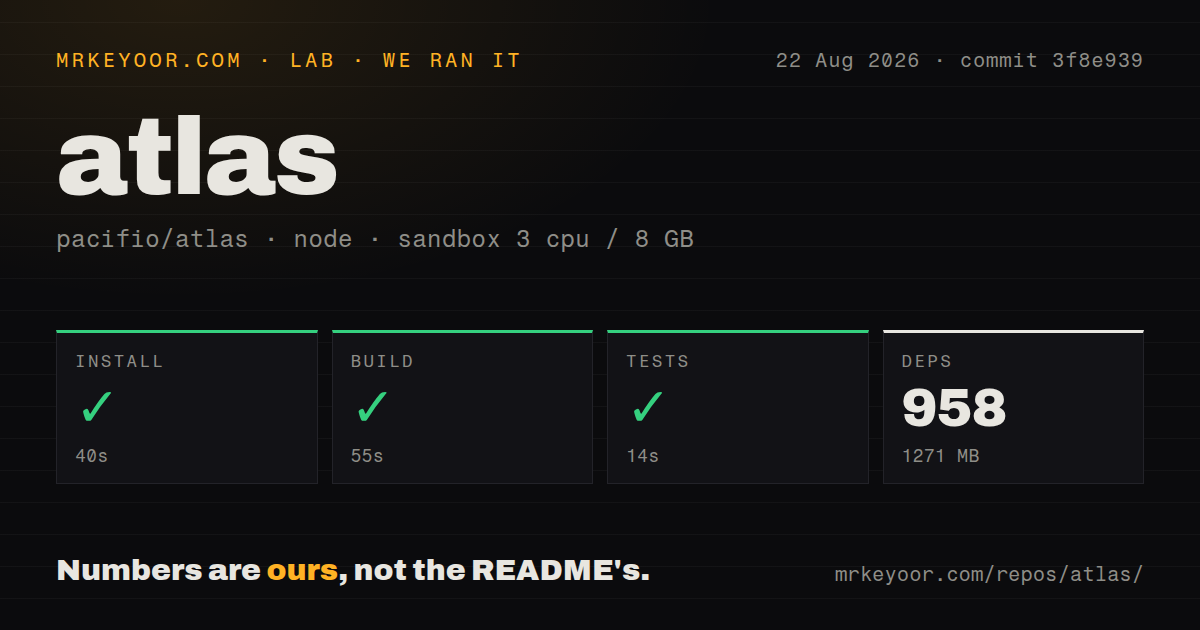
Our fresh Node 22 sandbox installed 958 Bun packages in 40 seconds. Dependencies occupied 1,271 MB, much larger than the 11.9 MB source checkout. The production build then succeeded in 55 seconds. That footprint is understandable for a Tauri desktop application combining a web frontend, Rust backend, editor, Git tooling, embedded browser, local search, and several agent adapters, but it is still a real cost for contributors and CI machines.
The test command succeeded in 14 seconds at commit 3f8e939. Our measurement block did not include a test count, so the defensible statement is that the invoked suite passed, not that some invented number of cases ran. The repository had 1 CI workflow file and a conventional tests directory. Together with the successful build, this is the cleanest lab result among the early-stage agent projects in this batch.
The lab ran in an unprivileged Debian container with 3 CPUs and 8 GB of memory. That verifies install, build, and test behavior in the stated environment. It does not test the downloaded macOS application, native WebKit behavior, account sync, external agent login, or a real multi-agent repository session. Those product paths still need a hands-on trial on a supported Mac.
macOS is supported; Linux and Windows are experiments
The releases page provides a macOS disk image, and the README calls macOS the supported platform. Building from source requires Bun, stable Rust, and Xcode Command Line Tools. The first Rust compilation is described as taking minutes, while later compiles are expected to be faster. Claude Code must already be installed and available on PATH; its account or subscription remains separate from Atlas. Other ACP agents similarly depend on their own binary and authentication model.
Linux can compile from the shared Tauri codebase after installing GTK 3, WebKit2GTK 4.1, and GLib development headers. The project still labels Linux and Windows untested. That should end the buying decision for teams requiring officially supported desktops outside macOS. A passing Debian build in our sandbox is encouraging for contributors, but it does not override the maintainer's support statement or establish that every native panel works correctly.
Local storage is clear, while analytics default on
Atlas says code, notes, sessions, and the semantic memory index stay on the machine in local mode. Embedding also runs on-device. Session capture scrubs secrets before persistence according to the README, and an account is optional. These choices make local evaluation possible without uploading the repository or transcript to an Atlas service, although the chosen external coding agent still follows its own data policy when prompts are sent.
Anonymous usage analytics are enabled by default. The README describes the data as coarse metadata rather than code or prompts and links to instructions for disabling collection. Teams with strict telemetry rules should turn it off before importing a work repository, then verify the setting. Optional organization and sync features introduce an account and a remote boundary, so they deserve a separate security review from local-only use.
The team timeline is a roadmap item, not a live promise
The roadmap describes a combined history from every teammate and device, but says the ingest service for that team timeline is not live. It also lists account-routed model access, organization-scoped agents, shared documentation, issue tracking, and cross-device session pickup as future work. Some client groundwork already exists, yet none of those aspirations should be treated as available simply because the local checkpoint model points in that direction. Buy the current single-machine workflow, not the future collaboration story.
GitHub recorded the last push on August 25, 2026, the same day alpha-0.3.0 was released. The repository had 1,283 stars and 25 open issues and pull requests when fetched. Current work includes timeline preferences and cleanup after the ACP port, while open issues call for better subagent visibility and configuration. Atlas is active and early. Its 55-second build and 14-second green test run justify a trial, especially for a Mac user already paying the context-switching cost between agents.