
The extra decision happens before your next generation
Astra-Ares asks a separate model how hard your coding agent should think next. The selected Codex model stays fixed while Jev chooses its reasoning effort and how long that choice should last. That is useful when a task moves between routine file work and difficult interpretation. You can investigate adaptive effort without writing the native checkpoint yourself, provided you're willing to own a patched CLI.
The small wrapper is approachable: our checkout contained 50 files and roughly 5,568 source lines. Its MIT license covers the bridge, while the patched Codex source uses Apache-2.0. The Astra-Ares README calls this an experimental reference implementation. I would take that description seriously. The interesting purchase here is access to an implementation you can inspect, with explicit decision records, rather than a promise of lower bills.
What happened when we ran it
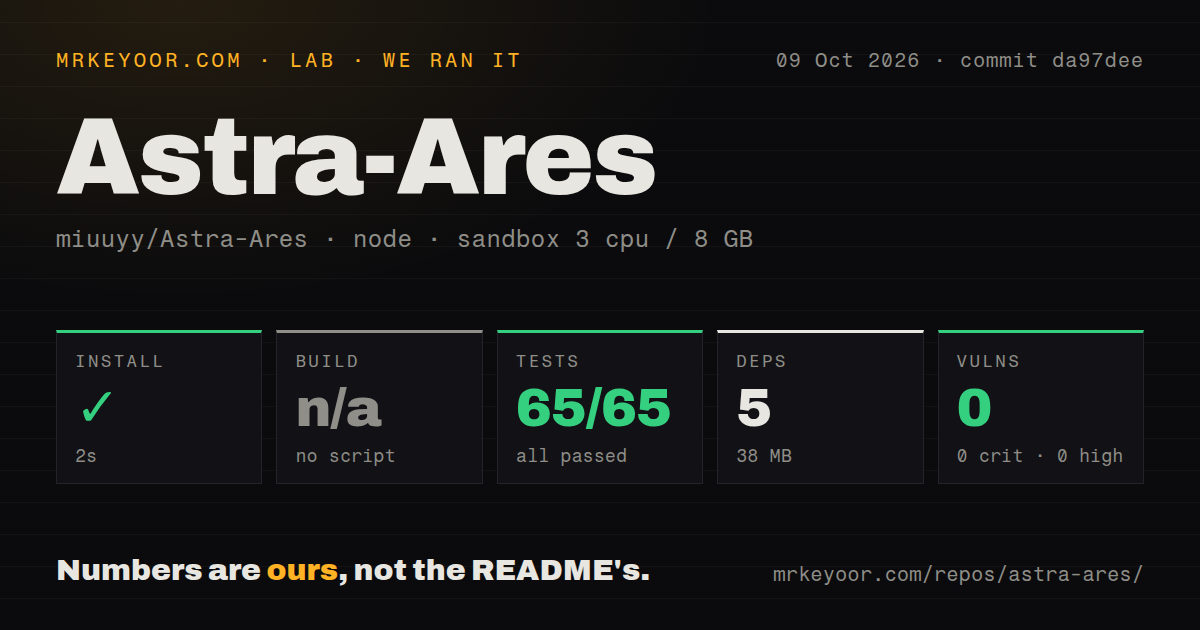
Our sandbox installed Astra-Ares at commit da97dee in 2 seconds, adding 5 packages and using 38 MB on disk. We ran it on October 9, 2026, in a fresh Debian container using lab-node:22, with 3 CPUs, 8 GB of RAM, no secrets, and no elevated privileges. The checkout occupied 1.2 MB before installation. Those figures describe the JavaScript repository path we exercised.
The node:test step passed all 65 tests in 10 seconds, with 0 failures. No build script or target was available, so the harness skipped that step. Npm audit reported 0 known vulnerabilities. The scan found 2 CI workflow files, a tests directory, and no Dockerfile. These are encouraging local results. They don't establish that the patched native CLI compiled, a live evaluator accepted requests, or adaptive effort reduced spending.
A passing npm suite leaves the native setup ahead
The documented route continues after npm ci: npm run setup downloads pinned Codex source, applies the patch, and compiles a separate executable. You'll need Rust through rustup and a native C/C++ toolchain alongside Git, curl, and tar. npm link then exposes ares and astra-ares. There is no published npm package or prebuilt Ares download in the README's distribution path.
Our 38 MB installed footprint therefore isn't a capacity estimate for a working native installation. The supplied lab result has no native compilation measurement. Mac users may need Xcode Command Line Tools, and Windows users follow separate PowerShell instructions with the MSVC toolchain. Our Node 22 sandbox supports the wrapper requirement, but it can't settle those platform details. Read the validation boundaries before treating a green JavaScript suite as desktop acceptance.
The evaluator receives task context outside Codex
OpenRouter is the default evaluator route and requires a funded API key. Your selected coding model uses its separate Codex login. Ares stores the evaluator credential outside the checkout, with restricted file permissions on macOS and Linux. Windows privacy depends on user-profile folder permissions. The provider configuration also covers Vercel, direct TypeSafe access, and a separately operated local decision service.
The 65 passing tests came from a container without secrets, so they establish no paid-provider access. For actual use, Jev receives a bounded view of the task, public progress, and recent tool results. Private or encrypted reasoning is excluded, while Codex retains its own conversation. If policy forbids sending source snippets to an extra provider, the default route is a poor fit. A local evaluator needs the project's decision protocol, an ordinary chat endpoint won't satisfy it.
Provider failure stops the current turn
Ares records a choice as applied only after Codex acknowledges the native settings. It can reuse an accepted choice across subsequent generations, and new user input or tool failure triggers reassessment. The selected model still connects directly to OpenAI. That arrangement gives you a readable distinction between an evaluator recommendation and the effort actually used, without inserting the evaluator into the coding model's request route.
The fresh install added only 5 packages, but runtime dependency also includes evaluator availability. Exhausted provider errors stop the current turn visibly. Ares doesn't silently change providers or manufacture an effort setting. That is sensible behavior for an experiment where you need trustworthy records. It also means an evaluator outage can interrupt coding. Developers who prefer fewer failure points should keep ordinary Codex with a manually selected effort.
Recent issue work matters more than the missing release
The last push was October 7, 2026. GitHub showed 305 stars and 2 open issues and PRs, with issue and pull-request updates on October 10. The latest-release endpoint returned no published release. Taken together, these facts describe a small project receiving attention, with source-based distribution. The missing release alone gives no reason to call it abandoned.
Our 10-second test run is stronger evidence about local mechanics than about sustained use. Closed issue 13 reports hidden background generations triggering extra Jev decisions. Its closed status doesn't tell us whether the measured commit contains a remedy. Open issue 15 and its linked documentation proposal discuss another evaluator route. Read those threads for integration context, and keep the reporter's observations separate from our sandbox results.
Fixed effort is the easier choice until savings are measured
The README explicitly says workload cache hit rates and savings against fixed effort haven't been measured. That qualification determines my recommendation. Choose upstream Codex if you want its ordinary setup and can select effort yourself. OpenCode is another terminal-agent option when you're willing to change the agent rather than patch Codex. Neither is a direct replacement for this experiment's native effort controller.
Astra-Ares earned a closer look with a 2-second npm install and 65 passing tests. For adoption, use a representative coding task and compare completed work, evaluator charges, and interruptions against your usual fixed effort. Keep the decision logs private because the task context leaves the agent for evaluation. Until that comparison supports the extra service and patched executable, I'd keep Ares in an experimental profile beside the CLI I rely on.