APEX implements one decoder layer, not a complete inference chip
APEX turns the main operations of a transformer decoder layer into RTL: matrix work, attention, online softmax, RMSNorm, rotary position encoding, residual paths, SwiGLU, and a compressed key-value cache. One matrix engine is reused across the layer's jobs, while a sequencer and routing fabric move intermediate values. This is a focused hardware architecture, not a board you can buy or a server daemon you can deploy. The README explicitly excludes a DRAM controller, PCIe, and a network-on-chip from the tile's charter.
The project also draws a useful line between model sizes. Qwen2.5-0.5B is the model demonstrated through the FPGA path described by the repository. Qwen2.5-7B tokens have run through the software-verified golden pipeline, while the architecture is sized around 7B-class dimensions. Those statements are related but not interchangeable. Engineers evaluating APEX should follow each number back to its result artifact and ask whether it came from Python, RTL simulation, placed hardware, live FPGA execution, or a projection for a surrounding chip.
Our 8-second build exercised Python, not the FPGA toolchain
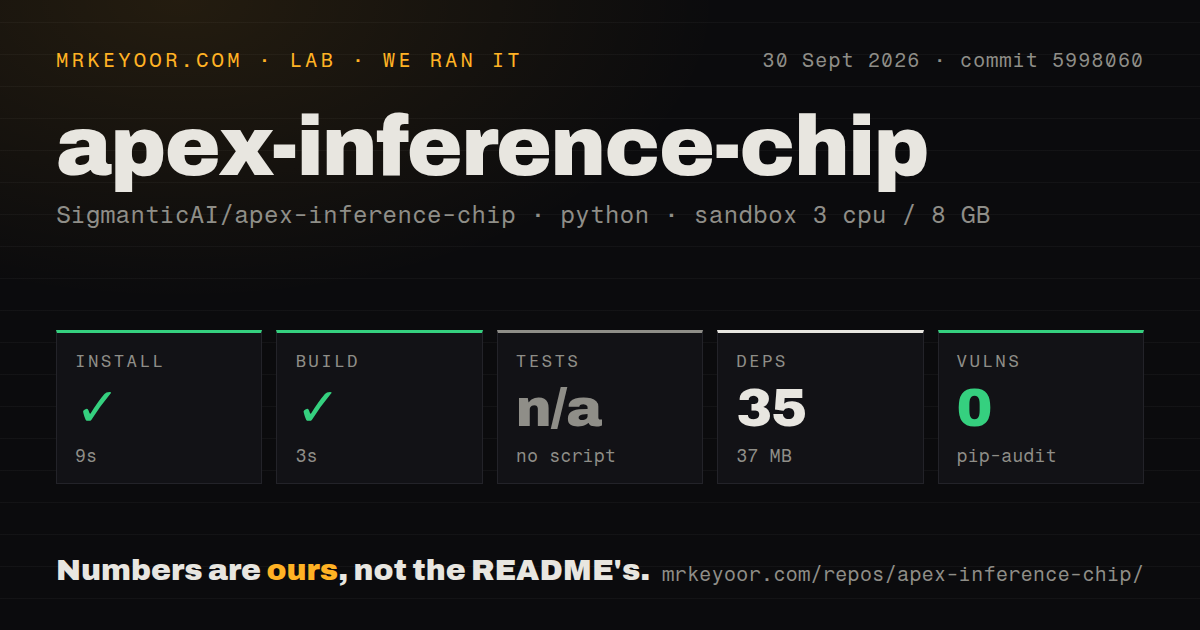
Our sandbox cloned commit 5998060, installed 35 Python packages in 15 seconds, and used 37 MB for them. The configured build succeeded in 8 seconds. pip-audit found 0 known vulnerabilities. The harness exposed no test script or target, so it skipped tests. These results show that the detected Python layer is easy to prepare in a fresh container; they do not reproduce bit-exact RTL checks, synthesis, place and route, or a live model on FPGA.
The source tree contained 1,033 files, about 77,787 lines of source, and occupied 51.1 MB. That is compact next to a full compiler stack, yet the tooling surface is specialized. APEX contains a NumPy golden model, RTL, simulation infrastructure, generated vectors, FPGA scripts, design records, and result folders. The AWS path needs suitable credentials and spending controls. The Lattice path needs the matching device and open hardware tools. No Dockerfile fixes those environmental choices for the reader.
KV compression sits inside the attention datapath
The main architectural idea is to store key and value data in compressed form rather than keeping an fp16 copy beside the accelerator. APEX describes per-channel INT4 keys, per-token INT4 values, an fp16 outlier lane, and precision tiers driven by token-importance tracking. Compression occurs after rotary position processing and before cache storage; decompression feeds attention reads. Metadata, padding, scales, and outlier costs are meant to count toward the claimed storage ratio instead of disappearing from the calculation.
That focus makes APEX more interesting than another matrix-engine example. Long-context decoding increasingly spends effort moving cached state, and the repository addresses that traffic in the hardware path itself. Still, the design choice must be judged with its accuracy and implementation evidence. The README points to evaluations using the verified codec and separates those software results from FPGA proof. Readers should resist collapsing a codec accuracy result, a routed frequency, and a full-chip throughput projection into one performance claim. They answer different questions.
Verification evidence is organized by execution boundary
The repository's method starts with an executable NumPy model, freezes vectors, compares RTL bit for bit, deliberately mutates hardware to test whether benches fail, and replays hardware jobs in simulation. Status and traceability documents are presented as the source of generated counts and known gaps. That structure is valuable because accelerator repositories often mix aspirations, simulation, and silicon in a single table. APEX instead labels host-mode hardware, walked-layer simulation, and ongoing walked-attention bring-up separately.
Our standardized run found no test target, despite the repository documenting its own verification commands and artifacts. Both facts can be true: the project has a custom evidence system, while it does not fit the generic Python test entry point our harness looked for. The repo has one GitHub Actions workflow, no tests directory, and no Dockerfile. A prospective contributor should begin with STATUS.md and the reproduction instructions for one named artifact, then confirm that the produced log matches the claim being evaluated.
An August push without issues or releases limits health evidence
GitHub recorded the last push on August 18, 2026, with 594 stars and 0 open issues or pull requests. The API returned no issue history in the requested list and no latest release. A recent push shows that the source was current this month, but an empty public tracker gives little evidence about response time, outside adoption problems, or how design disagreements are handled. The absence of reports should not be scored as the absence of defects.
Our successful 15-second install makes the reference layer approachable, while meaningful verification remains hardware work. Gemmini is a better fit for teams wanting a configurable accelerator generator inside a RISC-V research system. NVDLA supplies a broader neural-network accelerator design. APEX earns a place on the reading list when transformer decode, compressed context memory, and evidence provenance are the question. Wait for a fuller system and a clearer release history if the decision involves production capacity or procurement.