AirLLM swaps GPU memory pressure for disk traffic
AirLLM solves one narrow hardware problem: a model can be much larger than the memory on your graphics card. Instead of keeping every weight on the GPU, it moves one layer at a time. Sparse mixture-of-experts models can load only the expert selected for a token. The README says this lets a full-precision 70B model run in about 4 GB of VRAM, though that figure is the project's result, not one we reproduced in our CPU-only sandbox.
This design changes which resource stops you. GPU capacity matters less, but the original weights still have to be downloaded and split into layer files. Those files then travel through storage during generation. The FAQ calls disk loading the main bottleneck, and the quick start warns users to leave enough room in the Hugging Face cache. AirLLM is therefore a way to make an otherwise impossible model run, not a way to make it respond like a normal in-memory server.
One Python call hides a large model preparation job
The basic API is short. Install airllm, pass a Hugging Face repository ID to AutoModel.from_pretrained, tokenize a prompt, and call generate. AutoModel selects an implementation for model families including Llama, Qwen, DeepSeek, Mistral, Phi, Gemma, ChatGLM, and others listed by the project. A local model path also works.
First use is heavier than that snippet suggests. AirLLM downloads the original model and decomposes it into layer-wise files before inference. A 70B checkpoint is still a 70B checkpoint on storage. The delete_original option can remove the first copy after conversion, and layer_shards_saving_path can place the converted files on another volume. For gated models, you also need a Hugging Face token with access to the weights.
Compression is optional. The project can store weights in 4-bit or 8-bit form through bitsandbytes, which reduces disk movement at the cost of changing weight precision. That is a different proposition from the headline full-precision path. Decide which claim you care about before comparing AirLLM with a GGUF runtime, because a compressed AirLLM model and an unquantized streamed model solve the capacity problem differently.
What happened when we ran it
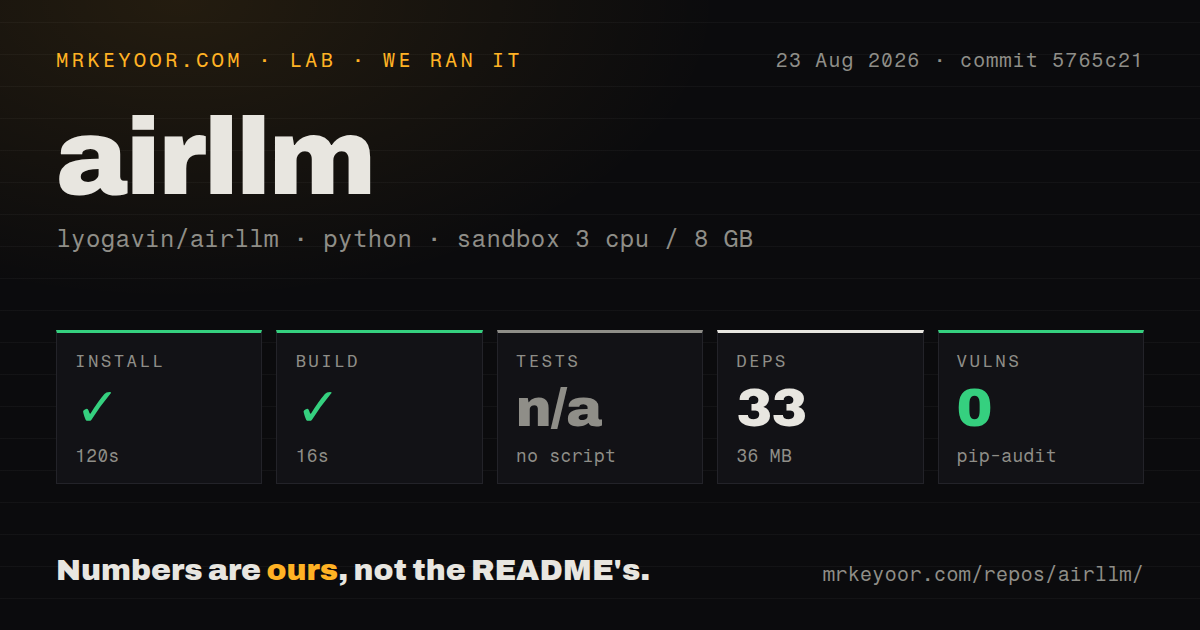
Our run installed AirLLM in 120 seconds inside a fresh Debian container with 3 CPUs and 8 GB of RAM. It pulled 33 packages and occupied 36 MB on disk before any model weights. The package build succeeded in another 16 seconds, and pip-audit reported 0 known vulnerabilities. Those results make the Python package itself look manageable.
The repository had no tests script or target, so the lab skipped tests. It also had no tests directory, though it contained 2 CI workflow files. That absence limits what the successful build tells us: the package assembled, but the repository did not give our harness a suite that could check model loading or generation. We did not download a large model or claim an inference measurement from this sandbox.
The 36 MB install is consequently the smallest part of the commitment. Model weights and generated shards can dwarf it. Issue #351 reports that a 3 GB model repeatedly created shards until they consumed as much as 50 GB. That is one user's report rather than our result, but it lines up with the README's warning that splitting is very disk intensive. Use a monitored scratch volume for the first conversion.
New architectures can fail at checkpoint parsing
The README describes wide model coverage, yet two August 2026 reports show where generic support breaks. Issues #340 and #345 concern recent Gemma variants whose checkpoints nest the language model under another module. AirLLM's layer parser expected a flatter name and raised a ValueError while splitting the files. One of those reports includes a proposed fix, but the open issues are enough reason to verify your exact model ID before planning around it.
Model-specific dependency combinations add another wrinkle. The README says Kimi K3 requires compressed-tensors, flash-attn, a CUDA 12 PyTorch build, and Transformers 4.56.x because its remote code does not load on Transformers 5.x. Qwen3.8-27B, by contrast, needs Transformers 5.8 or newer. A single environment may therefore be the wrong unit of deployment if you switch between those examples.
Platform support is similarly uneven. CPU inference is documented, while the main code sample sends tensors to CUDA. On macOS, AirLLM requires Apple Silicon, MLX, and PyTorch. Intel Macs are excluded. There is no Dockerfile in the repository, so reproducible driver and dependency assembly remains the user's job.
Active maintenance does not replace model-level acceptance tests
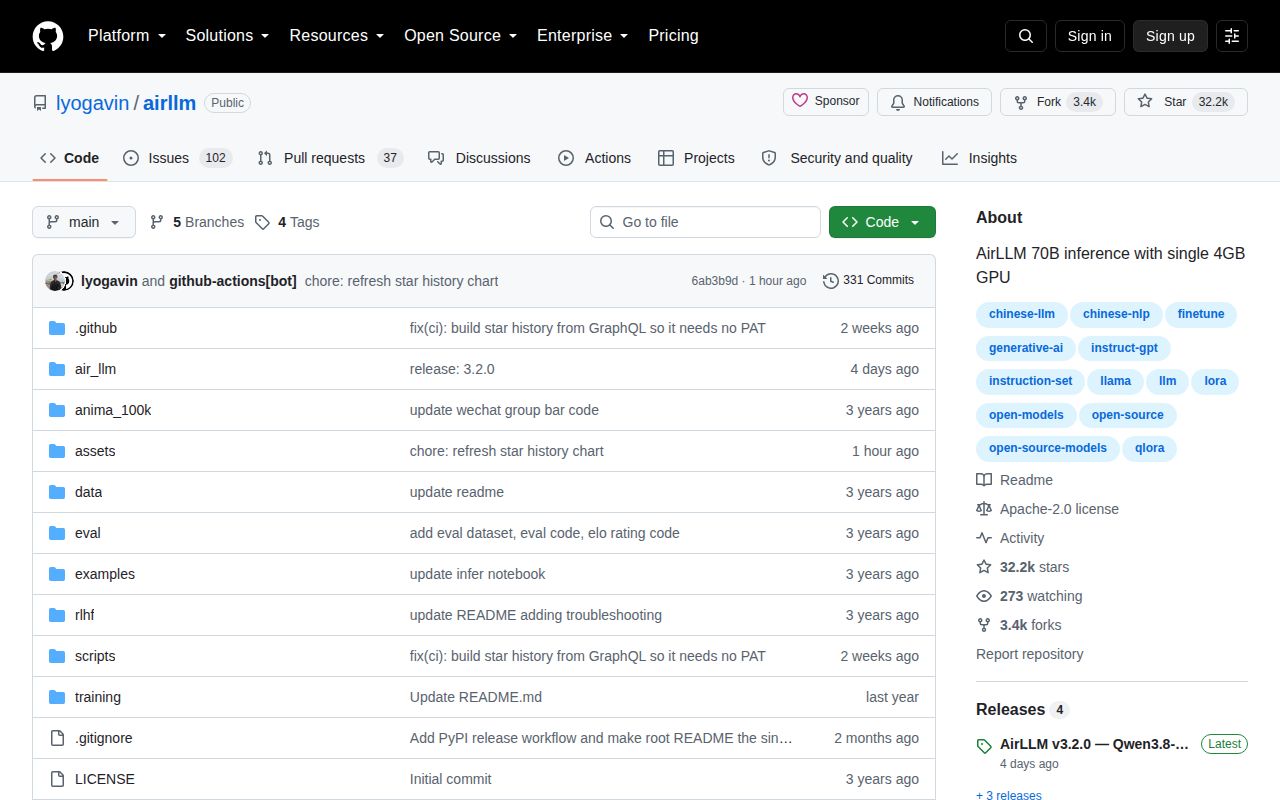
The repository was pushed on August 25, 2026, and release v3.2.0 arrived on August 18. The GitHub queue showed 144 open issues and pull requests, including current work on newer checkpoint layouts and GPU loading behavior. That activity is healthier than a dormant compatibility layer, but frequent model changes mean a green install says little about the checkpoint you intend to run.
AirLLM earns a trial when the alternative is not running the model at all. Start with a small checkpoint, put the cache on a volume with a hard limit, record generation speed, and inspect output before scaling upward. If a quantized model fits in RAM or VRAM, llama.cpp will usually be the more practical local choice. If you need concurrent production traffic, vLLM is designed for that job. AirLLM's best use remains deliberate, low-volume access to weights your GPU cannot hold.