
It is a novel production engine, not just a prompt wrapper
ainovel-cli addresses a real failure mode in AI-assisted fiction: generating a chapter is easy, while preserving plot logic, character state, pacing, and unresolved threads across a long book is hard. Its answer is a deterministic host that routes work among Architect, Writer, and Editor agents, with an Arbiter called only for bounded semantic decisions. That separation is sensible. Code decides what happens next from stored facts, while models handle planning, prose, criticism, and ambiguous judgments. The supplied documentation is primarily Chinese, so English-only users should expect friction unless an English guide exists elsewhere.
What happened when we ran it
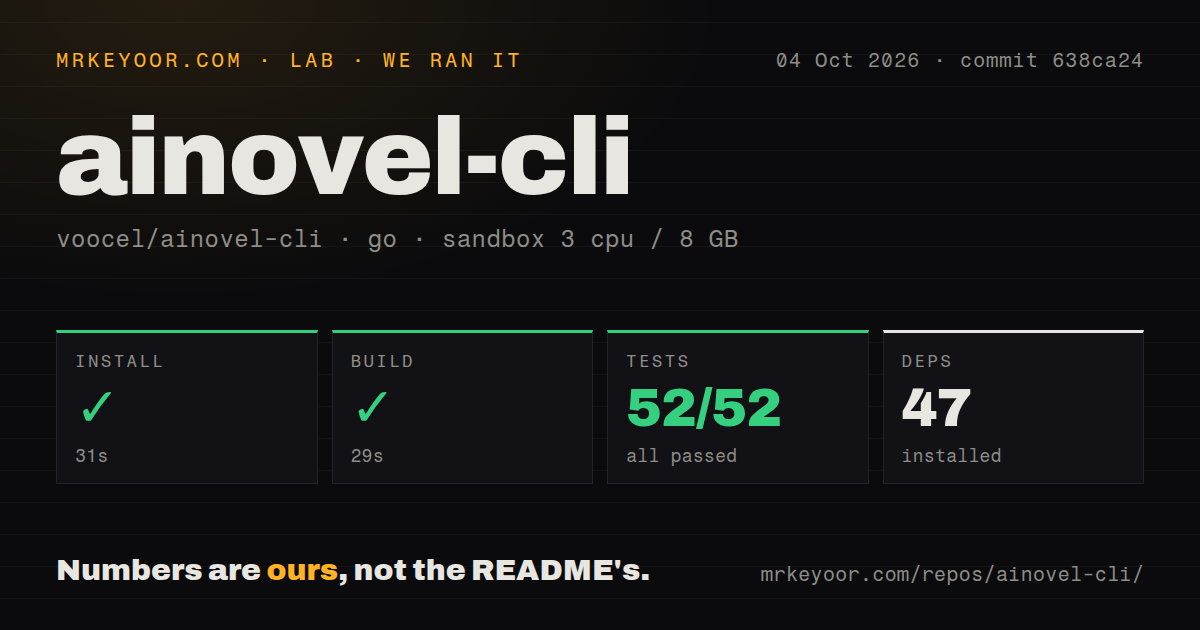
Our run used a fresh, unprivileged golang:1.24-bookworm container with 3 CPUs, 8 GB of RAM, and no secrets. Installation succeeded in 68 seconds and installed 47 packages. The build then succeeded in 31 seconds. The test phase completed in 297 seconds, with 52 passing and 0 failing tests. Those numbers do not measure generation speed or writing quality, since no provider credentials were available and no novel-generation benchmark was supplied. They do show that the repository installs, compiles, and passes its reported Go suite under a clean Debian-based environment.
The strongest ideas are checkpoints and bounded autonomy
The best design choice is step-level recovery. Writer work follows a fixed sequence: load context, reread relevant prose, plan, draft, check consistency, and commit. A successful tool call writes a checkpoint, so a crash should resume at the plan, draft, check, or commit boundary instead of replaying an entire conversation. Chapter commits use a persistent saga and idempotent tools, while Arbiter decisions are written to disk for replay and audit. For long-running, paid model workflows, these are practical safeguards rather than decorative architecture.
Long-form context also receives more care than the usual sliding window. The README describes chapter, arc, and volume summaries, with the most recent 3 chapter summaries kept close and older material compressed into broader layers. Related chapters can be recommended from foreshadowing, character appearances, state changes, and relationships. Planning is similarly progressive: the initial outline starts with 2 volume skeletons and a detailed first arc, then expands later arcs using accumulated summaries and character snapshots. The stated goal of supporting 500-plus chapters is not validated by our measurements, but the mechanisms are aimed at the right problem.
Its engineering is easier to judge than its fiction
The central limitation is evidence. A passing 52-test suite can validate routing, transitions, persistence, and other software behavior, but it cannot prove that a 500-chapter novel stays interesting or that the Editor improves prose. There are no supplied comparisons of completed books, model costs, token usage, time per chapter, or human ratings. The seven-dimensional review sounds thoughtful, yet it remains a model evaluating model-written material. Buyers should run a short representative arc with their preferred supported provider before committing money and time to a full book.
Configuration is another rough edge, and it leaves 1 manual setup step. The TUI guides first-time provider setup, but headless mode does not, so server users must initialize interactively or create ~/.ainovel/config.json themselves. The curl example is convenient, though piping a remote installer into a shell still deserves normal source and checksum scrutiny. The README excerpt is extensive but truncated in the supplied evidence, and its Chinese-first presentation narrows accessibility. There is also no homepage beyond GitHub, leaving evaluation, support, and onboarding concentrated in the repository.
Recent activity is healthy, but cadence is still unproven
The repository has 1,862 stars and 24 open issues, a healthy adoption signal for a specialized Go writing tool without an established homepage. The latest release, v0.7.7, was published on August 25, 2026, and the last push occurred at the same timestamp, only 5 days before this review. A GitHub Trending item also recorded 18 stars in a day. Together, those facts point to active maintenance and current attention. They do not reveal response times, contributor diversity, or a long-term release cadence, so community health looks promising rather than settled.
Version v0.7.7 should also set expectations. The software passed our clean build and test run, and its checkpoint, state-transition, CI, and container signals suggest serious engineering. Still, a pre-1.0 release can change interfaces or stored formats, and unattended generation amplifies small mistakes over many chapters. Keep workspaces backed up, pin a version for long books, and test recovery before depending on it. The 24 open issues are not alarming at this adoption level, but users should inspect relevant reports before choosing a provider or deployment mode.
It fits as an orchestrator around model APIs
In a real stack, ainovel-cli belongs above supported model providers and beside ordinary operational tooling. Run the TUI for supervised creation, or place headless mode under a process manager or container scheduler with persistent mounts for configuration and story workspaces. Capture stdout, stderr, and logs/headless.log separately. Because state lives in files, backups and versioned snapshots are straightforward. The tool is not a local model runtime, publishing platform, collaborative editor, or rights-management system, so those concerns remain external.
The final judgment is favorable but specific: this is one of the more credible autonomous-novel architectures evidenced by a working 31-second build and 52 passing tests, not proof of push-button literary success. Choose it when restartability, auditable routing, rolling planning, and unattended output matter more than sentence-level control. Choose an interactive writing interface when human revision is the main loop, or a local inference project when privacy and hardware control come first. For the right operator, ainovel-cli is a serious foundation that still needs a small paid pilot before a full-length commitment.