Agno combines an agent SDK with the service around it
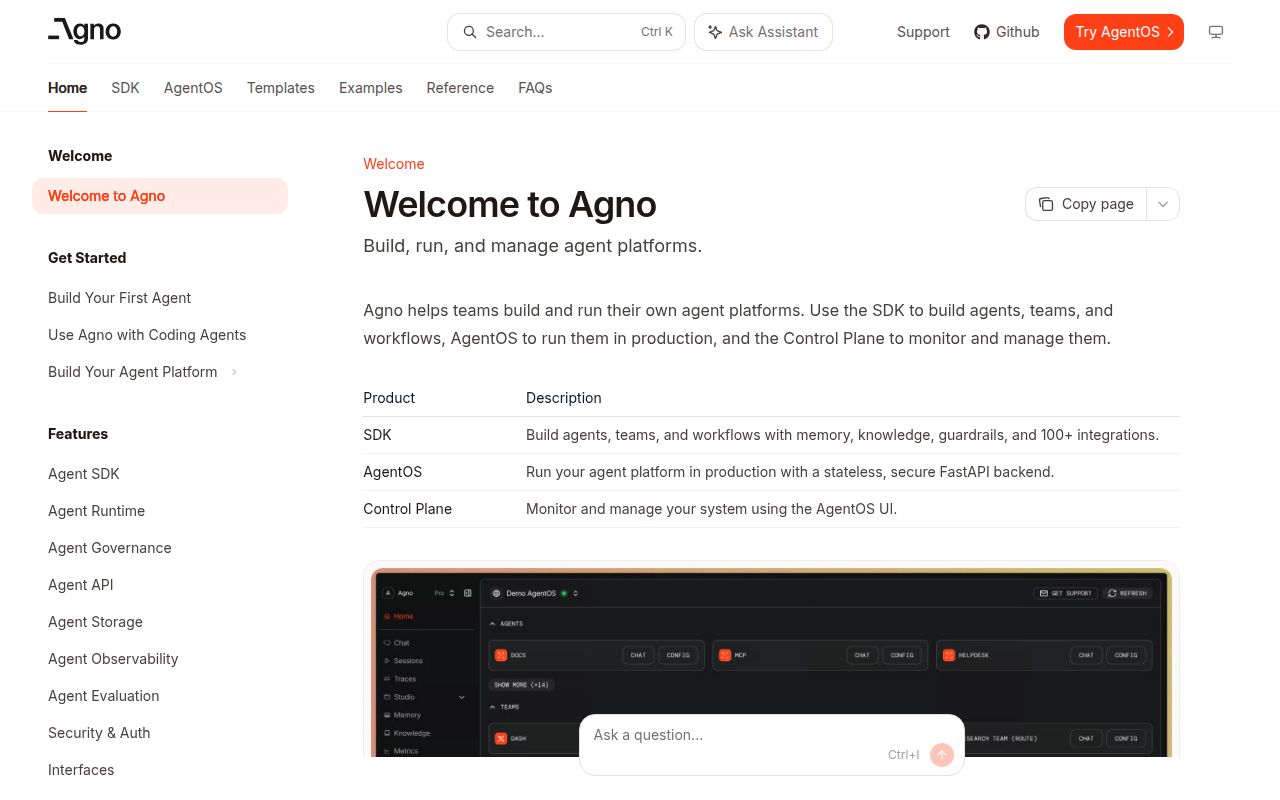
Agno is broader than a library for calling a language model. The Python SDK defines agents and teams, while AgentOS exposes them through a production API and a web control plane. Storage covers sessions, memory, knowledge, and traces. The runtime adds scheduling, human approval, audit logs, JWT-based roles, and tenant isolation. More than 100 integrations connect agents to data and external tools.
That scope solves a familiar transition problem. A prototype can survive as a script with one provider key. A product needs persistent sessions, access rules, observability, background work, and a stable client interface. Agno places those concerns in one project and offers more than 50 API endpoints with server-sent events and websockets. It can also present agents through Slack, Telegram, WhatsApp, Discord, AG-UI, A2A, and MCP.
The starter template creates a platform, not a single script
The README's recommended start is unusual: give a coding agent a prompt that points it to a separate deployment repository. The Railway template creates a REST API, Postgres database, MCP server, and control plane through Docker. Matching starter repositories target plain Docker, AWS, Google Cloud, Azure, Fly, Render, Modal, and Helm. Developers who prefer manual work can follow a 20-line first-agent guide and build upward.
This split is useful once you understand it. The main repository contains the framework and a very large cookbook, while the starter repositories carry deployment choices. It also means a clone of agno-agi/agno is not the whole documented onboarding path. Teams evaluating the project should pick one deployment target, record exactly which template revision they used, and avoid treating an AI-driven setup prompt as a substitute for reading the generated configuration.
What happened when we ran it
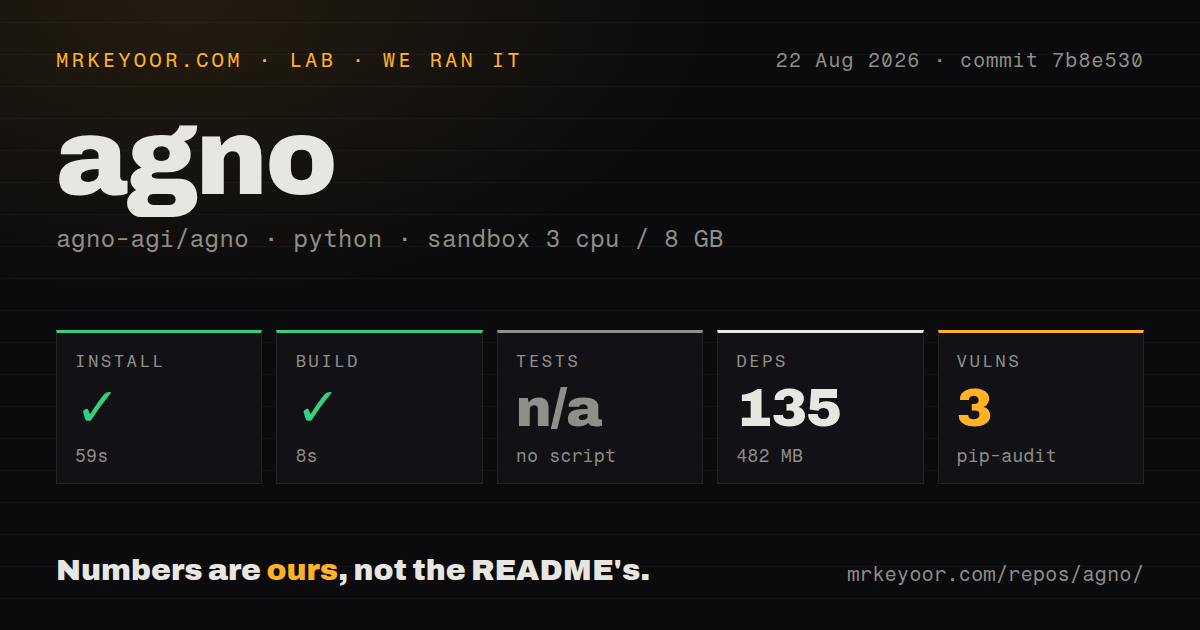
Our sandbox tested commit 7b8e530 in cookbook/00_quickstart/. Installation took 59 seconds, added 135 packages, and used 482 MB on disk. The build completed in 8 seconds. There was no test script or target in that quickstart, so the test step was skipped. pip-audit reported 3 known vulnerabilities.
The checkout itself was much larger: 5,260 files, roughly 896,024 lines of source, and 47.8 MB before installation. It had 7 CI workflow files, but no Dockerfile or tests directory at the measured location. Those figures should frame the result correctly. We proved that one quickstart installs and builds in a clean Python 3.12 Debian container; we did not prove every provider, integration, database adapter, or deployment template works.
The 482 MB footprint is reasonable for a modern Python AI environment, yet it is far from a tiny utility. Audit the 3 reported vulnerabilities against the resolved packages before production deployment. Our lab block does not identify their packages or severity, so no stronger conclusion is justified. Pinning the tested dependency set and rerunning the audit in the final image is the practical next step.
Owning the data still requires external model credentials
Agno says users can control their data, memory, and security posture. Self-hosted Postgres and the runtime support that aim, but most useful agents still call a model provider. Toolkits may also need credentials for GitHub, Slack, databases, or other services. The security boundary therefore depends on which model and tools a team connects, not only on where AgentOS runs.
Telemetry is another explicit choice. The README says Agno sends one event per agent run to help prioritize model providers, while excluding prompts, messages, and outputs. Setting AGNO_TELEMETRY=false disables it. Companies with strict outbound-data rules should set and test that variable in deployment policy. Leaving it to each developer makes behavior differ between laptops, CI, and production.
Human approval can pause runs and restrict tools that need administrator permission. That is useful for agents capable of changing outside systems. It does not decide which actions deserve approval, and a long integration catalog increases the number of credentials and permission scopes an operator must review. Start agents with the smallest tool set they need.
Version 3 is active enough to demand careful upgrades
Agno v3.0.0 was released on 2026-08-24, and the repository was pushed again on 2026-08-25. GitHub reported 1,297 open issues and pull requests combined. The number reflects both user reports and a busy contribution queue, so it is not a defect count. Recent work covered MCP structured content, session caching, tool-hook arguments, Postgres concurrency, and more flexible authorization.
That activity is reassuring for support and risky for casual upgrades. Changes around schemas, stateful tools, storage races, and authorization sit on production paths. Pin versions, exercise the exact database and provider mix in staging, and read migration notes before moving a running service to v3. A same-day patch stream is evidence of maintenance, but it also says interfaces are being corrected in public.
Choose Agno when consolidation saves more work than it creates
A team already juggling separate code for agent execution, APIs, memory, traces, roles, schedules, and chat interfaces can get real value from AgentOS. Apache 2.0 licensing also makes internal and commercial adaptation straightforward. The linked documentation covers each subsystem, and the deployment templates give operators concrete starting points.
Smaller applications should resist adopting the whole surface too early. Pydantic AI is a cleaner fit for typed agent code when you want to select infrastructure yourself. LangGraph suits explicit state machines and durable flows. CrewAI puts role-based agent teams nearer the center. Agno earns its weight when the operating platform is the problem you are trying to solve.