The standalone mesh starts with broad development permissions
Start agentmesh-one on a shared machine and its initial policy lets every enrolled member publish and call every service. The self-hosting guide says to replace that policy before sharing it. This is the first decision that matters with SAM, now called Agent Mesh: you are taking responsibility for which agents may reach which tools. A successful enrollment alone doesn't establish that boundary.
Our measured checkout contained 779 files, roughly 117,097 source lines, and occupied 31.2 MB. The scope explains some of that size: a node sits beside each agent or backend, a control plane issues credentials and holds policy, and routers provide discovery and relay connections. The standalone binary combines the control plane, a router, and a console for smaller deployments. You can try the architecture without starting with Kubernetes.
What happened when we ran it
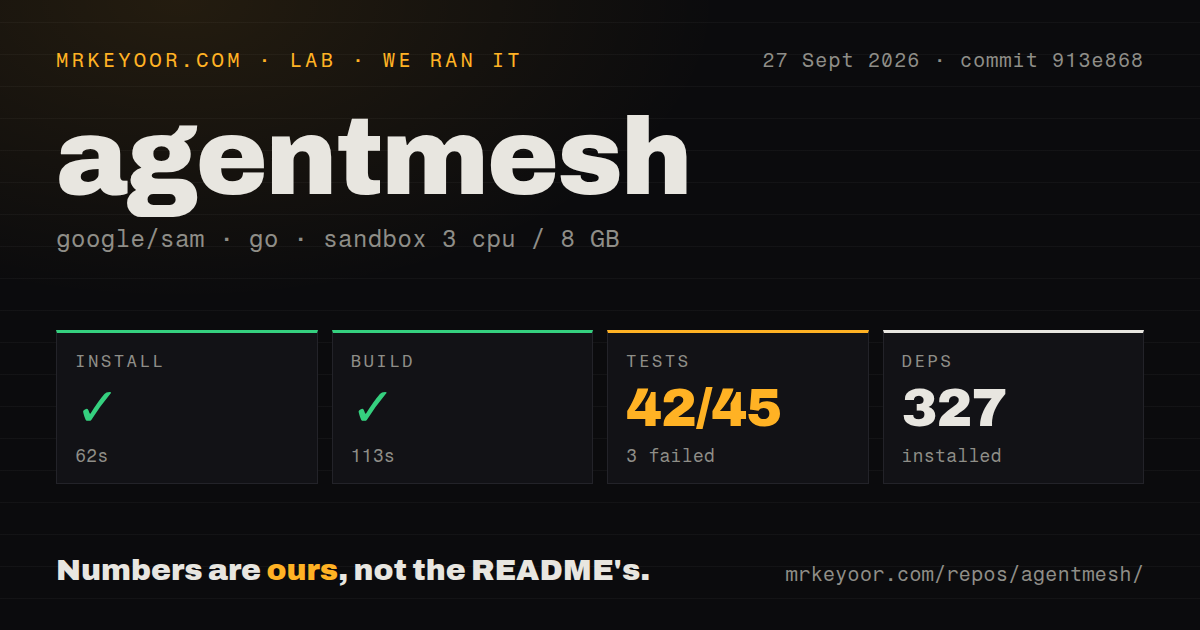
Our run installed 327 packages in 62 seconds and built SAM successfully in 113 seconds. We cloned commit 913e868 on September 27, 2026, into an unprivileged container using golang:1.24-bookworm, with 3 CPUs, 8 GB RAM, and no secrets. Those results establish that the measured source could install and compile in that environment. They don't measure remote tool latency or model throughput.
The test command exited with code 1 after 207 seconds. The lab summary reports 42 passed and 3 failed out of 45 results. Its tail names TestKeyRotationIntegration, then marks github.com/google/sam/tests/integration as failed. Several preceding packages, including secrets, storage, and tunnel, report success. The excerpt doesn't show the failed assertion or identify the other failures. Blaming permissions, unavailable credentials, or missing Debian packages would go beyond the evidence.
The scan found 15 CI workflow files and a tests directory, with no Dockerfile. That shows checking infrastructure exists, but it doesn't change the failed command in our container. We would keep that result on the adoption checklist until a reproducer explains it. Nothing in this run establishes that a current release candidate passes, or that the failure persists after the measured commit.
Local backends stay behind a node and an explicit service grant
The documented Ollama example keeps the model server on loopback and publishes it through a node as a named inference service. Another member calls it through an OpenAI-compatible API. MCP tools follow the same general pattern: publish a service, discover its provider, then call through the node. The destination checks the caller's credential and policy. This fits teams whose tool servers live on machines that cannot all accept direct inbound connections.
For your own mesh, enrollment needs an identity provider or bootstrap tokens that an operator issues. Remote machines require an HTTPS control-plane URL. Keep the standalone data directory on durable storage: it contains the database, router key, and generated tokens. The guide's sharing checklist also tells operators to restrict enrollment and keep administrative tokens out of logs. These are concrete operating tasks beyond the initial node login.
Bootstrap identities can need an operator after an extended outage
The identity documentation explains what happens when a node misses a signing-key grace period. An OIDC node holding a refresh token can enroll again automatically. A bootstrap-enrolled node ordinarily needs an operator to mint another token. Autonomous recovery is available, but disabled by default, and the guide spells out the tradeoff: that node can keep recovering until it is banned. Choose that behavior deliberately for intermittently connected devices.
Our 207-second failed test command named key rotation, which makes this recovery behavior worth checking during a trial. The log doesn't establish a broken rotation design, and the documentation doesn't explain our failure. Keep those claims separate. Exercise the enrollment method you intend to deploy, including a machine returning after an outage, before giving its agent access to a private tool.
The renamed commands still expose a familiar local MCP endpoint
Our Go 1.24 sandbox covered a checkout whose README uses sam-node; the current quick start uses agentmesh-node. Match commands and documentation to the revision you deploy. The current daemon exposes MCP over a token-protected local TCP listener, alongside a Unix socket accessible to your user. An existing MCP client can use that endpoint to discover and call remote tools without becoming a native mesh participant.
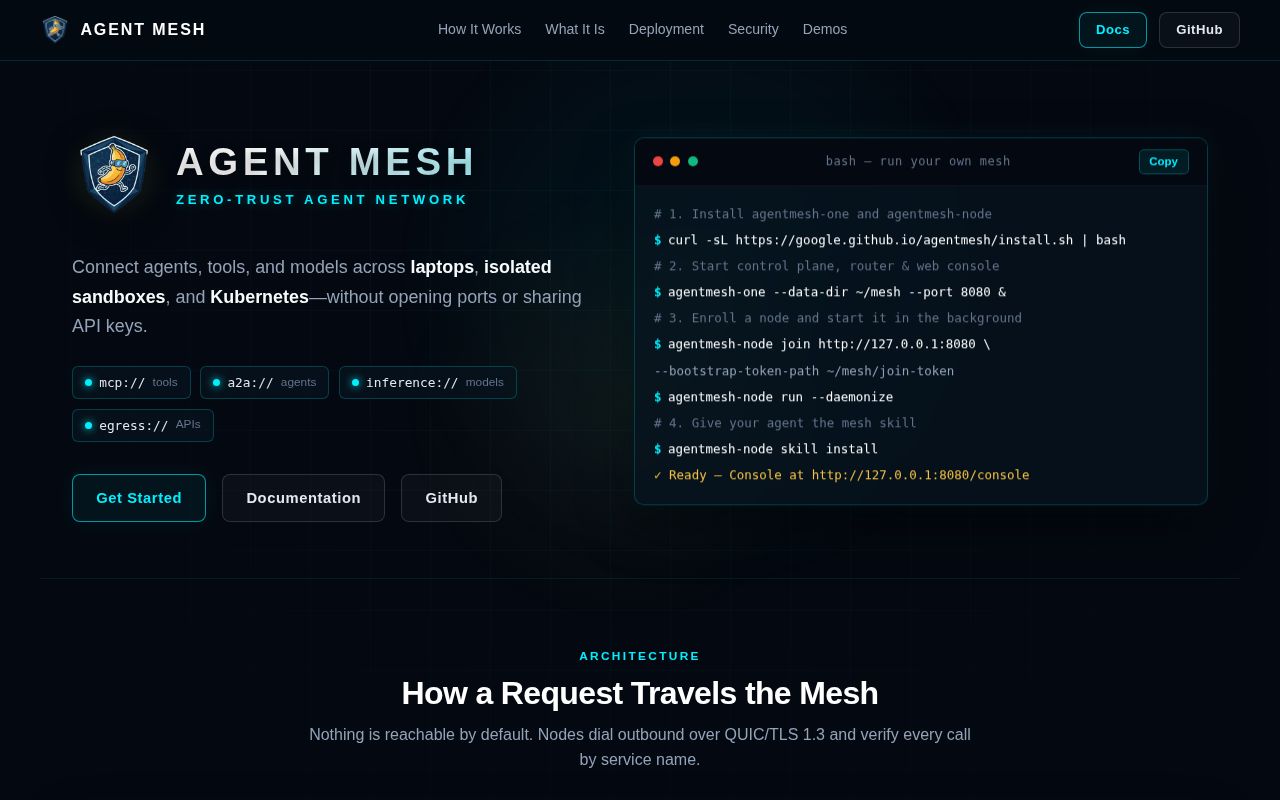
The supplied skill teaches an agent the discovery and calling workflow. Its installer writes into Claude Code's skills directory, among other supported locations, and the guide still requires you to register the MCP endpoint. Interactive enrollment needs a person. That's a useful boundary for a laptop assistant: the skill can manage ordinary node use after enrollment, while the owner chooses the mesh it joins.
October activity supports a trial, while the testnet remains expendable
GitHub recorded a push on October 14, 2026, with 1,049 stars and 24 open issues and PRs. Release v0.1.0-rc.9 was published October 7. Recent pull requests and health reports show ongoing work, including issue 706, which reported an unhealthy public testnet on October 14. The README already promises no testnet uptime. Neither that service nor Google's ownership should substitute for your own deployment and support arrangements.
Choose Tailscale when private connectivity between machines is enough, or MCP Proxy Server when known MCP servers simply need a shared endpoint. Agent Mesh earns the extra operating work when discovery and permissions across distributed tools are your problem. With 42 passing and 3 failing results in our run, my next step would be a small mesh with harmless tools and explicit grants. Require the failed integration case to be understood before those grants reach anything sensitive.