Agentgateway puts LLM, MCP, and A2A traffic under one policy layer
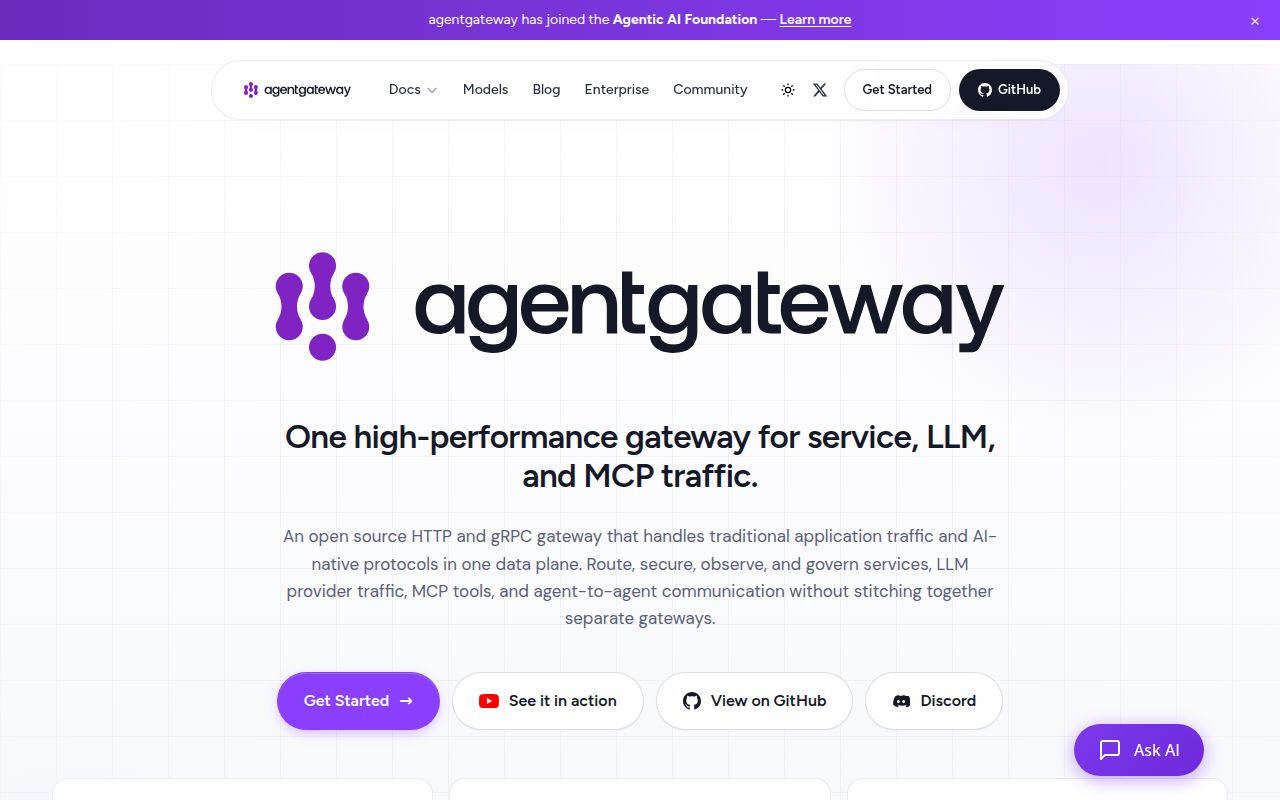
Agentgateway sits between agent applications and the systems they call. On the model side, it exposes an OpenAI-compatible API and routes to providers such as OpenAI, Anthropic, Gemini, and Bedrock. On the tool side, it federates MCP servers across stdio and network transports. A2A support handles communication between agents. The appeal is one place to apply identity, routing, budget, and telemetry rules across all 3 traffic classes.
That is a platform feature, not an application library. A team can add JWT, API keys, OAuth, TLS, CEL-based RBAC, rate limits, load balancing, failover, and prompt filtering without implementing each control in every agent. Model routing can account for GPU utilization, queue depth, cache state, and adapters when used with Kubernetes inference extensions. The gateway does not remove provider behavior differences; it gives operators a common control point for managing them.
Standalone YAML is simpler than the Kubernetes controller
Standalone mode uses flat YAML and ships a built-in interface for exploring connections. Kubernetes mode adds a controller, CRDs, Helm charts, and Gateway API resources. The latter fits organizations already expressing traffic policy through cluster objects. It is too much machinery for a single service with one model provider and a fixed tool list. Start standalone unless Kubernetes ownership is already present.
Feature parity is incomplete. Issue 3136 says standalone had 13 newer native provider types in v1.4.1, while the Kubernetes AgentgatewayBackend CRD exposed only the original set. The reporter routed Mistral through a generic OpenAI adapter, which then attributed cost metrics to the wrong provider. A gateway evaluation should compare required providers and policies in the exact deployment mode, not only read the combined feature list.
What happened when we ran it
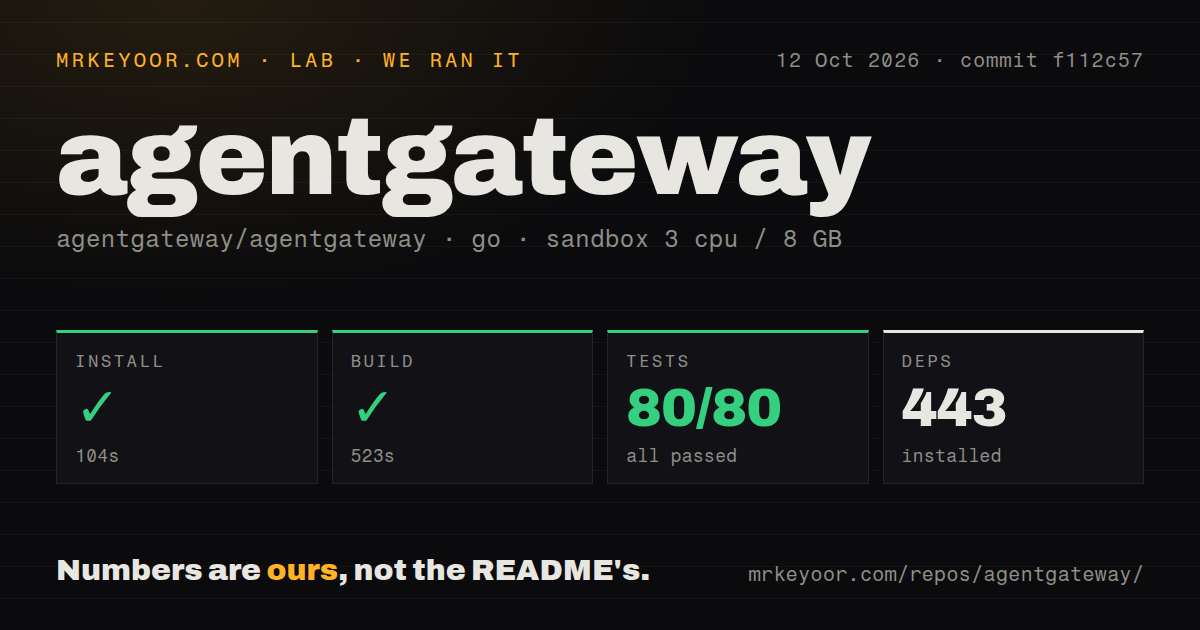
Our sandbox installed 447 Go packages in 95 seconds. The build succeeded in 362 seconds, and the measured tests finished in 193 seconds with 78 passed and 0 failed. This is the only project in this batch whose full test step completed cleanly. The 650 seconds across install, build, and tests also show that source work starts before deployment is configured.
commit 6cb2e9c contained 2,401 files, about 392,255 lines of source, and a 37.9 MB checkout. GitHub identifies Rust as the primary language, while the lab detected and exercised a Go build path. The repository had 4 CI workflow files and a Dockerfile, with no top-level tests directory. Those facts fit a mixed gateway and controller codebase rather than a small single-language proxy.
The sandbox had 3 CPUs and 8 GB of RAM, used an unprivileged Go 1.24 Debian container, and had no secrets. Passing tests do not cover real model keys, OAuth exchanges, Kubernetes policies, remote MCP servers, or upstream timeouts. Run an integration matrix with your providers and identity system before treating the green 78-test result as production evidence.
Version 1.4.1 tightened protocol and authentication behavior
Release 1.4.1 shipped on July 29, 2026. It added MCP Tasks support, validated upstream response types, logged asynchronous MCP errors, and changed fail-open federation so an all-upstream failure returns an error rather than empty success. OAuth token exchange now fails closed when its configured subject token is missing. These are consequential changes for a component that decides which agent requests cross a trust boundary.
The release also carries upgrade work. Standalone LLM and MCP listeners can no longer share a top-level port unless attached to the same gateway. Some custom model-catalog keys need renaming, and OAuth configurations relying on an implicit JWT fallback must select the raw validated token explicitly. Pin the release, read upgrade notes, and test configuration rendering before replacing a running gateway.
Guardrails can block traffic without proving the audit trail
Agentgateway supports regex checks, OpenAI moderation, Bedrock Guardrails, Google Model Armor, and custom webhooks. That range lets an operator choose deterministic or provider-backed checks. A guardrail must be evaluated on false positives, bypasses, latency, and what happens when its service is unavailable. The word guardrail does not by itself establish that unsafe traffic is blocked or that an allowed request is safe.
Issue 3178 reports an audit gap in MCP guardrails at commit 6cb2e9c. A request-phase denial could return a JSON-RPC error to the client while the native access log lacked an MCP error or guardrail decision field. A filtered tool list could look like an ordinary 200 response. Security teams requiring evidence of every deny or mutation should reproduce the case and wait for or carry a fix.
Buffered bodies need a process-wide memory limit
Policies that inspect request bodies must buffer data. Issue 3184 reports that v1.4.1 enforced a per-request maxBufferSize but lacked an aggregate cap across concurrent requests. Under the reporter's held-request load, memory grew with bytes in flight until the process was killed, then recovered. Their numbers describe that issue's environment, not our sandbox, so they should guide a reproduction rather than become a universal capacity claim.
Set conservative body limits, pod memory limits, request timeouts, and upstream concurrency controls. Then hold responses while sending the largest permitted bodies and observe rejection behavior. A proxy should shed load with a controlled status before its memory budget is exhausted. This matters more when CEL rules or guard services inspect full prompts, attachments, or tool payloads.
Active development is both reassurance and upgrade work
GitHub recorded the last push on August 25, 2026. The repository had 4,552 stars and 351 combined open issues and pull requests when fetched. The project is under the Linux Foundation and publishes binaries, container images, and Helm charts. Daily issue and pull request activity shows attention across authentication, telemetry, Kubernetes resources, provider import, and MCP behavior.
Choose Agentgateway when those layers already exist as separate problems. The 78 passing tests support a trial, while the 362-second build, open audit gap, memory-overload report, and standalone-versus-Kubernetes differences set the due-diligence list. If the team only needs a shared model endpoint, LiteLLM or another focused proxy will take less policy and cluster expertise to operate.