The suite keeps the researcher responsible for the paper
Academic Research Skills divides academic work into four Claude Code skills: research, writing, peer review, and a pipeline that connects the stages. Its best decision is stated plainly in the README. The system can search, organize, check, and revise, but the researcher remains responsible for the question, method, interpretation, and central claim. That boundary matters more than the long feature list because a ten-stage agent workflow can otherwise look like a substitute for scholarly judgment.
The repository is large for a prompt-based toolkit. Our checkout contained 2,558 files and about 251,411 lines of source at commit 7ef93e0. Much of that footprint is instructions, reference material, schemas, examples, journal criteria, and validation scripts. A user is adopting a method as much as a package. Expect to learn its vocabulary, including Material Passports, integrity gates, review seats, and cross-model handoffs, before the full pipeline feels predictable.
Four skills cover research, writing, review, and orchestration
The deep-research skill supports guided questioning, literature reviews, and systematic-review work. Academic-paper turns a research brief into a draft while carrying source and style information forward. Academic-paper-reviewer uses several roles to challenge a manuscript, and academic-pipeline owns the handoffs and checkpoints. The README also documents shorter entry points such as /ars-plan and /ars-lit-review, so a user does not have to begin with the whole system.
The useful part is the explicit record keeping. Citation locators, source provenance, revision trajectories, data-access labels, and an experiment intake declaration give later stages something concrete to inspect. If a researcher says an external experiment supports a claim, the workflow can record the experiment identifier and compare the reported result with declared provenance. It does not prove that the experiment happened or that the result reproduces, and the README says so. That is an unusually important limitation to put in writing.
The integrity controls reduce risk without proving correctness
The project documents citation existence checks, claim-to-source review, methodology checks, figure inspection, and reporting conformance. An optional claim audit fetches cited sources and can refuse output when support is missing. The pipeline also uses human checkpoints and can ask another model to inspect selected work when the user enables and funds that path. These controls make fabricated or mismatched citations harder to carry unnoticed into a manuscript.
They do not establish research validity. The included post-publication audit is a sobering example: it reports 21 problems among 68 references after earlier review rounds had passed them. The maintainers use that result to justify external verification, and users should take the same lesson. A green pipeline is evidence that the declared checks ran, not evidence that a paper is true. The README also says current live reviewer profiles remain uncalibrated and that some measured-profile application is not wired.
What happened when we ran it
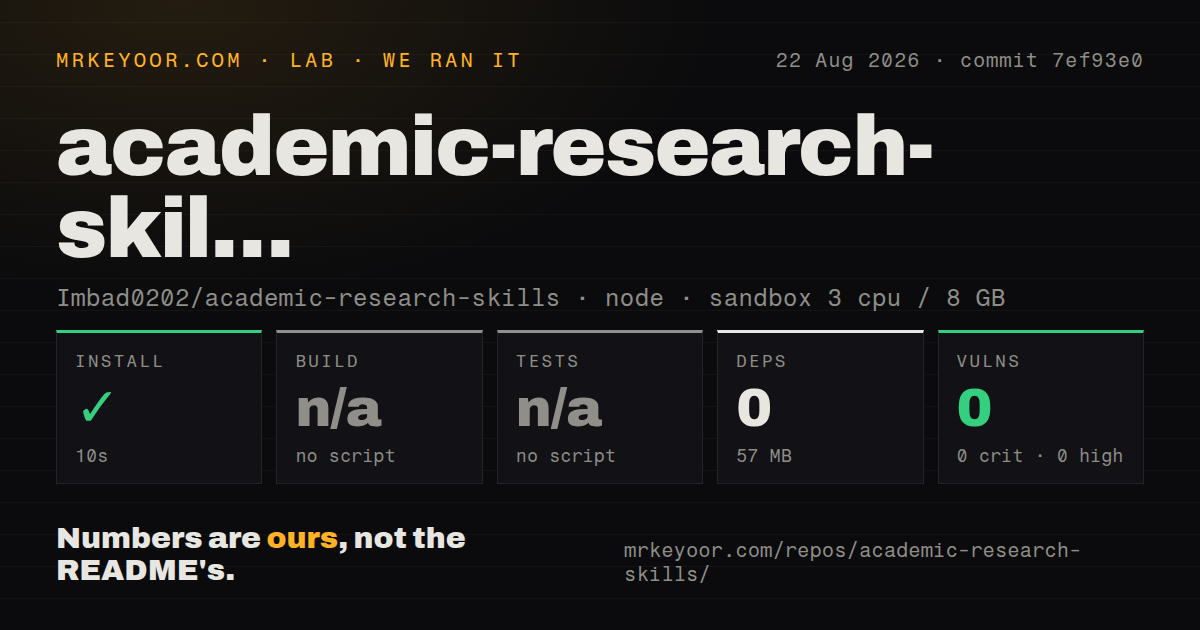
Our sandbox installed the repository in 10 seconds at commit 7ef93e0. The install added 0 packages and occupied 57 MB on disk. There was no build script or target, so the build step was skipped. There was also no test script or target, so our harness could not run the repository's checks. npm audit reported 0 known vulnerabilities.
Those results describe packaging, not research quality. The checkout has a tests directory and 14 CI workflow files, but neither fact supplied the standard Node test entry point our run expected. A prospective maintainer should inspect the repository's own validation commands before changing a skill. A normal end user can install through Claude Code's plugin marketplace and try /ars-plan without compiling an application.
PDF output and guarded writes add platform requirements
The short install is genuine for the core prompt workflows. A recent Claude Code installation and an Anthropic account or API key are the main requirements. Output ambitions change the setup. DOCX generation can require Pandoc, while APA-style PDF work can require tectonic and the documented fonts. Optional cross-model review needs another model provider and sends approved material outside the primary Claude session.
Windows has a sharper edge. Some optional features need a real Python interpreter rather than the Microsoft Store placeholder. The write-scope guard is launched by a POSIX shell script, so Git Bash is required for that protection. Without Git Bash, the README says the guard is inactive and PowerShell produces a hook error per call. Core skills still work, but a lab choosing the guard for safety should verify it rather than assuming the hook loaded.
Claude-specific machinery limits portability
Claude Science can import four skills from the repository, yet the import is a point-in-time snapshot. Slash commands, hooks, and subagent orchestration do not transfer. Pi has a community-maintained wrapper with documented limitations. Codex users are directed to a sibling repository packaged for that environment. This is sensible disclosure, though it means the advertised pipeline depends heavily on its host rather than being a neutral research format.
Licensing deserves equal attention. The badge and README specify CC BY-NC 4.0. That is easy to miss in a repository full of technical material, and it is not the same commercial permission developers expect from MIT or Apache 2.0 code. A company planning to fold these workflows into a paid research product should settle the license question before customizing hundreds of files.
Active development is paired with unfinished evaluation
The repository was pushed on 2026-08-24, and release v3.21.1 was published the same day. GitHub listed 18 open issues and pull requests combined. Open work includes a frozen outcome-level manuscript study, reviewer calibration, prompt-injection behavior, and inquiry-state design. Those topics show active maintenance, but they also identify evidence the project does not yet have.
Use Academic Research Skills when you want visible checkpoints, source records, and a human decision at each consequential stage. Start with one bounded task and inspect every artifact it creates. Researchers looking for autonomous authorship, a host-neutral workflow, confirmed outcome improvements, or commercial reuse under a permissive license have concrete reasons to choose something else.