The download button depends on a trusted interception certificate
wx_channels_download does more than parse a shared URL. On first run it installs a root certificate, starts a local proxy, and modifies WeChat Channels responses so the interface gains a download button. Its certificate guide says this changes the system's global trust chain and tells cautious users to provide their own root certificate. That warning should decide whether you install it on a daily work machine.
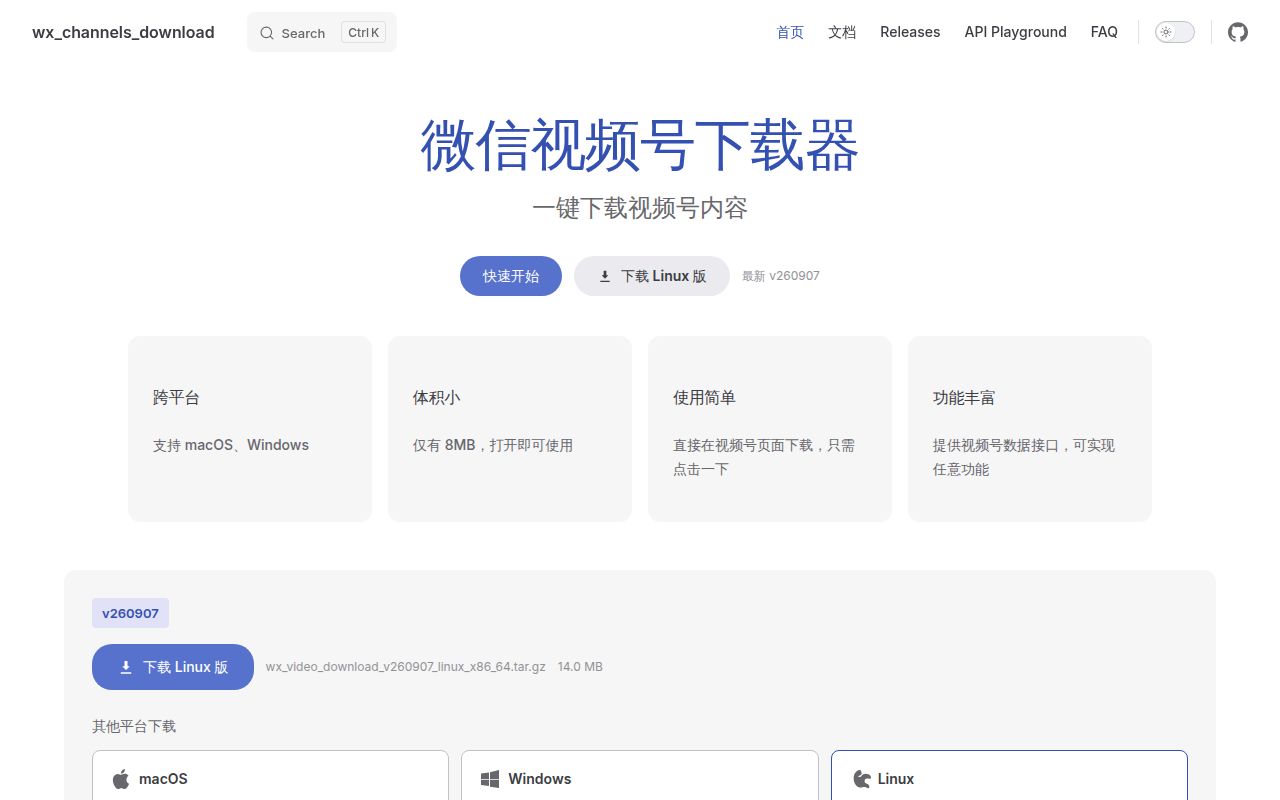
The ordinary flow is direct once interception works. Open a Channels video in the WeChat desktop client, let playback begin, pause it, and click the injected button. A menu can request another quality instead of the currently playing default. The docs also show floating controls when the inline button does not appear. Release v260907 added original-video support and expanded downloads to Bilibili, YouTube, and Kuaishou.
Batch queues run 3 downloads at a time
A creator page gets a batch-download control that creates tasks for the available posts. The documentation says the queue runs 3 tasks at once and leaves the rest waiting. Live capture is marked experimental and requires FFmpeg; its menu can copy the generated FFmpeg command to the clipboard. These are useful archive features, but permission to view a video does not automatically grant permission to republish it. The project's own disclaimer tells users to obey applicable law.
Open reports put boundaries around automation. Issue 562 says an original-video request fell back to the lowest-quality file. Issue 565 says automatic download failed when a Channels video was opened from an official-account article, even though injection and manual clicking still worked. Issue 571 reports that an unfiltered, unrotated stdout log reached 240 GB during a 2-hour batch job. These are user reports, not failures reproduced in our sandbox, but each affects unattended use.
What happened when we ran it
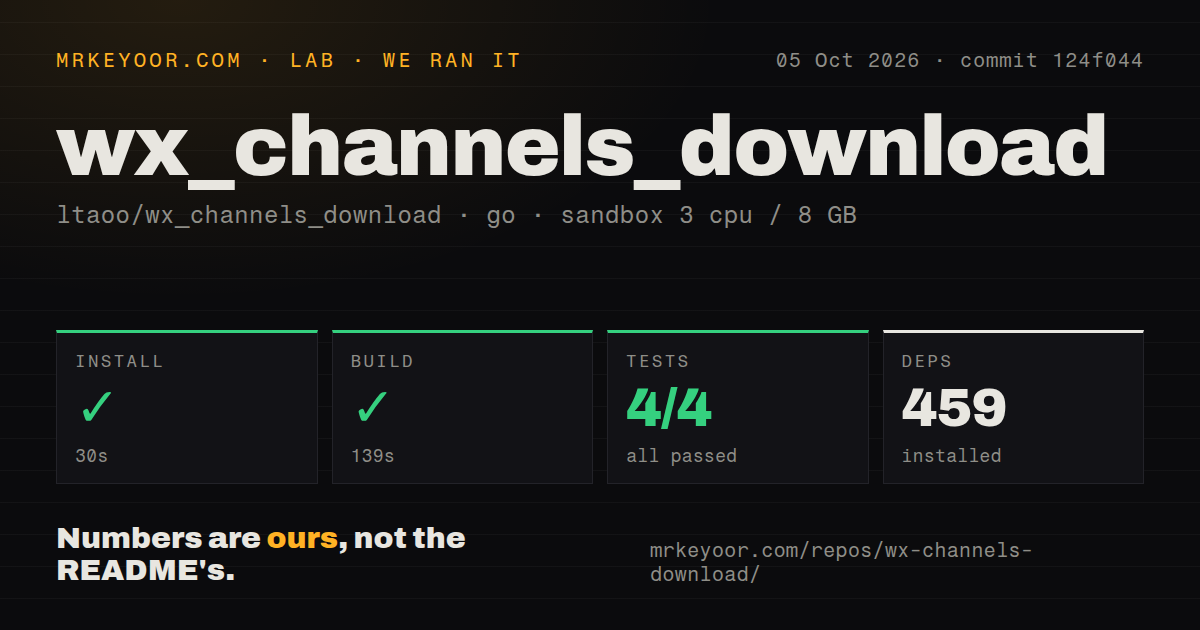
Our sandbox installed commit 124f044 in 30 seconds and added 459 packages. The checkout had 855 files, about 198,009 lines of source, and occupied 15.2 MB. The Go build completed successfully in 139 seconds. This was a fresh unprivileged Debian container with 3 CPUs, 8 GB of RAM, and no secrets.
The test step passed in 21 seconds. Go reported 4 passed and 0 failed out of 4. That is a clean result, although 4 cases cover very little of a tool that touches certificates, proxies, WeChat pages, encrypted media, storage, browser controls, and several operating systems. Our run did not install a root certificate, launch WeChat, intercept traffic, download a video, or test media quality.
Runtime setup is more sensitive than the 139-second build
Windows can install the certificate and configure the system proxy on first launch. macOS requires one initial sudo run, and the guide documents Gatekeeper approval. Linux uses a downloadable binary with TUN mode enabled in config.yaml, then starts under sudo. Manual certificate instructions cover Debian, Fedora, and Arch families, including an extra NSS database step when Chromium-based applications do not trust the system store.
That access level is substantial. A trusted root certificate plus traffic interception deserves the same review you would give a corporate debugging proxy. Inspect the certificate configuration, keep the local service bound appropriately, and uninstall the trust entry when you stop using the program. The lab's 4 passing tests say nothing about whether a particular packaged binary, certificate, or WeChat client version is safe for your machine.
The MCP endpoint can control downloads and read local state
The built-in MCP server gives compatible AI clients tools for application settings, URL parsing, downloads, Channels queries, task status, account data, browsing history, logs, and certificate status. Streamable HTTP uses the main service's /mcp endpoint, while stdio starts a child command that talks to an already running downloader API. Both modes expose the same tools. This is meaningful automation, especially for troubleshooting and queue management.
It also widens the trust boundary. An MCP client can reach local account and history data and can create download work. The documentation names the available access but does not make a public Internet deployment the default. Keep the endpoint local, limit which AI client can invoke it, and review every exposed command before enabling automation. Passing 4 Go tests cannot substitute for authorization checks around that local control surface.
The license blocks selling the software
GitHub's repository API did not identify a standard SPDX license. The checked-in LICENSE combines MIT text with the Commons Clause, which removes the right to sell the software or a product or service whose value substantially comes from it. That restriction means the code is source available but does not carry ordinary MIT commercial rights. A company building a paid archive service should obtain separate permission or choose a genuinely permissive alternative.
The project was pushed on September 30, 2026, and v260907 was published on September 7. GitHub listed 8 open issues and pull requests on October 5, split into 7 issues and 1 pull request. Four CI workflow files and the passing build support a picture of active engineering. The open reports about webtop startup, Apple Silicon containers, logging, injection, and video quality still need checking against your chosen deployment.
Choose it only when the proxy design fits your risk budget
For personal, authorized archiving on a dedicated machine, wx_channels_download has a capable workflow: page injection, quality choices, batch queues, live capture, an API, and MCP control. The build and all 4 available tests passed in our container. The certificate and system-proxy model remains the deciding cost, and the Chinese-only documentation raises the support burden for teams that cannot read it.
nobiyou/wx_channel is worth checking when an MIT license matters. knowing-top/ChannelsDownloader uses Apache-2.0 and focuses on capturing and previewing URLs on Windows and macOS. The Electron alternative also declares MIT. None removes the need to verify that you may save the content, but they change the licensing and desktop tradeoffs. Do not install a global trust certificate merely because this repository compiled cleanly.