More than 1,000 layers make Worldview useful for visual triage
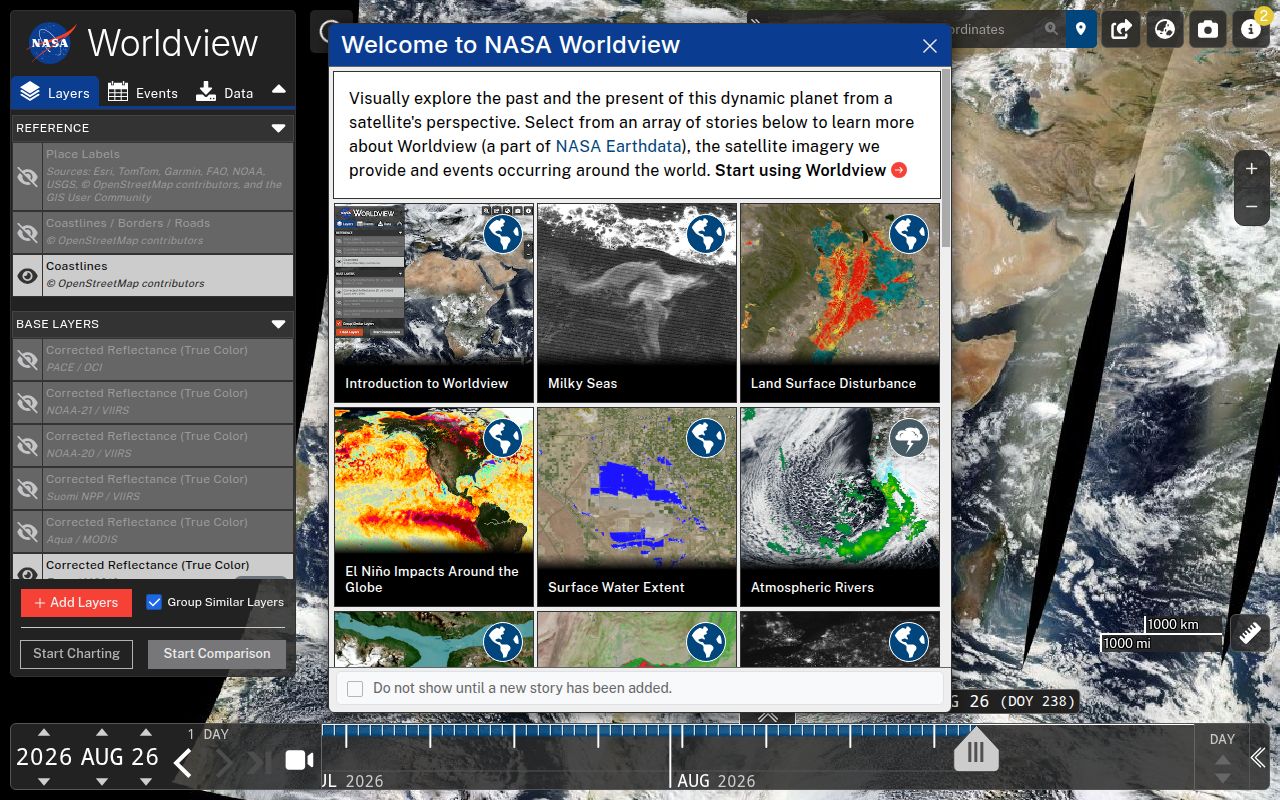
NASA says Worldview can browse more than 1,000 global satellite imagery layers, many updated daily and available within 3 hours of observation. Some records extend almost 30 years, while geostationary layers are offered in 10-minute increments for the latest 90 days. That range is useful for checking a wildfire, smoke plume, flood, or storm before choosing data for closer analysis.
Worldview is a viewing and comparison interface rather than a scientific processing package. Users can change dates, combine layers, inspect metadata, make snapshots or animations, and hand selected data to Earthdata Search. OpenLayers draws imagery delivered by NASA GIBS. If your work starts with calculations, reprojection, or bulk files, Worldview is often the reconnaissance step before a GIS, notebook, or data pipeline.
Node 24.15 and live GIBS metadata make the build environment specific
The checked-out package requires Node 24.15.0 or newer, while the README only says Node LTS. Installation uses npm ci, followed by npm run build and npm start. The build cleans old output, requests GetCapabilities documents from GIBS, generates the active configuration, and produces a development Webpack bundle. Network reachability and upstream metadata are part of a clean build.
Custom deployments copy config/default to config/active, then change JSON for sources, layers, features, tours, and branding. Every configuration change needs another build. The production command builds optimized assets, while npm start serves local development content on port 3000. Operators still need to choose a web server, caching, monitoring, and an update process.
What happened when we ran it
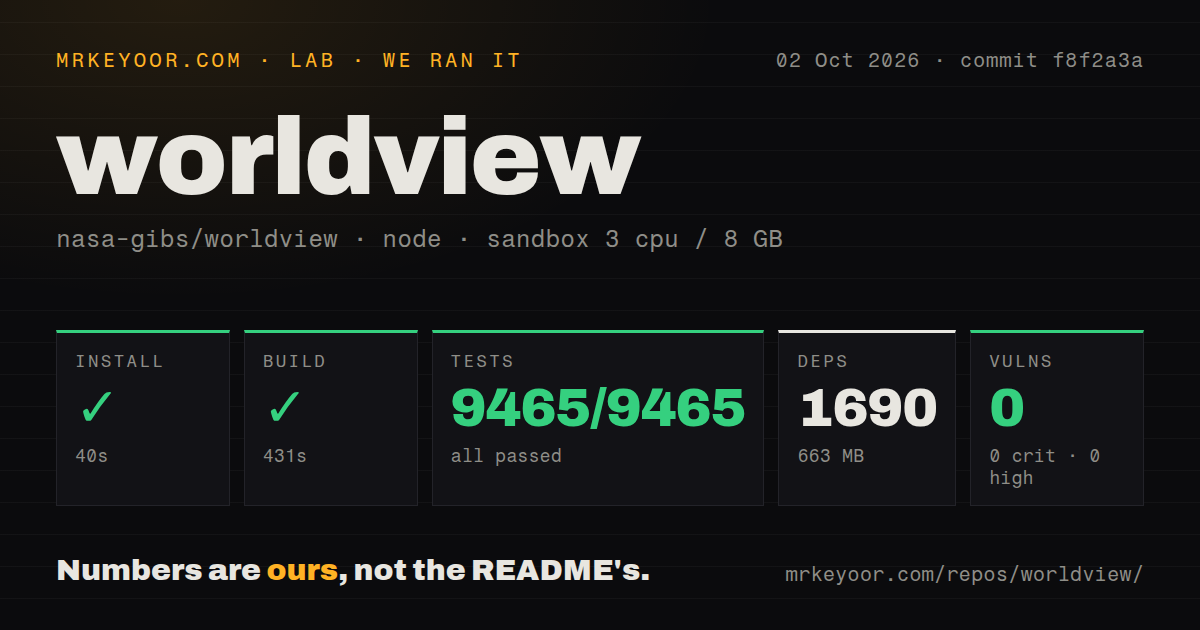
Our sandbox installed 1,680 npm packages in 74 seconds and used 587 MB on disk. The build succeeded in 382 seconds, the slowest step by a clear margin. Tests completed in 209 seconds with 9,477 passed and 0 failed out of 9,477. Npm audit found 0 known vulnerabilities across all severity levels. These figures come from commit 3e0434b in an unprivileged Debian container with 3 CPUs and 8 GB of RAM.
The checkout contained 6,328 files, about 201,726 lines of source, and occupied 145.5 MB before installation. Our scan found 2 CI workflow files and a Dockerfile, although no directory literally named tests. That is a layout signal rather than a lack of tests: Jest discovered 9,477 cases and every one passed. The build also reached the external metadata required by the project scripts during our run.
Worldview v5.2.0 embeds trade controls for a simpler map
The embedding guide for Worldview v5.2.0 says non-NASA sites must request permission before using the hosted application in an iframe. Embed mode removes location search, sharing, projection switching, snapshots, data download, animation export, measuring, extended timeline controls, and most layer settings. It can preserve a chosen view and date, and gives readers a route to the full application. That suits an editorial map better than an interactive analysis product.
Optional features add integration work to a private instance. Natural events use EONET, location search points at ArcGIS's geocoding service, and shortened links require Bitly credentials. Google Tag Manager is enabled in the default feature configuration and can be disabled. Some options need CGI execution on the host. Operators should decide which outside calls belong and keep generated credential files outside public paths.
NASA-1.3 requires more care than Apache or MIT
Worldview uses NASA Open Source Agreement 1.3. Redistribution must include the agreement. A binary or other non-source distribution must also make the source freely available and explain how to obtain it. Contributors must identify their modifications and origin, preserve required notices, and avoid implying NASA endorsement. A company shipping a branded derivative should have counsel read the agreement before choosing this codebase.
The license grants rights to use, reproduce, modify, distribute, display, and sublicense the software under its terms. Worldview documents changing the application name, support address, about text, and a 247 by 45 pixel logo. A derivative is feasible, while the agreement defines how it must be represented and redistributed. Teams wanting an Apache-2.0 foundation for a new portal may find TerriaJS easier to approve.
Two open issues expose a custom-data boundary
GitHub showed 2 open issues after excluding pull requests. Issue 6687 explains that layer metadata is assumed to live at NASA's GIBS endpoint unless a layer is placed in a hardcoded skip list. The reporter patches that list during a Docker build to support internal layers and asked for configuration support. Private WMTS operators may find that map-source configuration does not cover every metadata request.
Issue 6716 concerns incomplete half-open intervals in several GIBS TEMPO colormaps and says the problem may have no effect on Worldview itself. It belongs to the surrounding data service as much as the client. A correct browser can still display confusing source metadata. Production checks should cover selected layers, legends, time ranges, downloads, and projections against the endpoints being used.
The 2026-08-25 push matches an active release process
The last push was 2026-08-25, and GitHub listed 16 combined issues and pull requests. Recent work included interface fixes, dependency updates, and layer changes. The latest published GitHub release was v5.2.0 on 2026-08-11. Its notes covered NOAA-21 aerosol layers, component updates, snapshot repairs, alert display, and NISAR date configuration. Current pull requests and release work show that maintainers are changing the application.
Worldview has been on GitHub since 2014, but the current quality signal is more useful than age. Our run passed 9,477 tests with no failures and found 0 known dependency vulnerabilities. A 382-second build and 1,680 installed packages are substantial for a map viewer. For teams committed to GIBS and Worldview's interaction model, that cost buys tested behavior. Others should first see whether the hosted application already answers the need.