One vector space covers text, images, video, and documents
WeMM-Embedding turns several media types into normalized vectors that can be compared in one retrieval system. The model accepts text, still images, video, visual documents, and interleaved combinations. A dedicated embedding token supplies the last-layer representation, followed by L2 normalization. That is useful for product search, media archives, document discovery, or agent memory where a query and the result may use different formats. Audio is explicitly unsupported.
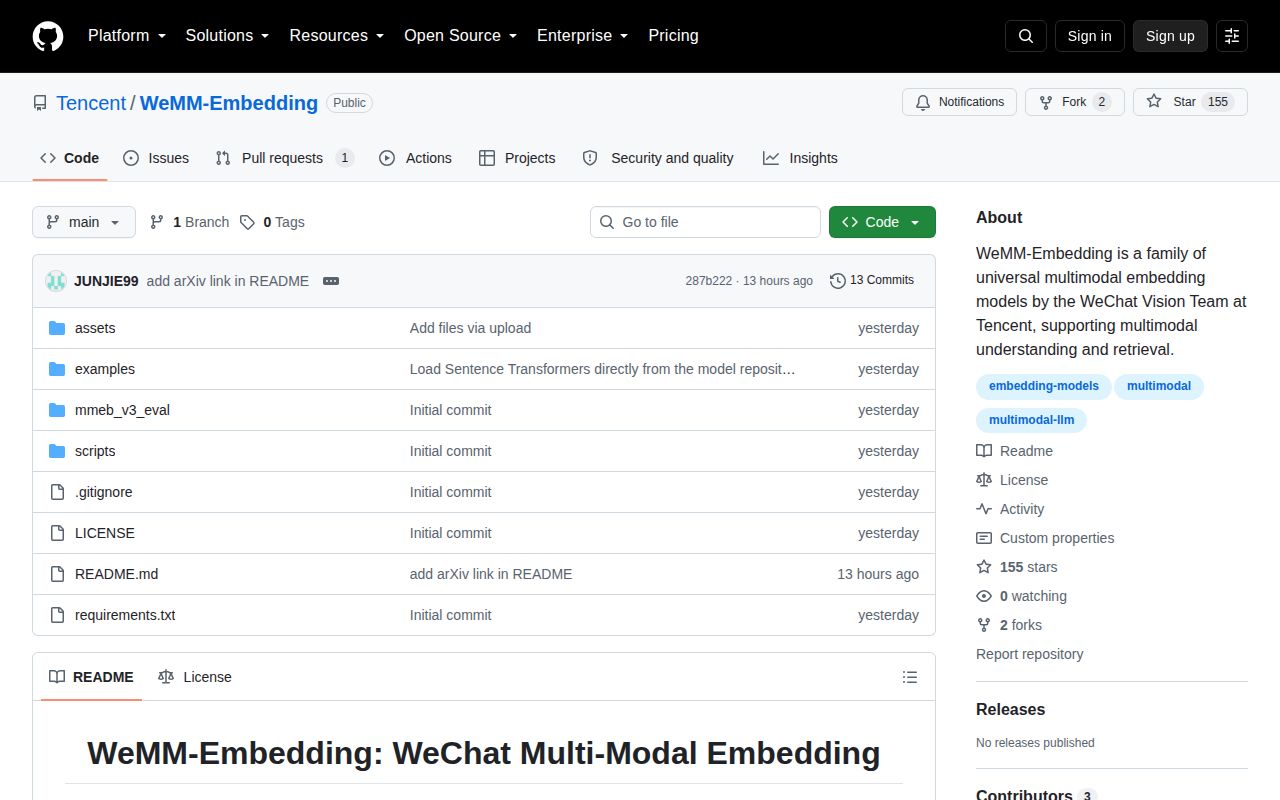
Tencent publishes 2B, 4B, and 9B checkpoints. Our repository checkout was much smaller than those model names imply: 45 files, about 7,524 lines of source, and 1.9 MB. Most of what an operator runs comes from Python dependencies and separately fetched weights rather than bespoke repository code. This is closer to a model release with inference and evaluation glue than a large application platform.
Six vector sizes let storage trade against retrieval quality
Each checkpoint supports Matryoshka representation learning, so an application can truncate the full vector to a documented size and normalize it again. The 2B model offers dimensions from 64 through 2,048, the 4B model reaches 2,560, and the 9B model reaches 4,096. Shorter vectors reduce index storage and comparison work, but the right dimension belongs in an application evaluation, not in a default copied from an example.
The README reports that its 2B checkpoint at 256 dimensions retained 98.7 percent of its full-dimensional image and video result on MMEB-v2. That is Tencent's benchmark statement, not our finding. Our lab did not download the weights or run retrieval tasks. A buyer should repeat the comparison on real query-to-item pairs, especially if document text, screenshots, or long videos dominate the corpus.
What happened when we ran it
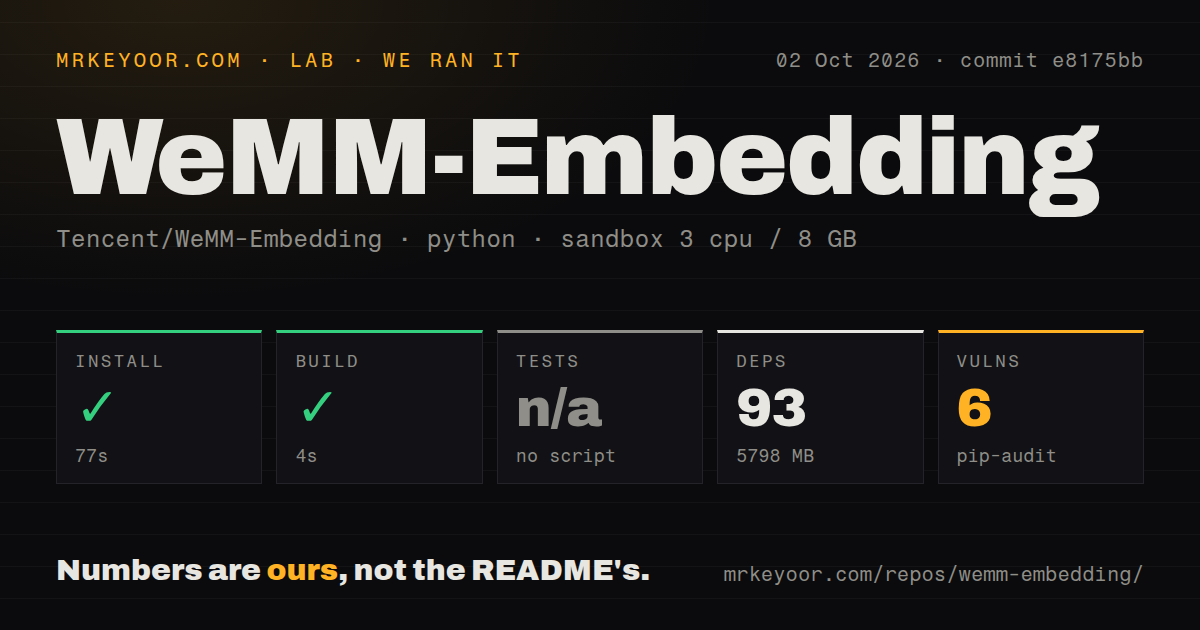
Our clean Python 3.12 sandbox installed the checkout in 76 seconds. Pip added 92 packages, and the environment occupied 5,047 MB on disk before any WeMM model weights were present. The build step succeeded in 5 seconds. Those numbers make the setup command look easier than the resulting footprint: the dependency tree alone is larger than many complete services.
There was no tests script or target, so our harness skipped tests. The repository scan also found 0 CI workflow files, no Dockerfile, and no tests directory. Pip-audit reported 3 known vulnerabilities in the installed environment. This makes dependency review necessary before exposing a server.
The 76-second install and 5-second build only checked repository mechanics. We did not fetch a 2B, 4B, or 9B checkpoint, measure GPU memory, time inference, or confirm Tencent's retrieval tables. Those are separate acceptance tests. The published evaluation uses many datasets and multi-node commands, which is useful for reproduction but is not evidence that a chosen model will fit one operator's hardware.
Transformers 5.2.0 is part of the reproducible path
The simplest examples use either Transformers or Sentence Transformers. Both accept a local model directory; Sentence Transformers can also load a Tencent model ID directly from Hugging Face. Inputs for text, image, and video are encoded independently in the example, with a dimension flag selecting a supported truncated vector. A production wrapper still has to validate media, batch requests, cache weights, and decide how vectors are stored.
Version choice is unusually important here. Tencent recommends Transformers 5.2.0 because newer versions may change preprocessing behavior. That warning should be treated as an index-consistency concern: if preprocessing changes, old and new vectors may no longer be produced under the same path. Pin the library and model revision, record both beside the index, and rebuild a sample before any upgrade. Our 92-package environment does not provide that policy automatically.
vLLM and SGLang are documented, but packaging is yours
For serving, the README gives commands tested with vLLM 0.27.0 and SGLang 0.5.9. vLLM uses its pooling runner plus the model's embedding chat template. SGLang needs a supplied video patch script and a precise embedding interpolation option. One-command wrapper scripts cover both paths, which lowers the chance of omitting a required flag during an initial trial.
There is still no Dockerfile in the 45-file checkout. Teams must choose a base image, accelerator runtime, exposed API, health checks, model cache location, and request limits. The 5,047 MB Python environment is only the first layer. With video inputs, upload size, frame sampling, decoding libraries, and timeout behavior need explicit limits before the service is safe to put behind a public endpoint.
The evaluation code is useful, while the project is very young
The repository includes the MMEB-v3 evaluation changes used for the report: a WeMM backbone, batched inference, dataset instructions, 64-frame video sampling, and multi-node execution. Tencent publishes results across image, video, visual-document, text, agent, and mixed-media tasks. Unsupported audio tasks receive zero rather than being quietly removed from the overall table, which makes the limitation easy to see.
Project health is current but too young for a maturity claim. GitHub recorded the last push on August 26, 2026, and listed 155 stars with 1 combined issue and pull request. The latest-release endpoint returned no tagged release. Apache 2.0 covers Tencent-authored repository code, while third-party components keep their own terms. Check the model card and every bundled component before redistributing weights or an image.
WeMM belongs in a measured retrieval trial
WeMM-Embedding covers four practical input classes and supports six or seven vector lengths, depending on checkpoint. Our successful 5-second build shows the small repository is mechanically usable, but the missing tests and 3 audit findings leave more verification than the short install command suggests.
Start with the 2B checkpoint, pin Transformers 5.2.0, and test the smallest vector that meets retrieval targets on your corpus. Record disk use again after weights and caches arrive. If audio is required, or if 5,047 MB before weights already exceeds the budget, stop there and choose a narrower model rather than forcing this family into the wrong system.