The agent can change Unity, not merely discuss it
Unity-MCP gives an MCP client direct tools for Unity work. The built-in set covers scenes, GameObjects, components, assets, packages, scripts, tests, screenshots, editor state, and profiler readings. A coding agent can create an object, alter its components, compile a script, run an EditMode test, and read the console without asking a person to copy results between windows. That is the useful difference from a generic chatbot that only writes C# snippets.
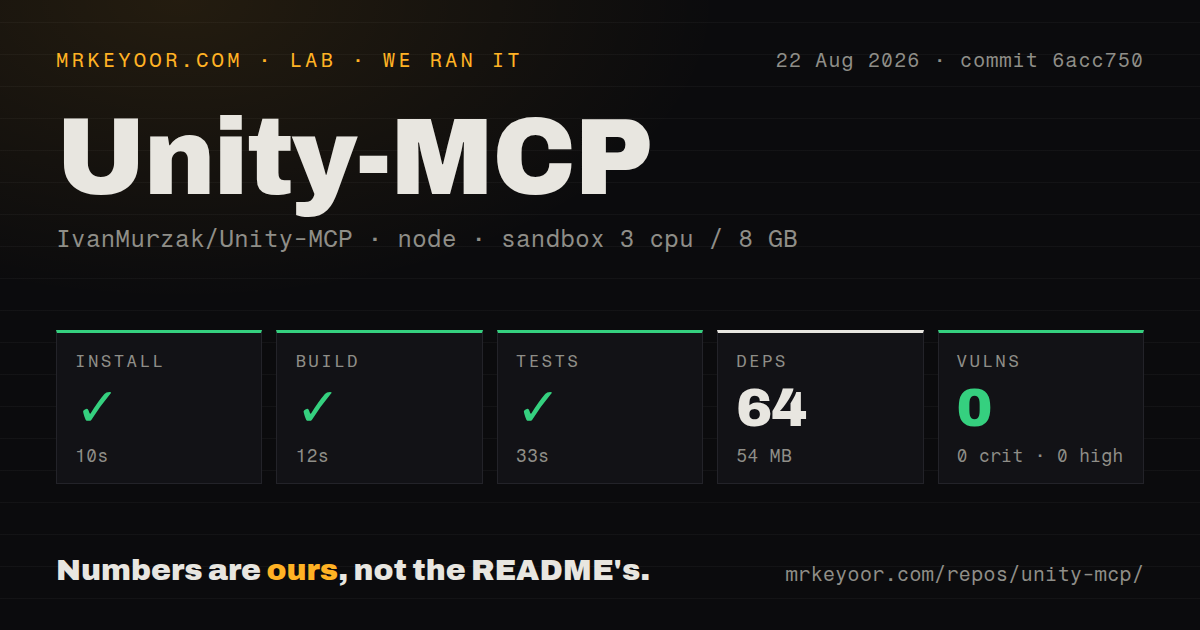
The repository is large because it spans a Unity plugin, server code, documentation, and a Node CLI. Our checkout at commit 6acc750 contained 2,514 files, about 98,197 source lines, and occupied 223.4 MB before the CLI dependencies. The product also supports editor and runtime use, though runtime starts with no tools. A developer must deliberately expose game methods, resources, or prompts before an external model can act inside a compiled title.
Seventy-plus tools cover real editor work, with broad permissions
The README lists more than 70 built-in tools. Useful ones include finding and changing GameObjects, modifying assets, calling reflected methods, capturing four types of screenshots, running Unity tests, and reading memory or rendering statistics. Custom tooling is straightforward in concept: annotate a class and method, describe the arguments, and return the result. Main-thread dispatch is available where the Unity API requires it.
That access deserves the same care as a developer with a terminal. Our dependency audit found 0 known vulnerabilities among the 64 CLI packages, but package health does not constrain what an authorized tool may do. The standard set includes asset deletion, package installation, arbitrary C# execution, and reflected calls, including private methods. Put projects in version control, work on a branch, inspect diffs, and keep irreversible operations behind a person until the transport has proved reliable.
What happened when we ran it
Our sandbox installed the CLI project in 10 seconds, adding 64 packages and using 54 MB on disk. The build succeeded in 12 seconds. Tests then completed successfully in 33 seconds. Npm audit reported 0 known critical, high, moderate, or low vulnerabilities. These results cover the Node CLI at commit 6acc750, not a Unity Editor session or the quality of changes produced by an AI model.
The checkout had 10 CI workflow files and a tests directory, but no Dockerfile in the repository scan. The README does document a published server image and direct binaries, so the missing root Dockerfile should be read as a source-distribution detail rather than proof that containers are unsupported. Our 3-CPU, 8 GB Debian run did not open Unity, connect an agent, use ai-game.dev, or execute an editor tool.
Local stdio is simpler than the cloud path
The recommended CLI flow installs the plugin into a Unity project, opens a browser for OAuth, starts Unity, and writes skills or MCP configuration for the chosen agent. Credentials live in a shared machine store, and the generated cloud endpoint is pinned to a project unless the user opts out. Teams can distribute enrollment codes. None of this is needed for the CLI build, but it is part of the advertised quick path.
A fully local setup can use a platform-specific server binary over stdio. The README provides commands for Windows x86, x64, and arm64, macOS Intel and Apple Silicon, plus Linux x64 and arm64. Remote HTTP brings ports, authorization mode, bearer tokens, idle timeouts, and matching plugin settings. One hard restriction is easy to miss: the Unity project path cannot contain spaces. That may force a project move before the first connection.
Duplicate calls and test hangs limit unattended use
Issue #825 reports a single mutating call executing 2 to 3 times when a SignalR connection dropped and renegotiated. The reporter reproduced duplicate file writes and warned that a failed response could follow an earlier successful mutation. Issue #840 describes the tests-run tool deadlocking Unity 6000.0.73f1 with plugin 0.81.1. Issue #863 reports another hang when a test clears PlayerPrefs, where the request identifier was stored. These reports concern earlier versions, but their failure modes are serious enough to retest.
Visual verification also has a boundary. Issue #837 says camera and game-view screenshots miss Screen Space Overlay canvases because Unity composites them after the camera render. The proposed workaround is a project-specific inspection tool that reads text, color, activity, and rectangle data. If most of your product is menus and HUD, an agent can change that UI without seeing the final overlay through the documented screenshots. Keep a human or a separate visual test in that loop.
Release 0.90.0 is active, while the open queue is mixed
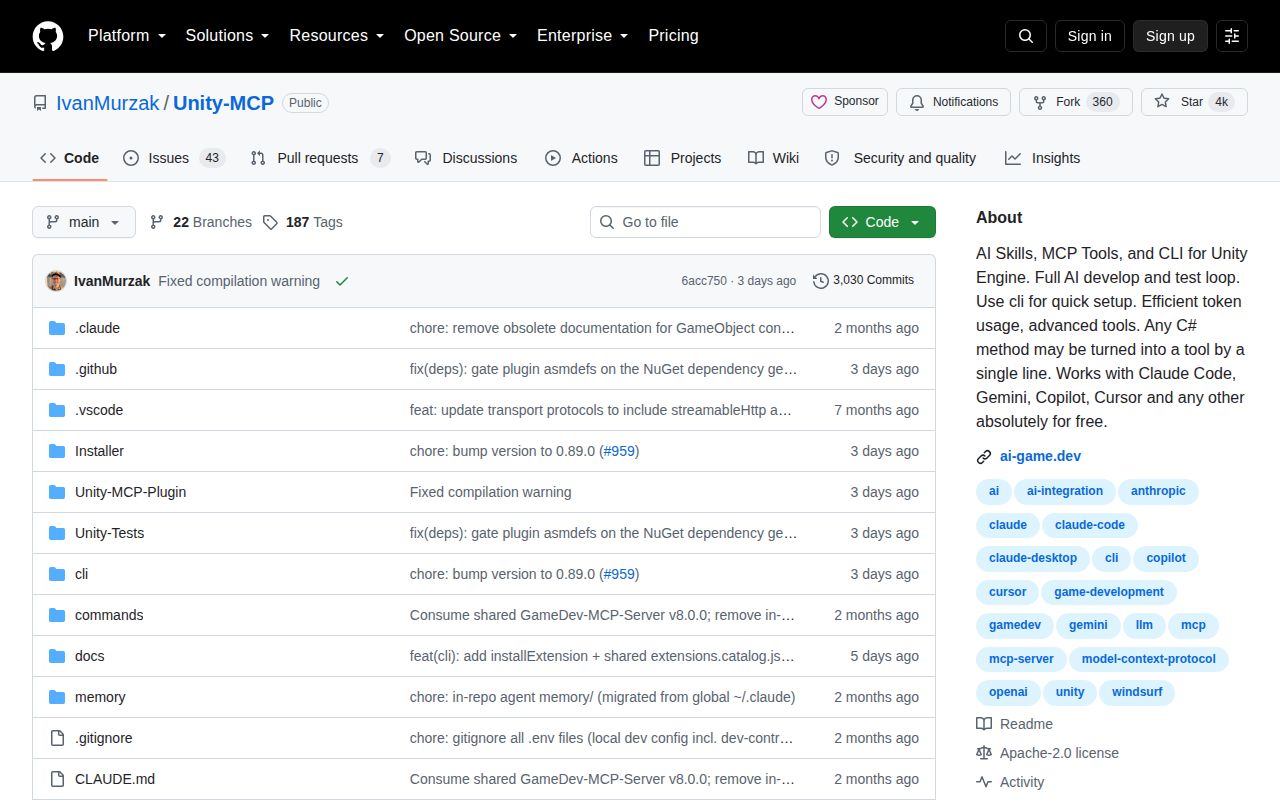
GitHub showed 3,989 stars, an Apache-2.0 license, and 49 combined issues and pull requests. The last push and release 0.90.0 both landed on August 24, 2026. The release includes the exact measured commit among its listed changes. Current open work includes fixes for undo registration, log-file races, package restoration, and filtered test totals, which indicates ongoing maintenance rather than a static tool.
Unity-MCP earns a trial because our 10-second install, 12-second build, and 33-second test run were clean, and the documentation explains far more than a demo connection. Its value rises with project-specific tools and repeatable editor chores. Its risk rises just as quickly when an agent can execute code or delete assets. Adopt it as supervised development infrastructure first, then widen permissions only after your Unity version, transport, and recovery process behave predictably.