One renderer produces images, animation, SVG, and PDF
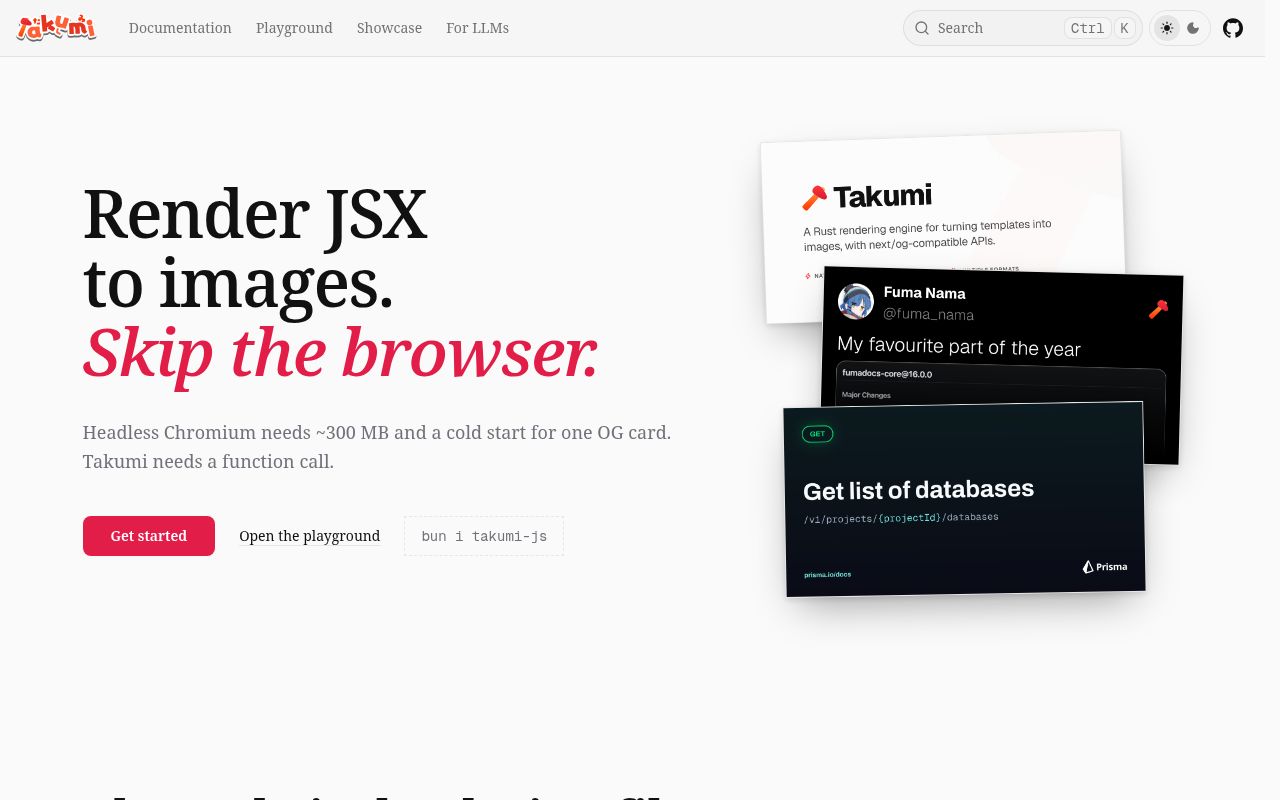
Takumi accepts JSX, HTML strings, or serialized node trees and runs them through a Rust layout and painting pipeline. Static output includes PNG, JPEG, WebP, ICO, and SVG. A time axis turns CSS animation into GIF, APNG, animated WebP, or raw frames for video work. A second vector backend produces paged PDF with selectable text, embedded subset fonts, links, metadata, outlines, attachments, tagged structure, and repeating headers or footers.
Our checkout at commit 9f3ba79 was 51.6 MB across 1,795 files and about 175,142 source lines. The monorepo holds the Rust core, raster and PDF backends, native Node bindings, WASM packages, JavaScript wrappers, documentation, and many framework examples. That is a large source tree for a renderer, but the parts support genuinely different runtimes and output formats rather than wrapping one browser executable.
CSS coverage is broad and deliberately short of Chrome
The image engine supports Flexbox, Grid, block, inline, floats, complex selectors, variables, calculations, media queries, gradients, masks, clipping, blend modes, SVG filters, and Tailwind v4 utilities. Typography includes text fitting, balanced wrapping, bidirectional text, CJK glyph selection, emoji, and text on a path. This is substantially more than the subset many social-card renderers accept. It is still an independent implementation of web styling, so browser parity is the wrong expectation.
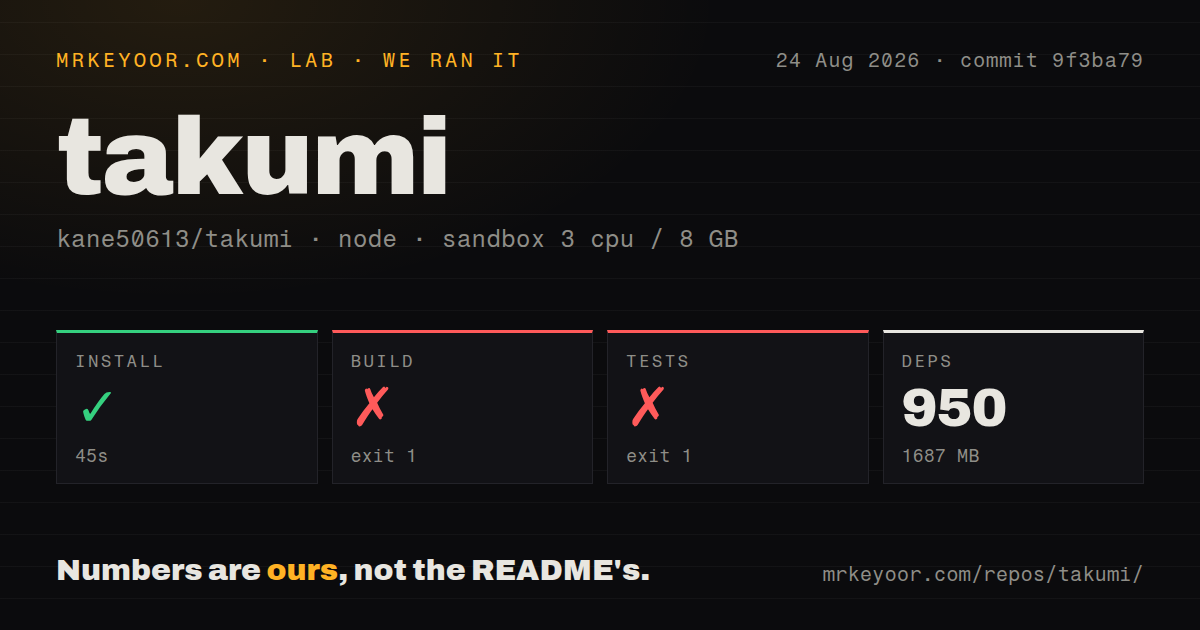
The 950-package installation took 45 seconds and occupied 1,687 MB in our full workspace. An application adding takumi-js is a narrower dependency decision, especially when it receives a prebuilt native binding. Compatibility work shifts from managing Chrome to checking Takumi's CSS and asset rules. Templates should use a tested subset, pin package versions, and compare rendered output after upgrades. Arbitrary pages with scripts and browser layout quirks remain Puppeteer's territory.
PDF pagination is the strongest reason to move beyond Satori
Takumi's PDF package understands forced breaks, break avoidance, widows, orphans, repeated table headers, shared column widths, counters, bookmarks, tagged structure, and PDF/A or PDF/UA targets. Factur-X XML can be attached for electronic invoices. The same HTML and CSS vocabulary can drive an OG image and a customer invoice, which reduces the number of template systems a web team maintains.
The README also names hard limits. PDF output lacks blur, drop-shadow, and backdrop filters. Remote assets must be preloaded when moving from Puppeteer. Only a fallback Latin font ships, so Arabic, CJK, emoji, brand typography, and variable fonts require explicit loading. The project says its WASM artifact is 1.5 MB gzip, a project claim we did not independently size. Buyers should run veraPDF and accessibility checks on their own documents instead of relying on feature labels.
Native bindings and WASM cover many runtimes
Node and Bun use native binaries for macOS, Linux with glibc or musl, and Windows across x64 and ARM64. Browsers and Cloudflare Workers load WebAssembly. Rust users can add the crate directly. A next/og-compatible ImageResponse lowers migration work, while helpers load Google Fonts or register reusable fonts on a persistent renderer. This is a sensible distribution strategy for server, edge, browser, and native applications.
Our lab used Bun in an unprivileged Node 22 Debian container with 3 CPUs and 8 GB of RAM. Installation succeeded, so the 1,687 MB dependency tree resolved in that environment. The later failures mean the complete contributor workflow did not reach a clean baseline. Product evaluation should test the exact runtime package rather than treating one Linux monorepo run as proof for every native target or Cloudflare deployment.
What happened when we ran it
Our run at commit 9f3ba79 installed 950 packages in 45 seconds. The build failed with exit 1 after 11 seconds because bun --filter '*' run build reported, No workspace packages matched the filter "*". The root manifest does declare several workspaces, but the log gives no further explanation. We report the mismatch and do not guess whether it comes from Bun behavior, repository configuration, or this checkout.
The test command failed with exit 1 after 12 seconds. The tail shows failed integration files under Waku SSR and TanStack Start, while the Cloudflare Workers example reports a failed build and one skipped test. Each visible failure ends with Build failed with 1 error, without the actual error text. The repository had 3 CI workflow files, pnpm-style monorepo signals, no Dockerfile, and no top-level tests directory in our lab inventory.
Active releases do not erase the failed snapshot
GitHub showed 2,879 stars, 14 open issues and pull requests combined, and a push on August 25, 2026. The latest published release was takumi-pdf@0.11.3 on August 23. Recent pull requests cover Tailwind parsing, CSS variables, stylesheet behavior, and a wider package release. Named users in the README include established documentation, event, and social platforms, useful evidence that the renderer solves production jobs.
Documentation is excellent. The README gives working image, PDF, animation, SVG, font, API-route, and Rust examples, then states when Satori, Puppeteer, React-pdf, or PDFKit is the better fit. Separate docs cover migrations and comparisons. That candor makes the project easier to evaluate. The next maintenance priority for a new contributor is still reproducing why the 11-second root build and 12-second test command failed.
Choose Takumi for controlled templates, not arbitrary pages
Takumi fits generated assets whose markup your team owns: social cards, invoices, certificates, reports, and branded animations. Start with one existing Satori or PDF template, provide every font and remote image explicitly, and compare output across languages and runtimes. For PDFs, verify text selection, page breaks, links, tags, archival conformance, and printer output. For images, keep golden fixtures that catch layout or shaping changes.
The full 1,687 MB contributor install is heavy and our root commands were red. That blocks an unconditional recommendation for this snapshot. The published API remains compelling because one browserless core covers far more than OG-image SVG. Use it where templates are constrained and deployment size matters. Use Puppeteer when the input is a real web page, and use PDFKit when direct drawing gives you more control than CSS.