The skills give your coding agent Supabase-specific instructions
Ask a coding agent to add a private field to a shared table, and advice about row-level security may still leave that field visible to existing readers. Supabase Agent Skills supplies written instructions intended to guide this kind of database and application work. The current collection contains a general Supabase skill and a Postgres best-practices skill. It gives an agent context for SQL and Supabase authentication.
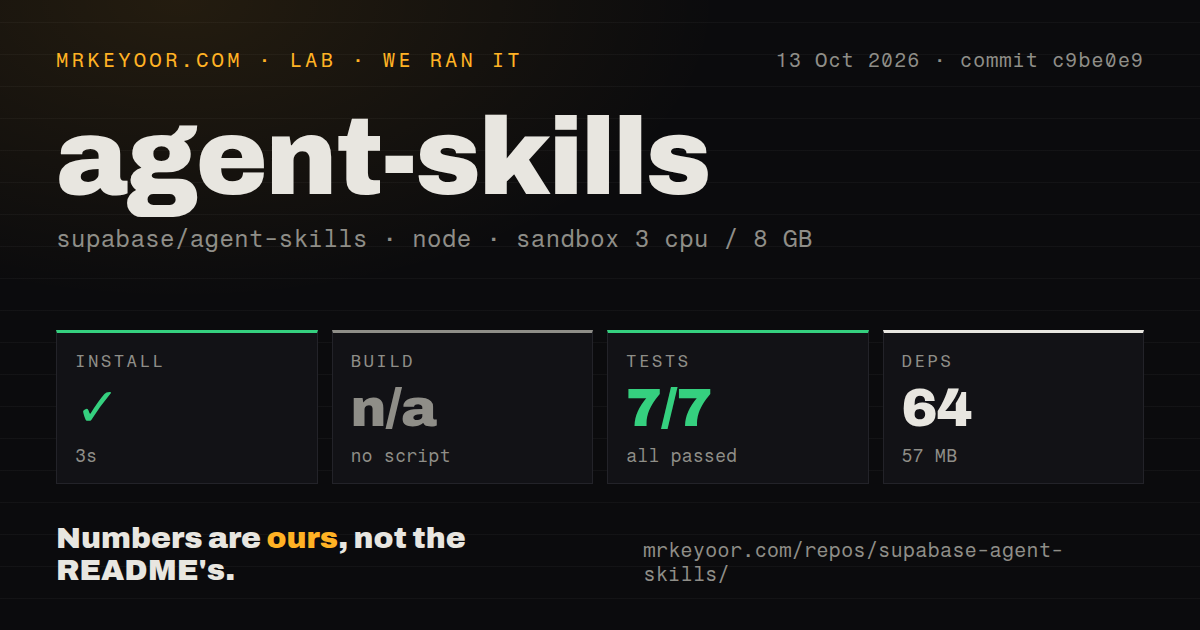
The code checkout in our sandbox was only 0.2 MB across 60 files, with roughly 265 lines of source. Its value lies in readable instructions and examples. I'd add the relevant skill to a repository where an agent already helps with Supabase work. I'd also inspect what it teaches before allowing its SQL near a database that matters.
What happened when we ran it
Our run of commit c9be0e9 installed 64 pnpm packages in 3 seconds and occupied 57 MB after installation. Vitest finished in 6 seconds with 7 passed tests and 0 failures. We cloned it on October 13, 2026 into a fresh, unprivileged Debian sandbox with 3 CPUs, 8 GB of RAM, the lab-node:22 image, and no secrets. Installation and the available tests both succeeded.
The lab skipped the build because it found no build script or target for that step. It recorded 2 CI workflow files, no Dockerfile, and a tests directory. The checkout itself had 60 files, about 265 source lines, and a size of 0.2 MB. These measurements describe the repository checks we performed. The supplied run contains no database workload, query latency measurement, or comparison of agent answers with and without the skills.
Installation checks do not assess generated SQL
The sanity test file at the measured commit copies the skill folders into a temporary source snapshot and invokes the skills installer for Claude Code. It checks discovery, installation of the public skills together or individually, and the presence of their manifests. That's a useful check against shipping an empty or incorrectly packaged skill. It cannot tell you whether an agent follows the instructions or produces correct application code.
The 7 passing tests therefore support a modest conclusion: the checked installation paths worked in our run. They provide no measured evidence that a proposed index speeds up your query, that an RLS policy separates tenants, or that an auth callback reaches the right route. Those are adoption checks for your application. Bring a representative schema task and inspect the resulting migration, including behavior under the roles that will actually use it.
Pick the skill that matches the work
The Postgres manifest points agents toward references on indexing, connection management, schema design, locking, and access control. Files pair SQL examples with explanations. A developer can read the same material directly, which makes disagreements inspectable: if the agent proposes a covering index or a transaction change, you can examine the relevant rule and decide whether its assumptions match your workload.
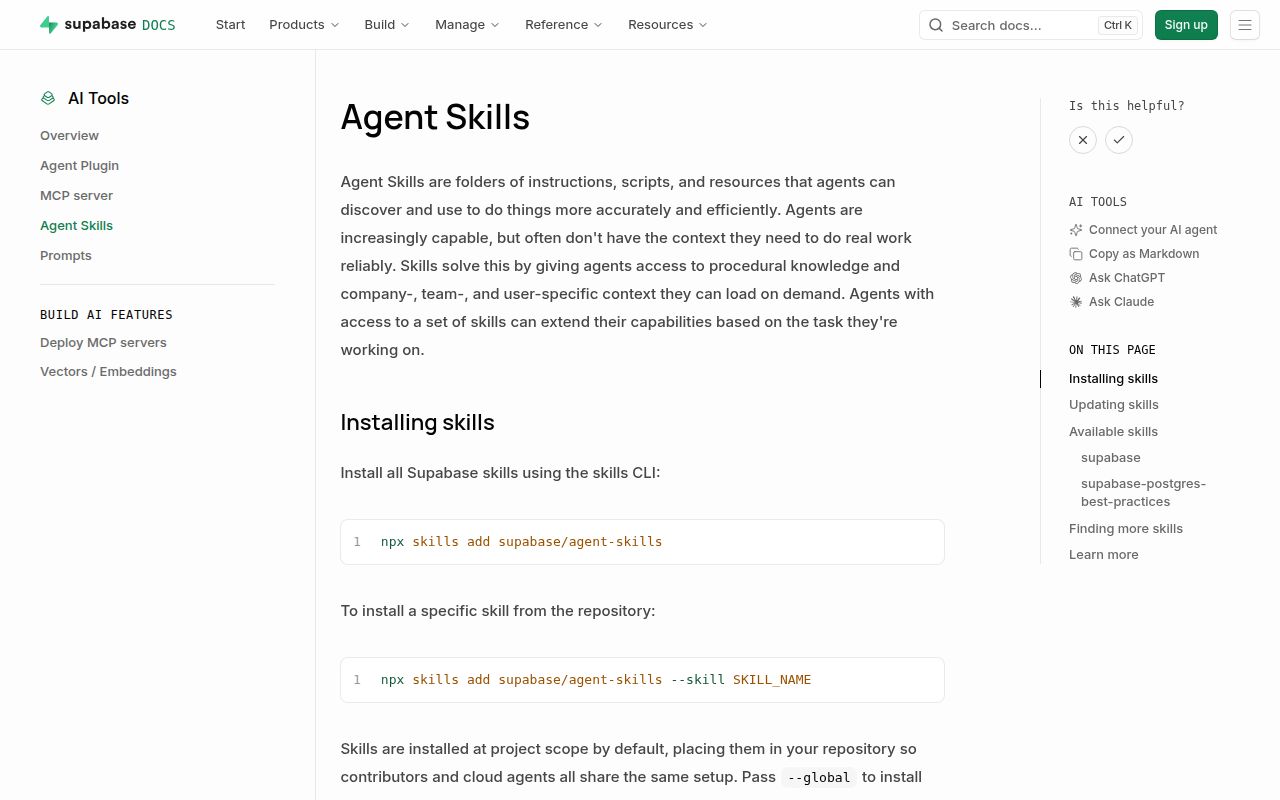
Our 57 MB dependency footprint belongs to installing the repository for its checks, rather than a resident database service. For ordinary use, the installation docs describe npx skills add supabase/agent-skills, with an option to select a skill. Project scope shares the files with contributors. The broader Supabase skill covers product workflows and documentation lookup. Installing that guidance does not itself supply a connected database or grant the agent access to one.
One RLS example has a reported permission conflict
Issue 619 identifies the helper-function example in security-rls-performance.md. The reference revokes execution from the authenticated role and then calls the helper from an RLS policy. The reporter says a signed-in query fails with a permission error and proposes granting execution to the role that uses the policy. The current reference file still contains that revoke-and-call sequence. We did not reproduce the database error ourselves.
That example is why the 6-second test result should not become a security endorsement. Another report, issue 625, describes adding a private phone field to a table already readable by other members. The complaint is about missing column-exposure checks in the general Supabase guidance. Both reports give teams concrete reasons to require application-specific access tests before approving security changes.
Connected workflows still need credentials and usable tools
The general Supabase skill discusses CLI and MCP access, recommends scoped personal access tokens, and directs agents to current documentation. Reading its Postgres advice requires no hosted project credentials. Acting on a hosted project does. Keep those choices separate when evaluating it: a folder of instructions can suggest an operation that the connected tool cannot perform or that your account cannot authorize.
Our 3-second install ran with no secrets, so it established nothing about hosted authentication. Issue 622 reports an Auth redirect task where the available SQL tools could not update hosted Auth configuration and the separate Management API credential was absent. If your problem is missing operational access, the Supabase MCP server is the more relevant project. If you need examples for authoring your own skills, use Anthropic's collection.
Recent activity includes unresolved guidance corrections
The last push was October 2, 2026. Release v0.1.9 was published September 28 with a change recommending scoped tokens, and October issue activity includes specific reports about RLS and Auth workflows. GitHub listed 2,804 stars and 517 open issues and PRs when checked. Those dates show continued attention, while the queue gives plenty of reasons to inspect individual advice rather than treating publisher identity as proof.
The 64-package install was an easy repository check. The adoption decision rests on whether these readable instructions help your agent make changes you can verify. Start with one schema or auth task in a disposable environment, review its output, and keep the useful rules alongside your project's own constraints. A passing installation suite should earn the skill a trial; permission to change production data must come from your application's evidence.