An agent with an offensive toolkit
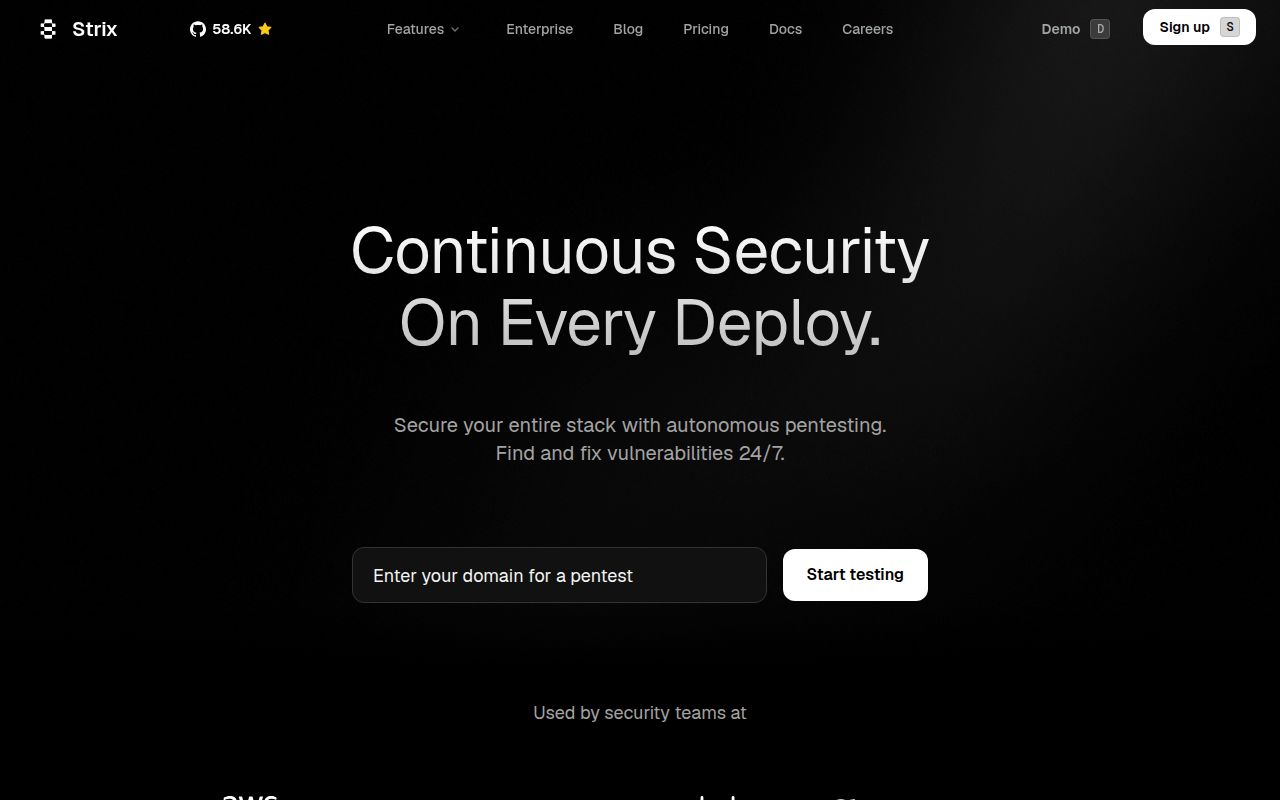
Strix takes a more active approach than a code scanner. Give it a local directory, repository URL, web address, API contract, or Postman collection, and its agents can inspect code, browse pages, intercept HTTP requests, run shell commands, and write proof-of-concept exploits. Findings are stored under strix_runs, with severity, reproduction details, and remediation guidance. A local viewer shows the current run, agent graph, history, reports, and live steering.
That breadth is the appeal. Static analysis can point at a suspicious path; Strix is designed to exercise the path and see whether it works. It can combine source and deployed targets, focus on a pull-request diff, or run headlessly in CI. The supplied agent skills let Claude Code, Cursor, Codex, and other compatible tools start scans, read results, attempt fixes, and scan again. Strix can also consume tools from configured MCP servers.
The same breadth creates risk. This software has a shell, browser, interception proxy, and exploit runtime. It belongs in an isolated environment against a target covered by written permission. The README makes that warning explicit. A careless target URL or overly broad credentials can turn a useful security check into an incident.
What happened when we ran it
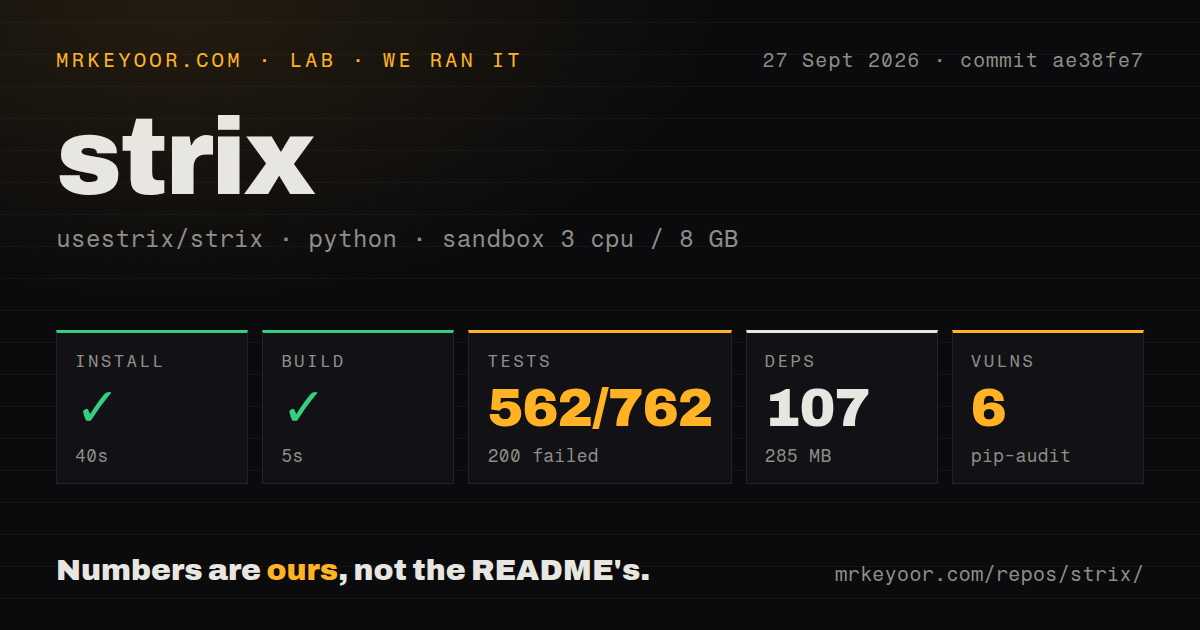
We cloned commit 1c499c5 into an unprivileged Debian container with 3 CPUs, 8 GB of RAM, no secrets, and a Python 3.12 uv image. The checkout contained 436 files, about 61,879 lines of source, and occupied 8.2 MB before installation.
Installation succeeded in 60 seconds. It installed 99 packages and consumed 243 MB on disk. The build then completed successfully in 11 seconds. Those two results support the README's claim that the Python side is approachable, although they do not cover the Docker image pull or a live LLM-backed scan.
The test result was poor. Pytest ran for 123 seconds, counted 390 passing tests and 200 failures out of 590, then stopped after reaching 200 failures. The tail repeatedly says async test functions are not supported natively and lists plugins such as anyio and pytest-asyncio. The final named failure, test_workspace_preview_honours_byte_budget, has the same message. That log tells us what pytest lacked during the run; it does not tell us whether the fault sits in dependency metadata, the test command, or our environment. Pip-audit also reported 3 known vulnerabilities.
The quick start leaves real work for the operator
The documented path is short: install the CLI, set a model name and API key, then point strix at a target. Docker must already be running, and the first scan downloads the sandbox image. Strix supports several model providers plus a ChatGPT subscription login. Local model gateways are documented through LLM_API_BASE, but issue #1095 reports that custom endpoints can fail before scanning because the API key reaches the model client twice. Anyone using an internal gateway should test the exact provider prefix and release before adding Strix to CI.
Authenticated testing needs more care than copying a username and password into an instruction. Use a disposable test account, restrict its privileges, and decide which hosts and actions are in scope. Postman and web-search integrations introduce more secrets. A remote MCP configuration can expose every tool from a server unless allowed_tools narrows the list. These are useful controls, but Strix cannot choose your blast radius for you.
CI behavior is sensible. Headless mode returns a nonzero exit code when it finds vulnerabilities, and quick pull-request scans can limit work to the diff when full Git history is available. A security team still needs a policy for model errors, contested findings, and accepted risks. Otherwise a nondeterministic agent becomes an unpredictable merge gate.
Proof of exploitation has a trust problem
A working reproduction is more useful than a long list of guesses. Strix's report model, proxy history, saved artifacts, and agent graph give a reviewer material to inspect. Its dashboard stays local by default and uses a tokenized session link. Binding the viewer to all interfaces is possible, but the README warns that the link grants access to scan data and should be protected by a firewall.
The weak point is knowing what the agents did not complete. Issue #1155 describes a specialist agent refusing its task while Strix treated the response as ordinary text and continued. The reporter's concern is false confidence: a report may appear complete even though a specialist never tested its assigned area. Until that path is fixed and covered by tests, require explicit task status in any review process and treat missing evidence as missing coverage.
Model choice adds another variable. Different providers may refuse offensive instructions, use tools differently, or spend very different amounts during a long multi-agent run. Strix exposes reasoning settings and supports several providers, but provider choice is part of the security methodology. Record it alongside the target, commit, scope, and result.
Project health and the decision
The repository was pushed on August 27, 2026, and release v1.5.3 arrived on August 10. GitHub showed 318 open issues and pull requests combined, with fresh issue and pull-request activity on August 27. The project is moving quickly, which helps fixes land but calls for pinned versions and a repeatable acceptance suite.
Documentation covers the CLI, viewer, API targets, CI, provider settings, MCP connections, agent skills, and the legal boundary around authorized testing. It is good enough to start a lab trial. The failed pinned suite keeps us from calling the source checkout dependable without qualification.
Use Strix as a second set of hands for an experienced security reviewer. Keep it isolated, verify every claimed exploit, and audit whether each assigned test finished. Teams wanting predictable signature or template checks should start with Nuclei or ZAP; teams prepared to supervise an offensive agent will find more ambitious coverage here.