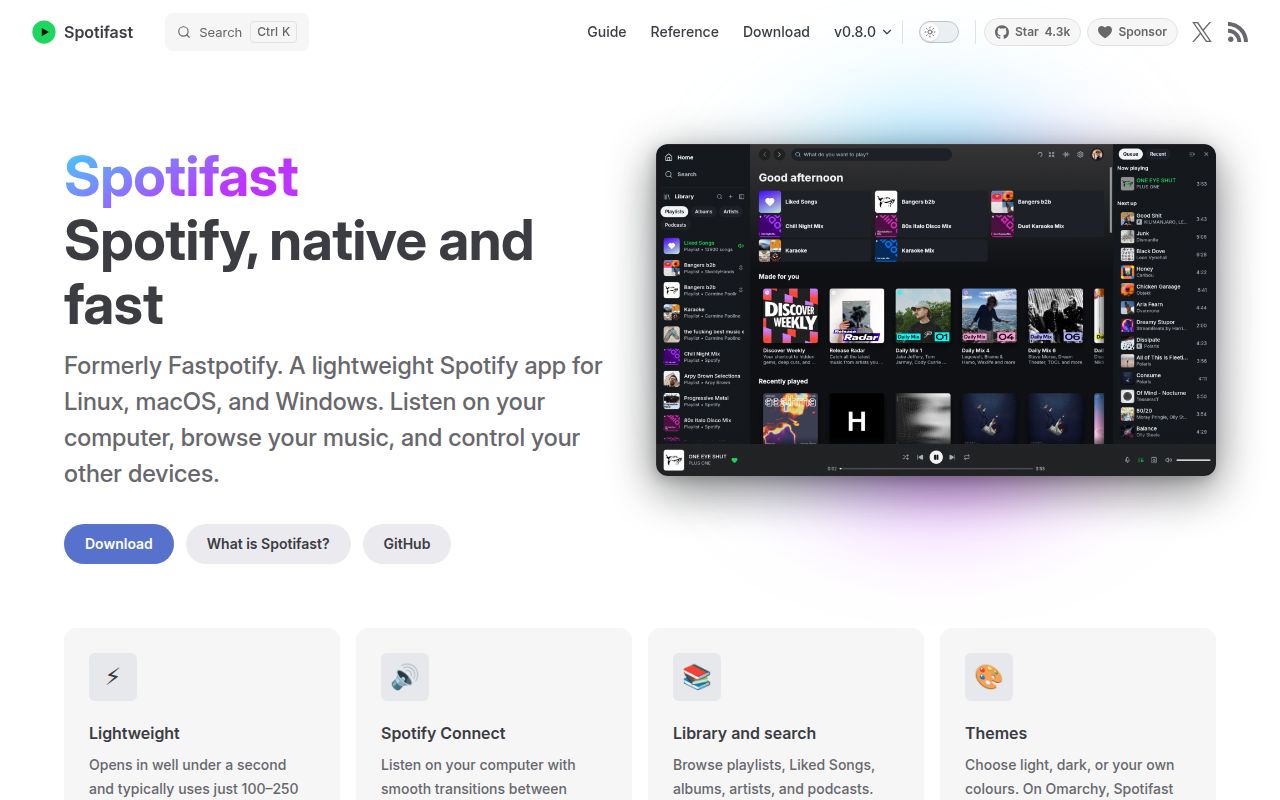
Version 0.8.0 renamed the app without shrinking its scope
Version 0.8.0 changed the product name from Fastpotify to Spotifast. Existing native-package settings and sign-ins carry over, and the old fastpotify command remains for scripts. Behind the new name is a full desktop client: library pages, search, playlist editing, podcasts, lyrics, a queue, and Spotify Connect control. Rust and egui replace the browser engine used by Spotify's official desktop app, while librespot handles playback.
Local playback reaches up to 320 kbps and includes gapless play, normalisation, an audio cache, and a ten-band equalizer. The stranger feature is useful rather than decorative: a Winamp mini player accepts classic .wsz skins and keeps its playlist and spectrum display. MilkDrop runs in a separate process and can download more than 10,000 presets on first use. The result feels like a complete music client with a clear taste.
Version 0.8.0 still needs two Spotify approvals
Version 0.8.0 keeps account access and local playback as separate grants. The first browser flow uses Spotify's consent page for the library, search, and remote control. Playing on this computer needs another one-time browser approval because Spotify treats streaming separately. Both reusable grants go into Secret Service on Linux, Keychain on macOS, or Credential Manager on Windows. Spotify Premium is mandatory for playback. A Free account can only browse and search.
Connection attempts have a 5-second limit before Spotifast tries another available server address. The default shared Web API app handles normal use, and you can add a personal Spotify Development Mode client ID for a separate quota. That split is practical, though it leaves the client dependent on Spotify's API policy and librespot's lawful access. The project says it knows of no account suspension caused by Spotifast, but it cannot give the assurance of an official Spotify product.
What happened when we ran it
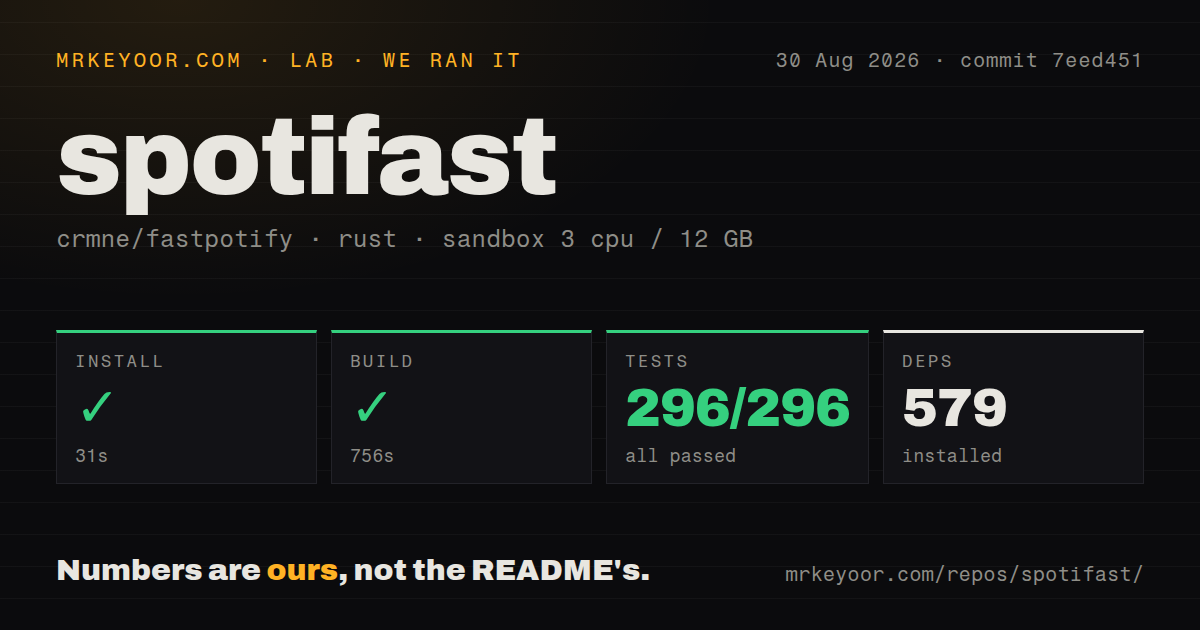
Our sandbox installed 579 packages in 31 seconds, then built commit 7eed451 in 756 seconds on 3 CPUs with 12 GB of RAM. Cargo test finished in 47 seconds with all 296 tests passing and none failing. A clean compile and complete test pass are meaningful for a cross-platform audio application. The twelve-and-a-half-minute build is equally meaningful if you expect to compile every update yourself.
The measured checkout contained 219 files, about 36,234 lines of source, and occupied 7.4 MB before dependencies. We found 3 CI workflow files, no Dockerfile, and no separate tests directory. Cargo still discovered and ran the Rust tests. Our unprivileged container had no secrets, so this run did not assess sign-in, sound output, startup time, memory use, API latency, or the quality of a real playback session.
The 756-second build makes packaged installs the sensible route
The 756-second compile is the strongest reason to start with a package. Arch users have AUR choices, macOS users get a Homebrew cask or app download, and v0.8.0 is signed and notarized for macOS. Building elsewhere needs Rust 1.95 or newer. The default MilkDrop feature also compiles libprojectM, which brings CMake, a C++ compiler, and libclang. You can omit it with --no-default-features.
Linux adds ALSA, PulseAudio or PipeWire, keyboard, and windowing development libraries. Windows source builds call for Visual Studio 2022, CMake, LLVM, and vcpkg. Nix provides a pinned development shell, which is the cleanest documented source route. The absence of a Dockerfile is no concern here: a desktop client needs host audio, windows, credential storage, and tray integration. Containerizing those parts would hide the setup problem rather than solve it.
A September 2026 push and 56 open items show an active young project
Release v0.8.0 arrived on 2026-09-14, and the last push was 2026-09-16. GitHub listed 4,295 stars, 45 open issues, and 11 open pull requests when we fetched it. The count is a busy review queue rather than 56 confirmed bugs. The release added the Spotifast name, custom themes, in-app updates, signed macOS downloads, settings search, and a long list of playlist and playback fixes.
Fresh activity has not removed every desktop wrinkle. Issue 498, opened on 2026-09-15 and updated the next day, reports that Follow system does not track the theme in a Fedora Silverblue Flatpak session. The README also says Windows testing with NVDA and accessibility for Winamp skins remain in progress. Neither point makes the app unusable, but both matter to people choosing it for a specific desktop or assistive setup.
Up to 320 kbps is enough for Spotify Premium, not Lossless
Playback tops out at 320 kbps because Spotifast stays within the access librespot provides. The contributor guide says Spotify Lossless is unavailable through that library and rules out proposals that bypass DRM. It also requires Spotify tracks to come from Spotify, so this will not become a manager for local files or substituted audio sources. Those boundaries are sensible. They also make the buying decision unusually clear.
Choose Spotifast if you already pay for Premium, want Spotify Connect plus a real library GUI, and prefer a native process to Spotify's web shell. The 296 passing tests make that trial easier to trust, while current packages spare you the 756-second compile. Keep the official client around until your usual speakers, suspend cycle, media keys, and audio backend have survived a week of use. Those desktop paths were outside our container run.