It adds distributed database capabilities without replacing the database
Apache ShardingSphere occupies an unusual middle ground. It is not a database, and it is more ambitious than a narrow connection proxy. The project describes itself as a standardized enhancement layer above heterogeneous databases, intended to make different systems easier to access and govern together. Its practical promise is that a company can keep databases it already trusts while adding sharding, read/write splitting, SQL federation, encryption, masking, auditing, traffic controls, and observability at another layer. That proposition is strongest in established estates, where replacing every storage system would be expensive or politically unrealistic.
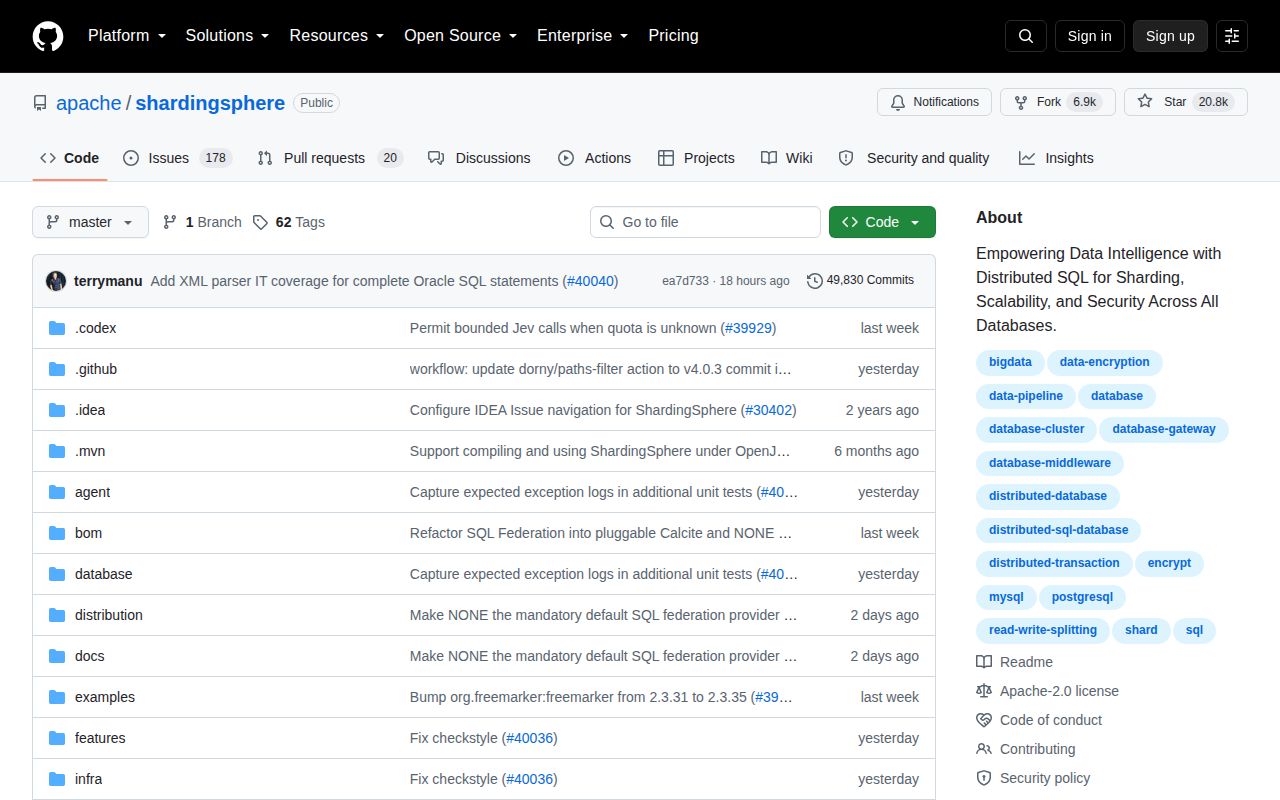
This is a large Apache top-level project, not a small middleware experiment. The repository has 20,791 stars, 9,655 files, roughly 190,531 lines of source, and a 152.7 MB checkout in our measured snapshot. It became an Apache top-level project in 2020, and the README says it has been adopted by more than 19,000 projects. Those figures do not prove suitability for a particular workload, but they establish a deeper footprint than most database-routing libraries.
JDBC and Proxy serve meaningfully different deployments
The strongest design choice is the dual-access architecture. ShardingSphere-JDBC runs with a Java application as an enhanced JDBC driver, sharing application resources and connecting directly to databases. That avoids operating a separate proxy and should appeal to teams using MyBatis, JPA, Hibernate, or other JDBC-based frameworks. ShardingSphere-Proxy is an independently deployed server that gives applications a database-facing endpoint, extending the project beyond Java-only estates and centralizing the enhancement layer.
That flexibility creates an early architecture decision rather than a free convenience. A team must decide whether each application should own routing behavior or whether a shared Proxy tier should own it. With JDBC, upgrades and rule changes travel with application deployments. With Proxy, the platform team gains a central control point but also adds another production service to size, monitor, secure, and make highly available. Version 5.5.3 offers a broad toolbox, yet no configuration can remove the need to test routing correctness against a representative data model.
What happened when we ran it
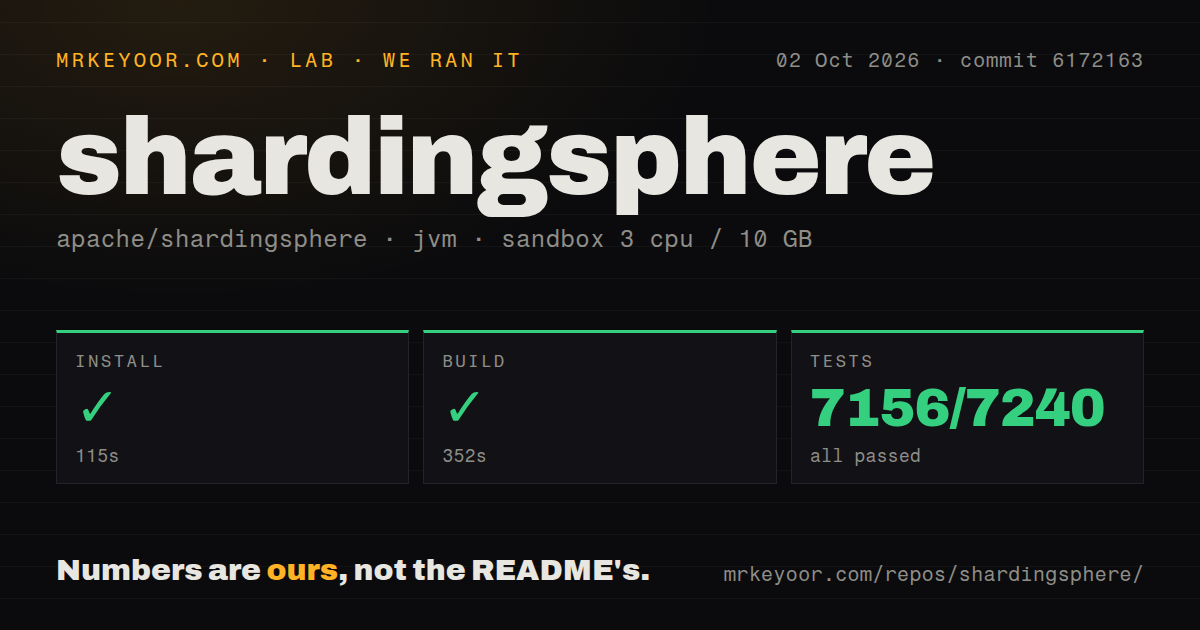
Our run was reassuringly uneventful. In an unprivileged Debian container with 3 CPUs, 10 GB of RAM, Java 21, and no secrets, installation succeeded in 75 seconds. The build then succeeded in 215 seconds. Tests completed in 551 seconds, with Maven Surefire reporting 5,298 passed, 0 failed, and 314 skipped out of 5,612. Those are source-build and test results, not transaction benchmarks, so they say nothing about query latency, throughput, or scaling under production traffic. They show that the checked-out commit could be assembled and tested cleanly in a fresh environment.
The repository also contained 18 CI workflow files and a tests directory, useful signs that verification is normal project work. It did not contain a Dockerfile in our snapshot. That absence is not fatal for a JVM project, but operators hoping to understand the system by building one repository-provided container will need another route. At 9655 files, local iteration is heavier than for a focused JDBC helper, although the 551-second test completion was reasonable for the suite size on our box.
Its breadth is both the reason to adopt it and the main risk
The concrete strengths are unusually broad. Sharding and read/write splitting address scale and replica use; SQL federation covers queries across data sources; encryption, masking, and audit features address governance; circuit breaking and rate limiting give operators traffic controls; and monitoring, tracing, and analysis improve visibility. The micro-kernel and three-layer pluggable architecture are designed to keep the core, features, and integrations decoupled. For an enterprise platform team, consolidating those concerns can be preferable to assembling several unrelated proxies and libraries.
The rough edge is cognitive and operational load. Every extra policy layer can make a surprising query harder to trace, especially when routing, federation, masking, and rate control interact. The README explains positioning and major capabilities well, but a feature inventory is not a migration plan. Teams still need failure drills, rule review, capacity planning, credential handling, upgrade procedures, and a way to compare results with direct database access. The 314 skipped tests in our run also deserve examination before relying on features covered by those skipped cases.
Active development matters more than the release date alone
Project health looks active rather than abandoned. The latest listed release is 5.5.3 from February 28, 2026, roughly six months before this review, while the repository was pushed on August 28, 2026, the day of review. That combination suggests ongoing development even though a newer release tag was not listed. There are 216 open issues, a meaningful queue that prospective adopters should inspect for their database engines and chosen features.
It belongs between applications and databases in an established platform
In a real stack, ShardingSphere fits where a platform team owns database access conventions across multiple services or storage systems. JDBC is the more direct choice for Java services that prioritize local control and do not want another network hop. Proxy is the clearer fit when multiple languages need one database endpoint or when routing policy must be centralized. Hybrid deployment makes sense only when ownership boundaries are explicit, because 2 access paths can otherwise produce configuration drift. Start with one concrete requirement, such as read/write splitting, and prove correctness before layering on federation or governance.
For a new application with modest traffic and one well-understood database, native database features will usually be easier. Vitess is a stronger specialist option for teams committed to MySQL sharding. TiDB or CockroachDB are more coherent choices when replacing the storage layer with an integrated distributed SQL database is acceptable. ShardingSphere earns its complexity when database preservation and heterogeneous access are requirements, not preferences. Its clean 5,298-test result lowers evaluation risk, but production adoption should follow workload-specific correctness and failure testing, not repository popularity alone.