The Senior Engineer for Your AI Intern
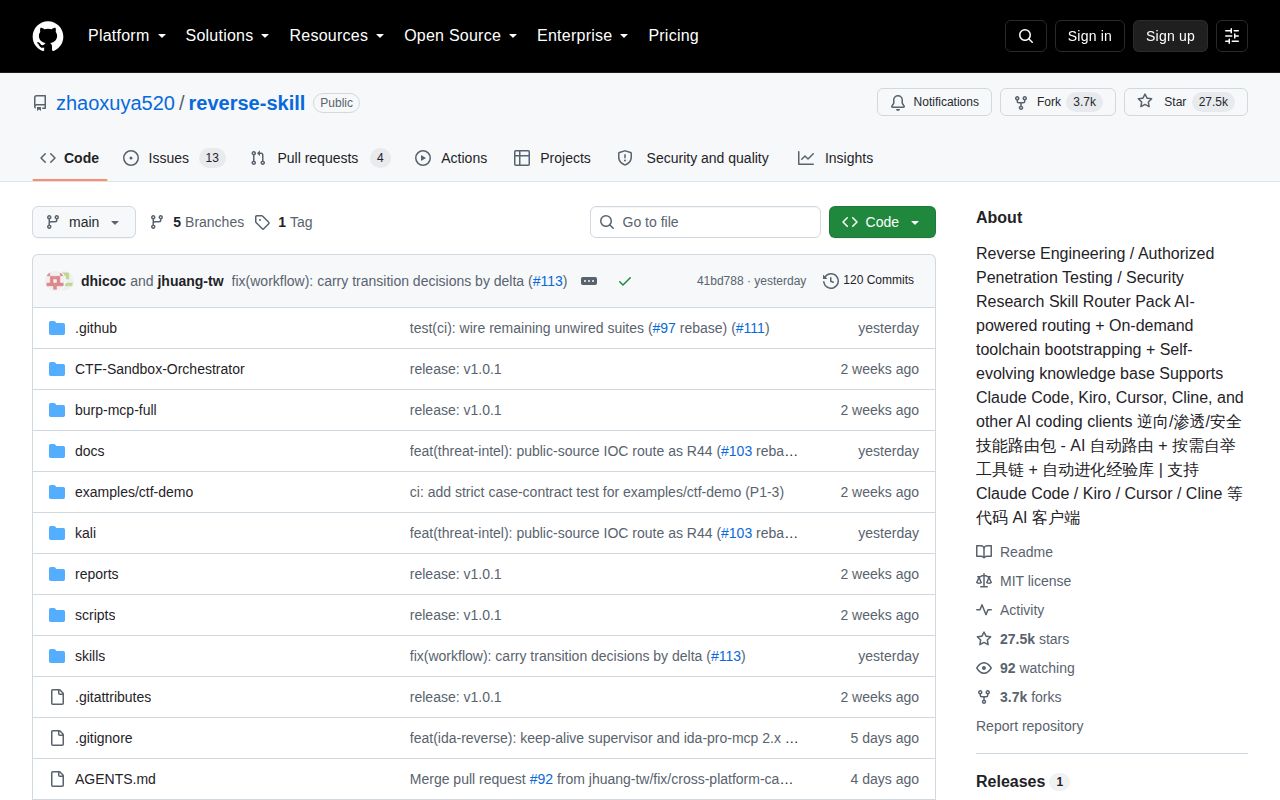
Large Language Models are like brilliant junior analysts. They’ve read every manual and can recall any command, but they have zero experience. Ask one to reverse-engineer an Android app, and it might guess apktool when it should be using jadx, or get stuck trying to decrypt traffic without realizing it needs to hook a function with Frida first. This is the exact problem zhaoxuya520/reverse-skill sets out to solve. It’s not a tool that does the work for you; it’s a structured knowledge base, a 'Cybersecurity Skills Router' that acts as the senior engineer, guiding an AI agent (or a human) through a logical, repeatable workflow.
The core idea is to treat cybersecurity operations as a routing problem. A task comes in, say, analyzing a suspicious .apk file. The framework first consults its RULES.md and MASTER-ROUTING.md to classify the task. It then directs the agent to the correct 'skill' playbook, like skills/apk-reverse/. This playbook contains a checklist of steps, tools to use, and procedures to follow, from initial reconnaissance to generating a final report. It’s a methodology enforced by code and documentation.
A Breathtakingly Ambitious Blueprint
The project's greatest strength is its sheer scope. The list of supported scenarios is a cybersecurity professional's entire toolkit: Android/iOS reversing, binary analysis with IDA and Ghidra, .NET decompilation, frontend JavaScript deobfuscation, malware analysis, full-scale penetration testing, CTF sandboxing, firmware hacking, and even niche topics like LLM security and OLLVM deobfuscation. The author has mapped out a significant portion of the offensive security landscape and attempted to codify the 'if-this-then-that' logic that experts develop over years.
Its AI-first design is another major plus. With a dedicated README_AI.md file intended as a bootstrap for agents, the project is explicitly designed for the next generation of development workflows. The system encourages good operational hygiene through scripts like case-init.ps1, which sets up a structured directory for each new engagement, complete with scope documents, timelines, and evidence logs. This is more than just a collection of scripts; it's an opinionated take on how to run a security engagement systematically.
The Elephant in the Repository
For all its conceptual brilliance, the project has a glaring, unavoidable weakness: its maturity. The latest release is listed as v1.0.0, dated July 17, 2026. This is not a typo. A release date set two years in the future calls the entire project's status into question. Is it an active, usable tool? A long-term research project? An abandoned proof-of-concept that went viral? It’s impossible to tell, and this ambiguity makes it extremely risky to adopt for any serious work. It feels less like a v1.0.0 and more like a v0.1.0-alpha with a placeholder date.
This concern is amplified by the community metrics. While over 11,000 stars indicate massive interest in the idea, the repository has only 13 open issues. For a project this complex and popular, such a low number is suspicious. It suggests that people are starring it as a bookmark rather than using it, testing it, and finding its inevitable rough edges. The project is also heavily reliant on PowerShell for its main orchestration scripts (master-route.ps1, case-init.ps1), which may alienate the large portion of the security community that operates primarily on Linux and macOS.
Finally, the learning curve is steep. The 'documentation' is the framework itself, a sprawling forest of Markdown files. To use it effectively, you need to internalize its logic, which requires a significant time investment. This isn't a tool you can pick up and be productive with in an afternoon.
The Verdict
reverse-skill is a forward-thinking blueprint for the future of AI-assisted cybersecurity work. It provides a much-needed strategic layer that can turn a powerful LLM into a genuinely useful teammate. The breadth of its 'skills' is impressive, and its structured approach to engagements is laudable. However, the bizarre 2026 release date makes it impossible to recommend for production use today. It is a fascinating project to star on GitHub, monitor for updates, and perhaps draw inspiration from for your own workflows. But until its status becomes clearer and it demonstrates a history of stable releases and genuine community feedback, treat it as the promising but unproven concept it appears to be.