Remix 3 is a new framework, not the next React upgrade
Remix v2 became a thin layer over React Router, so its bundler and server runtime moved into React Router 7. The maintainers call that the stable path for applications built on Remix v1 or v2. Remix 3 starts again with runtime Web APIs, its own component model, and no React dependency. Treat it as a new framework evaluation, even if your team knows the old conventions.
Existing applications should investigate React Router 7 before Remix 3. New projects can judge the release candidate separately. The main package we fetched reports version 3.0.0-rc.2, while the README calls the install a beta and uses the next npm tag. That suits prototypes and informed early adoption, not a policy that permits only final framework releases.
One remix package fronts dozens of replaceable modules
The repository covers cookies, sessions, authentication, CSRF and CORS middleware, file storage, S3, SQL data access, schema checks, multipart parsing, static files, a Fetch server, hot reload, testing, and UI. Most packages work independently. The umbrella remix package reexports them so an application can begin with one documented surface.
Streams replace Node streams, Uint8Array replaces Buffer, and Web Crypto replaces the Node crypto module. Blob and File carry file data. The README names Node, Bun, Deno, and Cloudflare Workers as targets, with Node 24.3 as the current package floor. Portability still needs package-level testing because database drivers, filesystem storage, and server adapters cannot behave identically everywhere.
What happened when we ran it
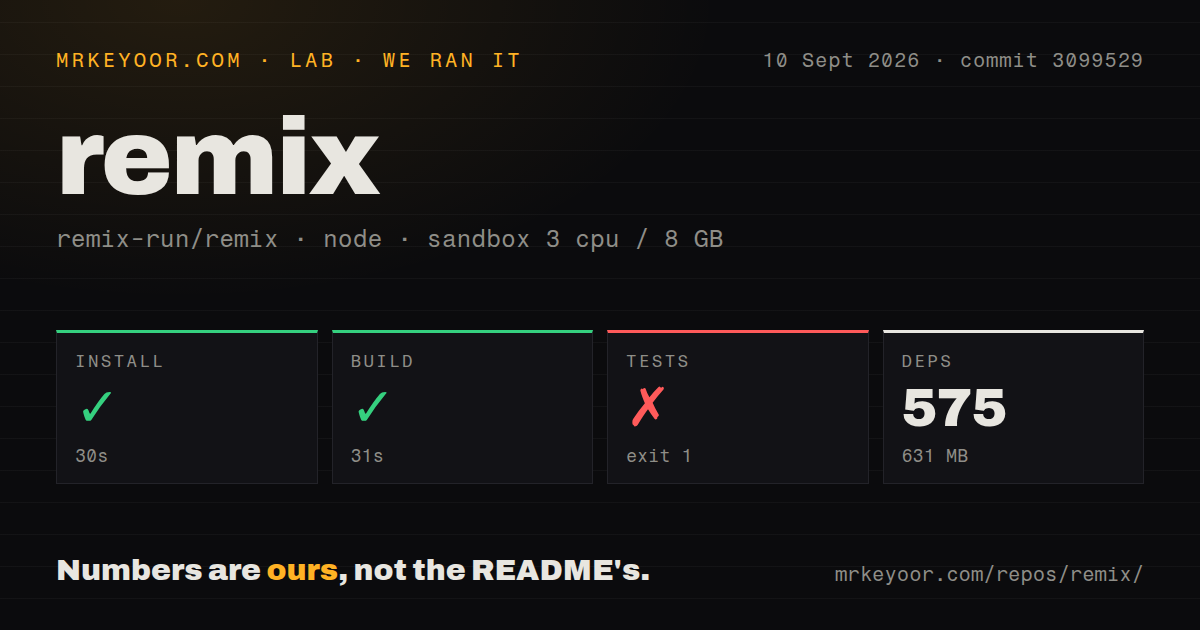
Our sandbox installed 575 packages in 30 seconds and used 631 MB. The monorepo built in 31 seconds at commit 3099529. Our measurement setup was an unprivileged Debian container with 3 CPUs, 8 GB of RAM, Node 22, and no secrets. The checkout had 2,529 files, about 298,449 source lines, and 31.6 MB. We found 14 CI workflow files, pnpm workspaces, and no Dockerfile.
Tests failed with exit code 1 after 17 seconds. Servers started, but Playwright said the Firefox 1522 executable and Chromium headless shell 1223 executable were absent from the cache. The log showed no failed application assertion and did not show those browsers being installed. The limited finding is that the complete test command could not run after dependency installation in our fresh container.
Node 24.3 is declared even though our Node 22 build completed
The current remix manifest requires Node 24.3.0 or newer. Our Node 22 sandbox still installed the workspace and completed its 31-second build, but that does not cancel the supported floor. Teams standardized on an older runtime should plan an upgrade before adoption, even if pnpm only warns and compilation happens to finish.
npx remix@next new scaffolds an app, while npm install remix@next adds the beta. No hosted account or framework credential is required. Optional OAuth, database, Redis, or S3 features bring their own secrets. The 24.3+ package supplies primitives, not a deployment account, managed service, or Docker image. Application packaging remains your job.
Zero dependencies is a goal, while the checkout pulled 575 packages
The README says Remix wants to avoid dependencies and eventually reach zero. It does not claim zero today. Our install fetched 575 packages and occupied 631 MB, including monorepo development and test tooling rather than only shipped application code. The principle explains why Remix wraps outside abstractions; the measured checkout describes the current contributor experience.
Owning more of the stack trades outside dependencies for reliance on Remix itself. The framework controls UI, assets, routing, auth helpers, storage, data tools, and testing. A project that already trusts React, an established SQL library, and a familiar build pipeline may see replacement cost here. Test only the modules that solve a named problem before accepting the umbrella.
UI 0.8.0 has an open navigation report
Issue 11808 says renderToString in UI version 0.8.0 and current main removes a document flush marker. In its reproduction, a link changes the URL and fetches a 200 response, but the displayed page remains when clientEntry is active. Streaming output or restoring the marker changes the behavior, while the server documentation recommends renderToString for static pages.
That report does not cover every navigation path, but it is the sort of integration edge an RC can contain. GitHub showed 49 combined issues and pull requests, a September 10, 2026 push, and active fixes around navigation, SQLite writes, and S3 object names. The project had 33,353 stars. Activity is high, while Remix 3 cannot borrow v2's production history after changing its component and runtime stack.
React Router 7 is the default for Remix v2 users
React Router 7 is the direct choice for an existing Remix app because the maintainers moved the older framework path there. Next.js is the conservative comparison for a new React application with mature deployment support. Astro better suits content-heavy sites that want less client JavaScript and do not need this full runtime toolbox.
A fresh experimental app can make good use of Remix 3's Web API focus and replaceable packages. The 30-second install and 31-second build make a trial inexpensive. Missing browser executables, the Node 24.3 floor, RC status, and the open UI navigation report keep it from being our default production recommendation today.