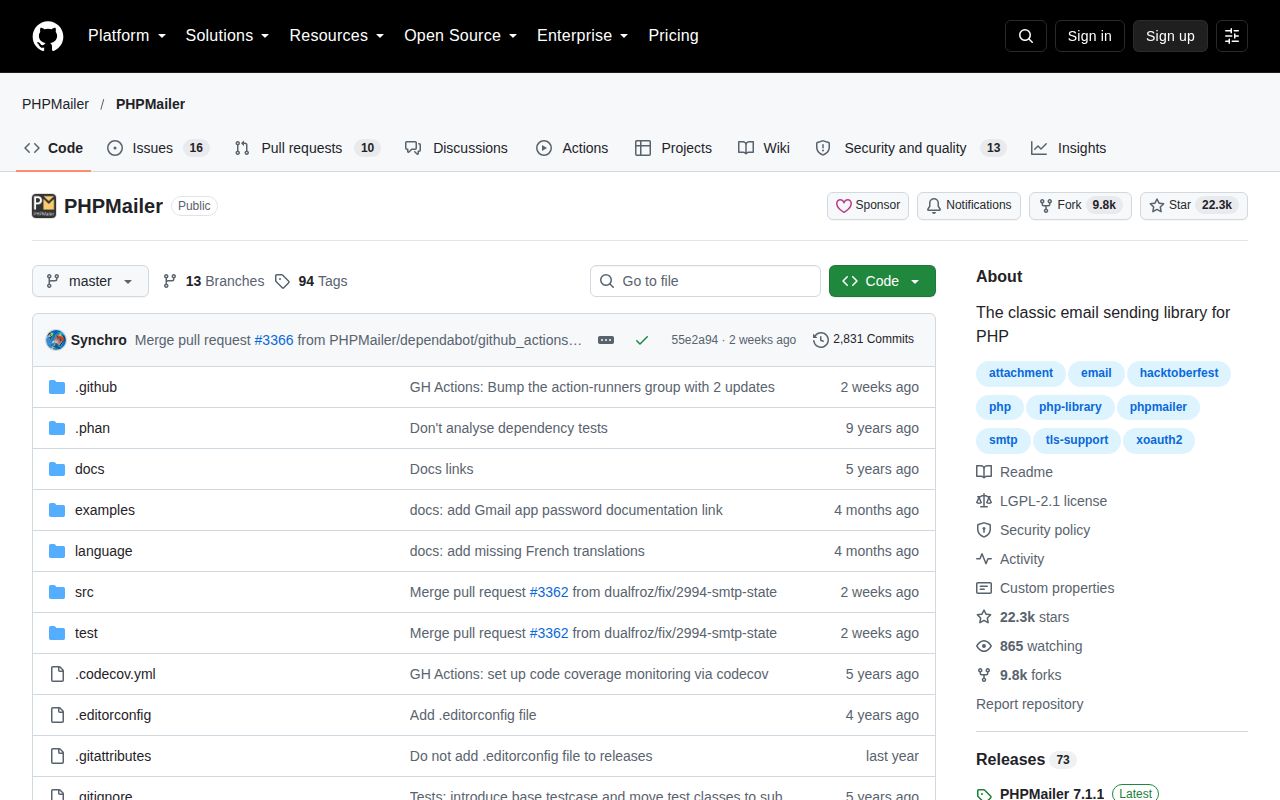
PHPMailer solves the parts of email that PHP leaves exposed
For PHP 5.5 and later, PHPMailer is a focused library for creating and transferring email from applications. That sounds narrow, but the problem is full of MIME boundaries, encodings, address validation, authentication methods, transport security, and inconsistent client behavior. PHP's built-in mail() function offers little help with those details. PHPMailer supplies a higher-level message API and an integrated SMTP client, letting an application send through a remote server even when the host has no local mail daemon.
The project dates to 2011 and has 22,297 GitHub stars in the supplied snapshot. Its README says it is used by WordPress, Drupal, Joomla!, Yii, SugarCRM, and other open-source projects. Those references are not a substitute for testing in your own environment, but they do show why PHPMailer is often the familiar, conservative choice in PHP. The current v7 line supports PHP 5.5 through PHP 8.5, an unusually wide compatibility range that matters in mixed-age estates.
What happened when we ran it
We did not actually run PHPMailer. Our 2026-09-10 sandbox had 3 CPUs and 8 GB of RAM, but the evaluator did not support the PHP ecosystem, and the repository had no Dockerfile that could provide a self-contained route. As a result, we have no honest install result, build duration, test count, or performance number. Treat this review as a source and documentation assessment, not a hands-on confirmation that v7.1.1 works in our container.
That limitation is specific and useful: the project does not package a ready-made container for an ecosystem-neutral evaluation. It is not evidence that normal PHP installation is difficult. For v7.1.1, the documented path is a single composer require phpmailer/phpmailer command, with Composer generating the autoloader. A manual route is also explained, requiring individual files such as src/PHPMailer.php, src/Exception.php, and src/SMTP.php when SMTP is used. We measured none of those paths on our box because PHP execution was unavailable.
Its strongest feature is protocol coverage without a framework
PHPMailer covers the message-building features most applications eventually need: multiple To, CC, BCC, and Reply-to recipients; HTML and plain-text alternatives; regular and inline attachments; UTF-8; and several transfer encodings. It also supports iCal content, automatic address validation, and protection against header injection. Error translations in more than 50 languages are a practical detail for applications that expose delivery failures to operators or users.
The SMTP layer is similarly concrete. It supports SMTPS and SMTP with STARTTLS, plus LOGIN, PLAIN, CRAM-MD5, and XOAUTH2 authentication. DKIM and S/MIME signing cover 2 common trust and security needs, while SMTPUTF8 support helps with internationalized addresses when the server also supports it. These are the kinds of features that make rolling a mail sender risky: a small happy-path script tends to become a poorly tested protocol library once production requirements arrive.
The v7 library also stays relatively unopinionated. It sends messages, but does not force a framework, queue, template language, or provider. That makes it useful in a small PHP script, a legacy application, or a custom service where a larger abstraction would be needless. Namespacing limits collisions, exceptions are supported, and the README includes both Composer and manual loading instructions. API documentation, CI, coverage, and OpenSSF Scorecard badges provide visible maintenance signals, though badges alone do not prove quality.
The rough edges sit around operations, not message composition
Installing v7.1.1 is only the first step. You still need an SMTP provider or local server, credentials, correct ports, transport security, sender-domain authentication, and sensible secret handling. PHPMailer does not promise queueing, scheduled retries, bounce processing, suppression lists, delivery analytics, reputation management, or a template management product. A web request that sends synchronously can still become slow or brittle unless the surrounding application moves delivery into a job queue.
XOAUTH2 is supported, but its setup requires league/oauth2-client plus a provider adapter, adding dependencies and provider-specific work. Manual installation is possible, yet the README itself makes the sensible case for Composer. Legacy users face a sharper boundary: PHPMailer 5.2 is unsupported even for security fixes, and migration introduces the src/ layout and PHPMailer\PHPMailer namespace. Any old application pinned to 5.2 should treat that as upgrade work, not long-term compatibility.
The LGPL-2.1 license also deserves review by organizations with strict distribution policies. It is a well-known open-source license, but it is not the permissive MIT-style default some teams expect. Finally, the breadth of supported PHP versions can be a virtue and a constraint: projects deeply integrated with a modern framework may prefer that framework's own mail component and transport conventions.
The maintenance signals are healthy, with one evidence limit
The latest supplied release is v7.1.1 from May 18, 2026, while the last push was September 10, 2026, just one day before this review. There are 24 open issues against 22,297 stars. Together, recent source activity and a modest visible issue count point to an actively maintained, widely adopted project rather than an abandoned package. The data includes only the latest release, so it cannot support a precise claim about release frequency or response time.
It belongs beside your application, not around your whole mail program
In a real v7 stack, PHPMailer should sit in the application or a dedicated worker, behind a queue when delivery is user-triggered and reliability matters. Configure it to talk to your organization's SMTP relay or transactional email provider, keep credentials outside source control, and capture errors in application monitoring. Let DNS records and the provider handle SPF, DKIM publication, feedback loops, and reputation, even if PHPMailer performs message signing.
Choose PHPMailer v7 when you need direct, explicit control over SMTP and MIME in PHP without adopting a framework. Choose Symfony Mailer or Laminas Mail when their surrounding ecosystems already define your architecture. Choose a hosted transactional platform when the real requirement is not merely sending but managing retries, bounces, analytics, and deliverability at scale. PHPMailer remains an excellent engine, but it is deliberately not the whole vehicle.