Nine configuration groups make GIMP feel closer to Photoshop
PhotoGIMP changes the part of GIMP that a migrating Photoshop user touches first. The README lists 9 configuration groups covering shortcuts, tool order, session layout, docks, preferences, context, splash art, theme adjustments, and canvas templates. Linux also gets a desktop launcher and replacement icon. The result is still GIMP, so filters, file handling, plug-ins, color behavior, and editing capabilities come from the installed GIMP version.
That boundary makes PhotoGIMP easy to understand. Release 3.1 maps shortcuts toward Adobe's Windows documentation, reorganizes the toolbox, adds bracket keys for brush size, and opens imported images with alpha channels. It cannot supply a Photoshop command that GIMP does not implement. Choose it when muscle memory is the obstacle. If a missing editor feature is the obstacle, changing 9 groups of local settings will not solve it.
Installation replaces the GIMP profile, so the backup is part of setup
The README requires GIMP 3.0 or newer. You must run GIMP once, close it, back up its profile, and copy PhotoGIMP's files over the generated configuration. That order matters because GIMP creates and writes its own settings. Copying while the editor is open risks having GIMP save over the incoming layout when it exits. Existing shortcuts and panel choices can also be replaced by the patch.
Removal is direct but blunt. Delete the GIMP 3.0 profile and start GIMP again to create fresh defaults, or restore the saved profile. Linux uses ~/.config/GIMP/3.0. Windows uses a version folder under %APPDATA%\GIMP, and macOS uses one under ~/Library/Application Support/GIMP. These are user files, so a backup is safer than trusting that every old preference can be reconstructed later.
What happened when we ran it
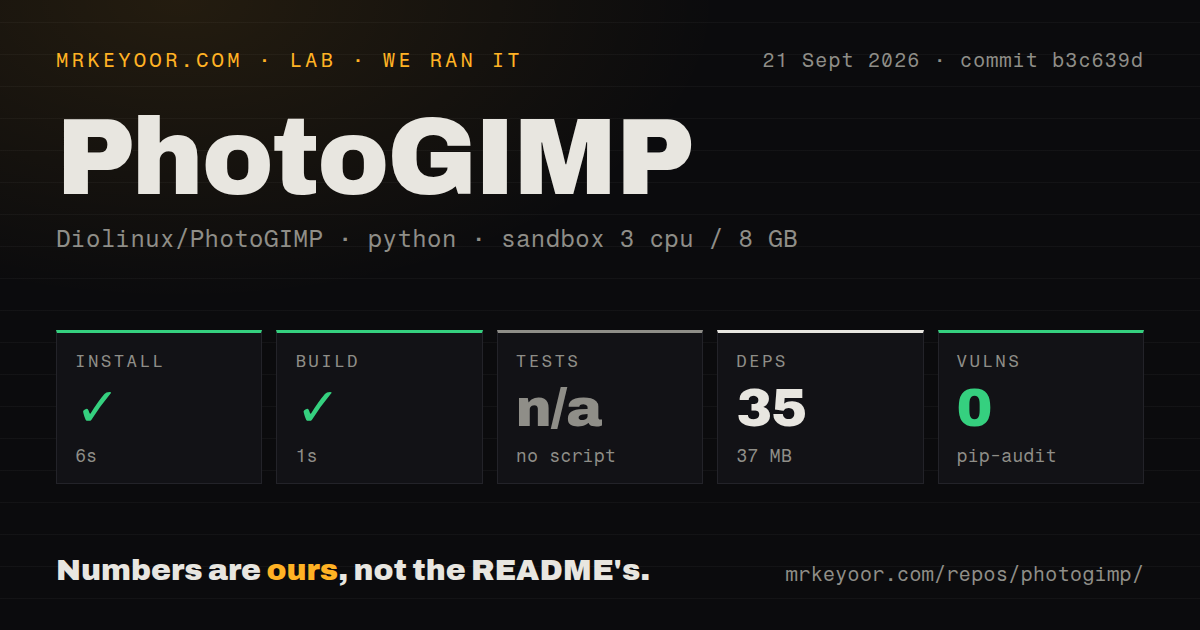
Our sandbox installed PhotoGIMP commit b3c639d in 6 seconds, adding 35 packages and using 37 MB. The build completed successfully in 1 second. Pip-audit found 0 known vulnerabilities in the installed Python environment. The checkout itself held 61 files, about 500 source lines, and 3.9 MB of repository data. Those numbers fit a packaging and configuration project rather than a second image editor.
There was no test script or target, so our pipeline skipped tests. That is the central limitation of this run. We did not launch GIMP, copy a profile into a graphical desktop, press the remapped keys, or inspect the panels on Linux, Windows, and macOS. A successful 1-second build says the repository's build step completed. It does not prove that the shipped configuration matches a particular GIMP release.
The measured repository had 2 CI workflow files, no Dockerfile, and no tests directory. A container would add little for a patch that needs a real desktop profile. Automated checks could still parse the release archives, verify expected paths, and compare action names with supported GIMP versions. With no supplied test target, compatibility reports from actual desktops carry more weight in this review.
GIMP 3.2 ignores 3 stale path-related entries
Issue 248 documents a specific GIMP 3.2 mismatch in PhotoGIMP 3.1. GIMP renamed vector actions and tools to path names, while the patch still ships the GIMP 3.0 identifiers. The reporter found 3 ignored entries in shortcutsrc, sessionrc, and toolrc, plus a related tool-options path. GIMP's log rejected those names even after the configuration was copied into the correct version folder.
One visible consequence concerns the b shortcut. PhotoGIMP tries to free it from the old Paths action so it can match Photoshop's Paintbrush binding. On GIMP 3.2, the obsolete unbind line is ignored. The same report says renaming 3 entries removed the warnings, but supporting both GIMP 3.0 and 3.2 may require version-specific files. That is a maintenance problem for a patch whose value rests on exact shortcut behavior.
Three operating systems have instructions, with different failure points
The README gives separate Linux, Windows, and macOS procedures, plus 10 translated guides. Linux users extract hidden .config and .local trees into the home folder. Windows users copy the numbered folder into %APPDATA%\GIMP. macOS users can merge through Finder or use rsync when Finder skips existing files. That is solid documentation for a manual patch, and the uninstall steps sit beside the install steps.
The archive shape still trips users. Open issue 242 says PhotoGIMP-linux.zip expands into a top-level PhotoGIMP-linux directory, so extracting it into the home folder does not place .config where the instructions say. Other reports concern GIMP 3.2 folders, a launcher that opens unchanged GIMP, and a layout wider than a 1,366 by 768 display. Version and screen size should be part of a first-run check.
Release 3.1 is maintained, but compatibility follows GIMP's config format
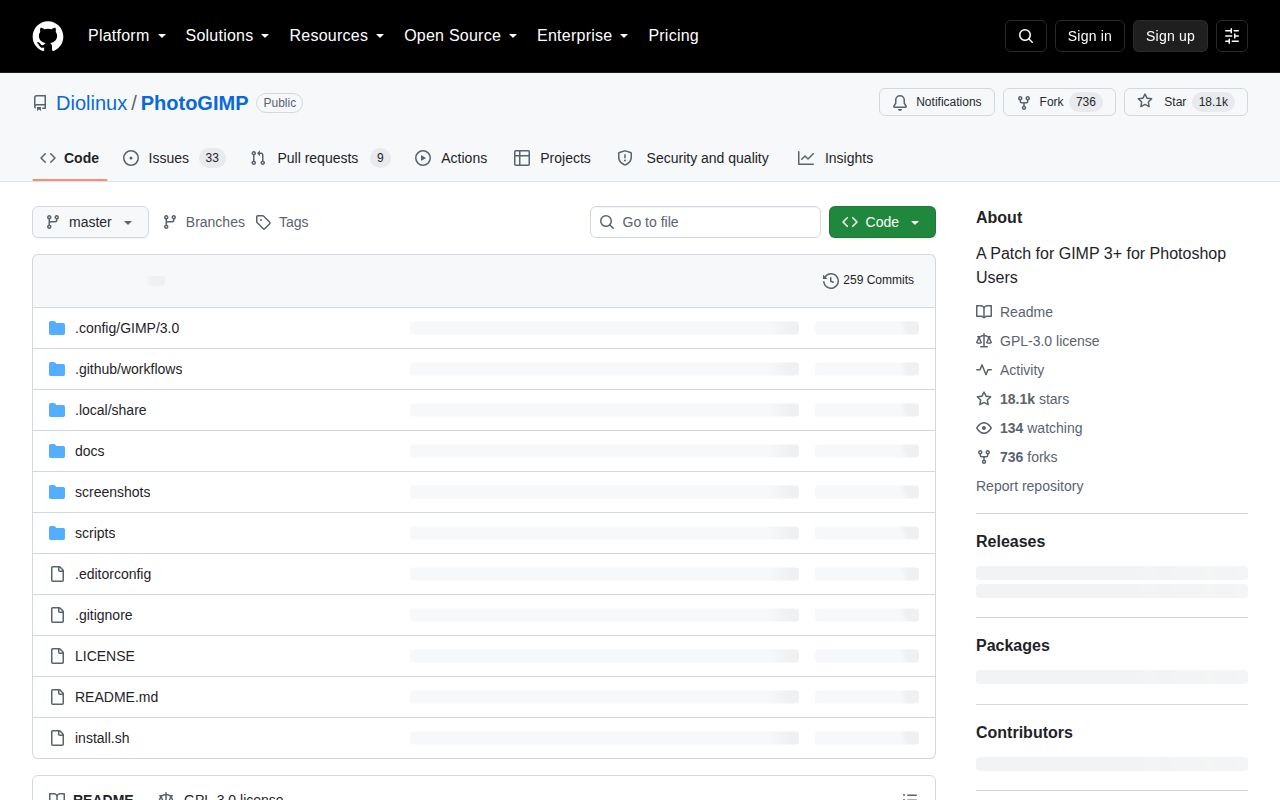
GitHub showed 18,079 stars, 736 forks, and 42 combined issues and pull requests. An issue-only search returned 33 open issues. Release 3.1 arrived on July 11, 2026, and the repository was pushed on September 5. The project is maintained and licensed under GPL-3.0. Its risk comes from tracking another application's configuration names across operating systems, not from an abandoned repository.
PhotoGIMP is a sensible bridge for someone who already knows Photoshop shortcuts and has just installed GIMP 3.0. Our 7 seconds of successful install and build work make the files easy to inspect, while the missing test target leaves desktop behavior unproved. Back up the profile, confirm the exact GIMP version, and test b, the Paths dock, window sizing, and launcher behavior before adopting the layout for daily work.