OpenSSL is core security plumbing, not merely a certificate command
OpenSSL packages libssl for secure transport, libcrypto for general cryptographic operations, and the openssl command-line program for operational work. The project traces its ancestry to SSLeay and carries copyright history from 1995 through 2026. Choosing it is an infrastructure decision, not the same kind of choice as adding a small application library. It can sit below servers, network clients, and tooling that must create or inspect keys and certificates.
Protocol coverage is a central reason to choose it. The README lists TLS through version 1.3, DTLS through version 1.2, and QUIC version 1. The command-line tool can create key parameters, X.509 certificates, signing requests, and revocation lists; calculate digests; encrypt and decrypt; exercise clients and servers; test QUIC clients; and handle S/MIME mail. Libcrypto is also usable without the TLS implementation.
What happened when we ran it
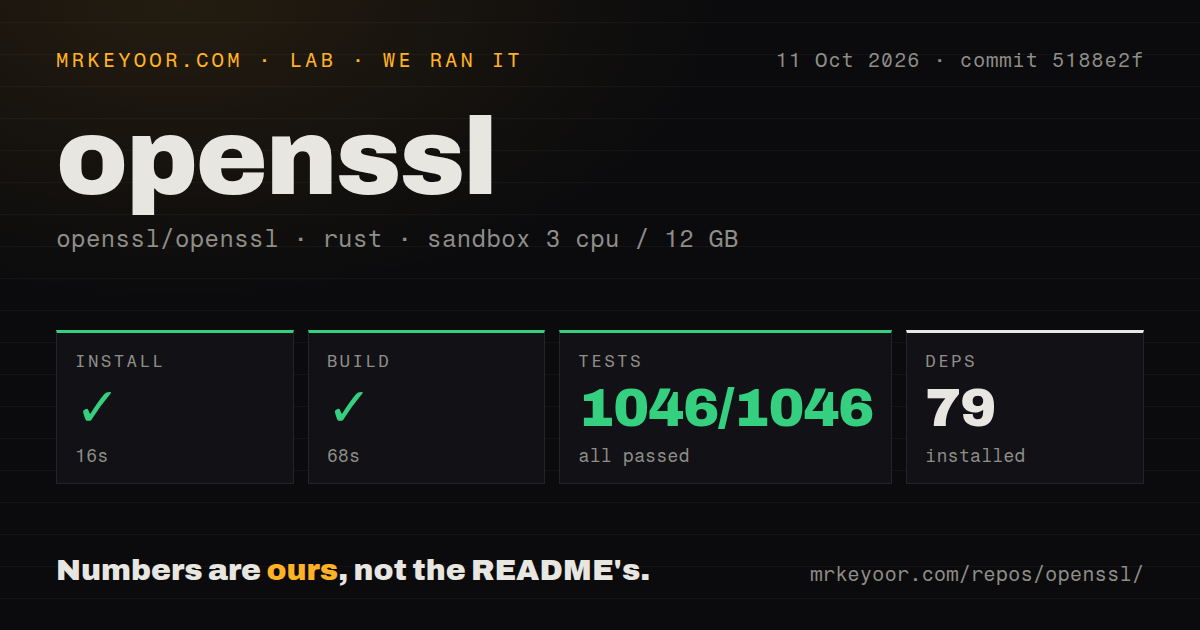
Our supplied run used commit 82733d9 in an unprivileged Debian container with 3 CPUs and 12 GB of RAM. Installation succeeded in 18 seconds with 81 packages. The build succeeded in 69 seconds. Tests completed in 37 seconds, with 1,046 passed and 0 failed. Those are clean results for a checkout recorded as 47,202 files, roughly 2,544,646 source lines, and 588.5 MB. It also exposed 32 CI workflow files, a Dockerfile, and a tests directory.
There is an important limit on that evidence: the lab metadata identifies Rust and says the exercised project lives in ./cloudflare-quiche. The repository under review is the C-based openssl/openssl project. We would not treat the 69-second build as a direct measurement of OpenSSL's documented native build process. It is valid evidence about what our runner executed, but buyers should reproduce the OpenSSL-specific Configure, build, and test path for their operating system.
Its strongest case is breadth with documented boundaries
OpenSSL covers transport protocols and standalone cryptography in one project, paired with practical diagnostics. The README routes readers to dedicated notes for Unix-like systems, Android, Windows, DOS with DJGPP, OpenVMS, Perl, and Valgrind. It also links a migration guide for earlier releases moving to OpenSSL 3.x. That documentation map is appropriate for a security-sensitive dependency where platform behavior and upgrade compatibility deserve explicit treatment.
Documentation is split sensibly by job. There are versioned manuals for OpenSSL 4.0, 3.6, 3.5, 3.4, and 3.0, an introductory guide, demos, and focused files for QUIC, providers, and FIPS use. The project states a useful production boundary: official releases are source tarballs, while most Linux and Unix users should normally link against shared libraries from their distributor or vendor.
The rough edges come from scope, responsibility, and evidence gaps
A toolkit this broad creates a large decision surface. Applications may need to choose between libssl and direct libcrypto use, understand providers, plan migrations, and account for platform-specific builds. OpenSSL 4.0 documentation exists, but the README calls out migration guidance to 3.x, signaling that upgrades deserve engineering attention. The presence of a FIPS-validated module does not by itself prove that any particular application deployment is compliant.
The project does not publish official binaries, instead pointing to operating-system packages and third-party builds. Support has different channels depending on the requirement, so teams should read SUPPORT before assuming GitHub issues are right. The legal section warns that some nations restrict cryptography use or export. With 1,569 open issues, self-support and vendor selection remain practical considerations.
The project looks active, but issue volume needs interpretation
The repository reports 30,752 stars, while the community snapshot lists 30,736, both roughly 30.7k. More useful for current health, the latest push was September 4, 2026, only 1 day before this review. The latest listed release, openssl-4.0.2, arrived August 25, 2026, or 11 days before review. Those dates show current code and release activity, not popularity alone.
The 1,569 open issues are substantial, but the count does not reveal response time, severity, duplicates, or maintainer throughput. One recent 4.0.2 release also cannot establish long-term cadence. The README provides several maintenance signals: GitHub Actions CI, nightly operating-system coverage, provider compatibility, QUIC interoperability, and daily checks. Adopters should still inspect the relevant stable branch, advisories, and vendor backport policy.
It belongs below applications and often behind a vendor package
In a real stack, OpenSSL belongs at the transport and cryptography layer, consumed by a server, client, runtime, proxy, or operating-system package. Its command-line utility is useful beside that layer for certificate work and protocol tests. On common Linux or Unix systems, the README's recommendation is persuasive: let the distributor handle packaging and updates unless there is a concrete reason to own a 4.0 source build.
Alternatives reflect different priorities. LibreSSL suits teams aligned with its OpenBSD-led direction. BoringSSL makes sense for controlled integrations that accept its product-focused API policy. GnuTLS offers a separate GNU-oriented TLS stack, while wolfSSL targets embedded or constrained environments. If OpenSSL API compatibility, its 3.x and 4.0 documentation families, and its command-line toolbox are requirements, replacing it may create more work than it removes.
The practical recommendation is conservative
Use OpenSSL when libssl, libcrypto, or the openssl utility clearly matches the requirement. Prefer a maintained vendor package for production, pin the supported branch, and test the exact integration rather than extrapolating from our Rust-subproject run. The project is mature and active by the supplied dates, but its 1,569-issue backlog and broad low-level API make it a dependency to manage deliberately.