One Operator covers more than 50 storage backends
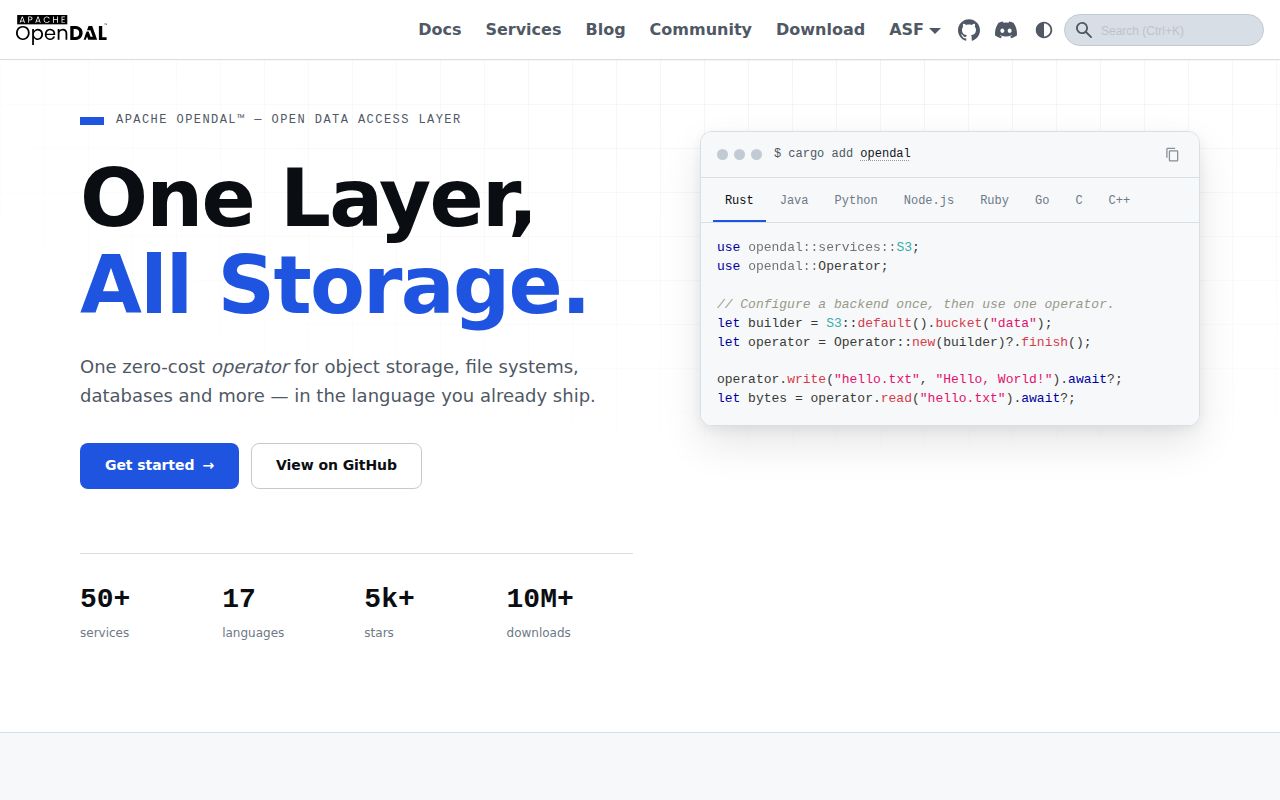
Apache OpenDAL puts a common set of storage verbs behind an Operator. Configure a service, build the operator, optionally wrap it in layers, then call read, write, stat, list, delete, copy, or rename. The documented service list spans S3-compatible object stores, Google Cloud Storage, Azure Blob, local files, HDFS, FTP, WebDAV, cloud drives, databases, key-value stores, and caches. The memory backend gives tests the same API without credentials.
This is useful when storage is a deployment choice rather than an application identity. A service can use memory in unit tests, a local filesystem during development, and S3 in production while keeping its operation code stable. Operators are cheap handles that can be shared across tasks, but each maps to one service and one root. Two buckets need two operators. Paths are always relative to that root, and a trailing slash marks a directory.
What happened when we ran it
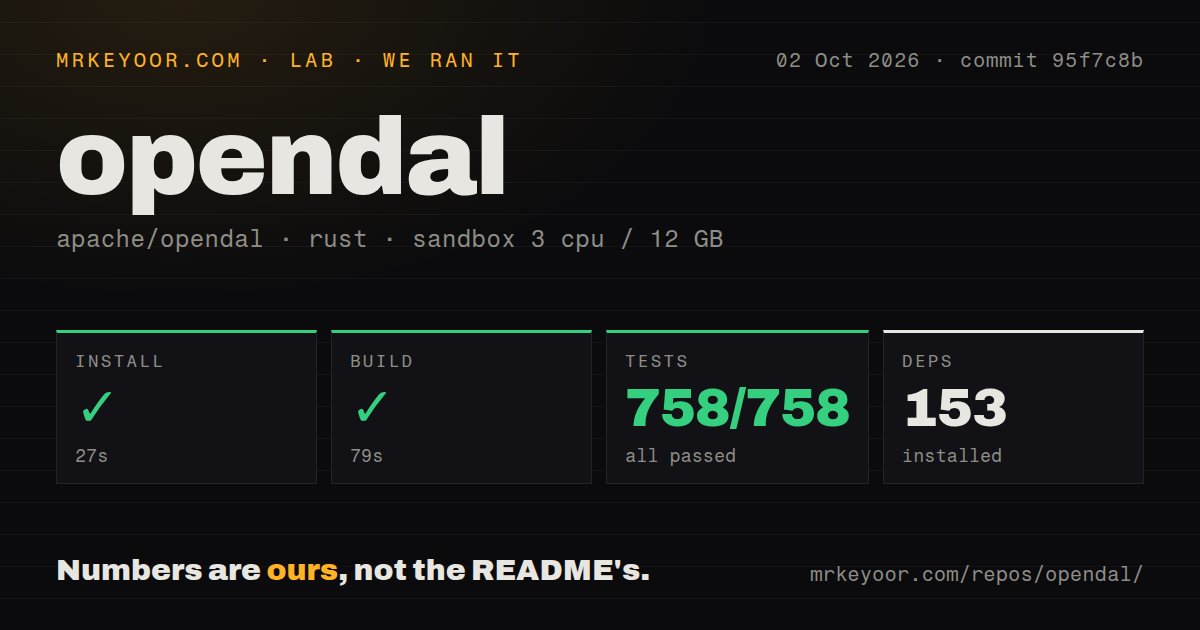
Our sandbox installed 155 Rust packages in 60 seconds. The core build succeeded in 102 seconds, and cargo test finished in 57 seconds with 652 passed and 0 failed out of 652. We ran commit d5dd6df from the repository's ./core/ directory in an unprivileged Rust container with 3 CPUs and 12 GB of RAM. The supplied result contains no failed step.
The checkout had 2,542 files, roughly 267,871 lines of source, and occupied 19.2 MB. Our scan found 50 CI workflow files and a tests directory, but no Dockerfile. Those figures describe the full repository, which includes many language bindings, while the install, build, and 652 tests describe the Rust core. They do not prove that every remote service or language package works with real credentials. OpenDAL's own contribution rules require service-specific bugs to be reproduced against the actual provider rather than inferred from source or an emulator.
Feature flags keep unused services out of the Rust build
The in-memory service is always available. Every other backend sits behind a services-* Cargo feature, so an S3 consumer enables services-s3 instead of compiling the whole catalog. Typed builders expose a provider's configuration, while maps and URIs support configuration chosen at runtime. Credentials are ordinary settings passed into the builder, but the guide tells applications to source them from an environment or secret manager rather than hard-coding them.
OpenDAL is async-first and uses Tokio by default. Synchronous Rust applications can enable the blocking feature and wrap an async operator, but that wrapper must be constructed outside an existing async context. Python has both Operator and AsyncOperator; other bindings cover Java, Node.js, Go, C++, and more. Each binding carries an independent version, so a team cannot infer Python compatibility from the Rust crate's v0.58.2 tag. Release management has to follow every runtime actually shipped.
Capability checks are the price of a shared API
Storage products do not agree on semantics. One may support server-side copy, another only read and write, and a third may expose presigned requests or conditional writes. OpenDAL reports each operator's capabilities, and calling an unsupported operation returns ErrorKind::Unsupported. That prevents silent invention of a feature, but portable code still needs a fallback or a narrower contract. The common API reduces call-site variation; it cannot make providers equivalent.
Issue 8157 shows the difficulty through atomic conditional delete. S3, Azure, GitHub, OneDrive, WebDAV, Google Cloud Storage, Dropbox, and other services use different tags, revisions, batch paths, or no documented atomic condition. The issue requires live behavior tests before a service advertises support and rejects a racy HEAD-then-DELETE emulation. Coordination code for leases or orphan cleanup should choose providers based on that capability instead of assuming the shared delete verb is enough.
Four default layers cover the first production controls
Retry, timeout, concurrent-request limits, and logging ship in the default Rust features. Layers wrap an operator in application-selected order; the last applied layer is outermost and sees the request first. The production guide places logging outside retry so every attempt is recorded, then shows a 3-attempt retry, 10-second timeout, and 16-request concurrency cap as an example rather than universal settings. Metrics, Prometheus, tracing, and OpenTelemetry layers use extra features.
Typed error kinds let code distinguish missing data, permission failures, rate limits, existing objects, and unsupported calls without parsing messages. Delete is idempotent, so deleting an absent path succeeds instead of returning NotFound. These decisions are documented well enough to build policy around them. Still, retry safety and timeout values depend on the operation and provider. A reusable layer is a mechanism, not proof that every request should be retried.
Release v0.58.2 fixed a missed integration break
GitHub recorded 5,342 stars, 318 combined issues and pull requests, and a push on August 27, 2026. The latest release, v0.58.2 from August 21, is candid about a mistake: object_store_opendal moved to the object_store 0.14 API, incompatible releases were yanked, and DataFusion 54 users were told to pin object_store_opendal 0.58.0. That is responsible recovery, but it also proves that integration versions need their own upgrade tests.
The same release contains provider-specific fixes for conditional uploads, pagination, path handling, writes, and listing across numerous services. Breadth creates maintenance surface. Our 652 passing core tests justify confidence in the common layer, while issue 8157 and the release notes argue for a live test matrix over the small set of providers and operations your product depends on. OpenDAL is strongest when that investment replaces several separate adapters. For one cloud, its native SDK may be the simpler and more complete choice.