mrkeyoor.com_
Tue 08 Sept 15:03 UTC
Self-Hostedevaluationupdated 08 Sept 2026

OpenClash review

OpenClash is a Chinese-language LuCI client for running the Mihomo proxy core on an OpenWrt router. The repository provides no English README or English user guide, so English-speaking operators must translate the Chinese documentation before changing DNS, firewall, subscription, or routing settings.

trackingstars / 7d
Verdict

Our OpenClash checkout installed 69 CodeMirror packages in 57 seconds, but it exposed no build or test target for the router application. Use v0.47.156 only if OpenWrt is already familiar territory and Chinese documentation is workable for the operator. For a general Linux host or a network where DNS and firewall changes cannot be rehearsed and rolled back, run Mihomo through a narrower deployment path.

We ran it

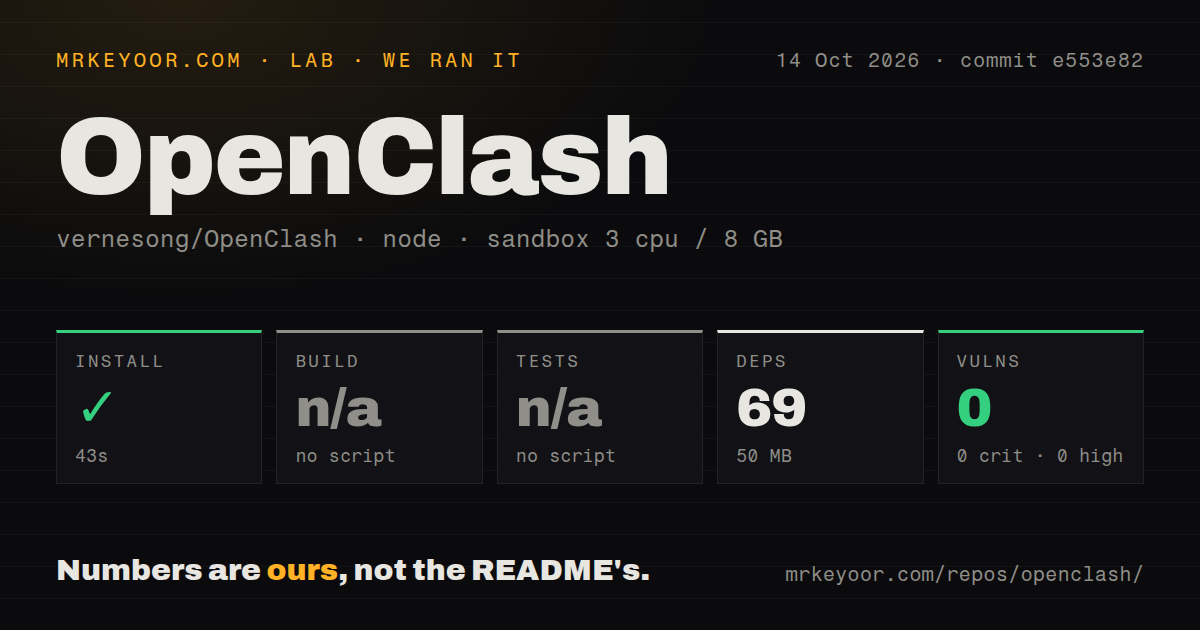
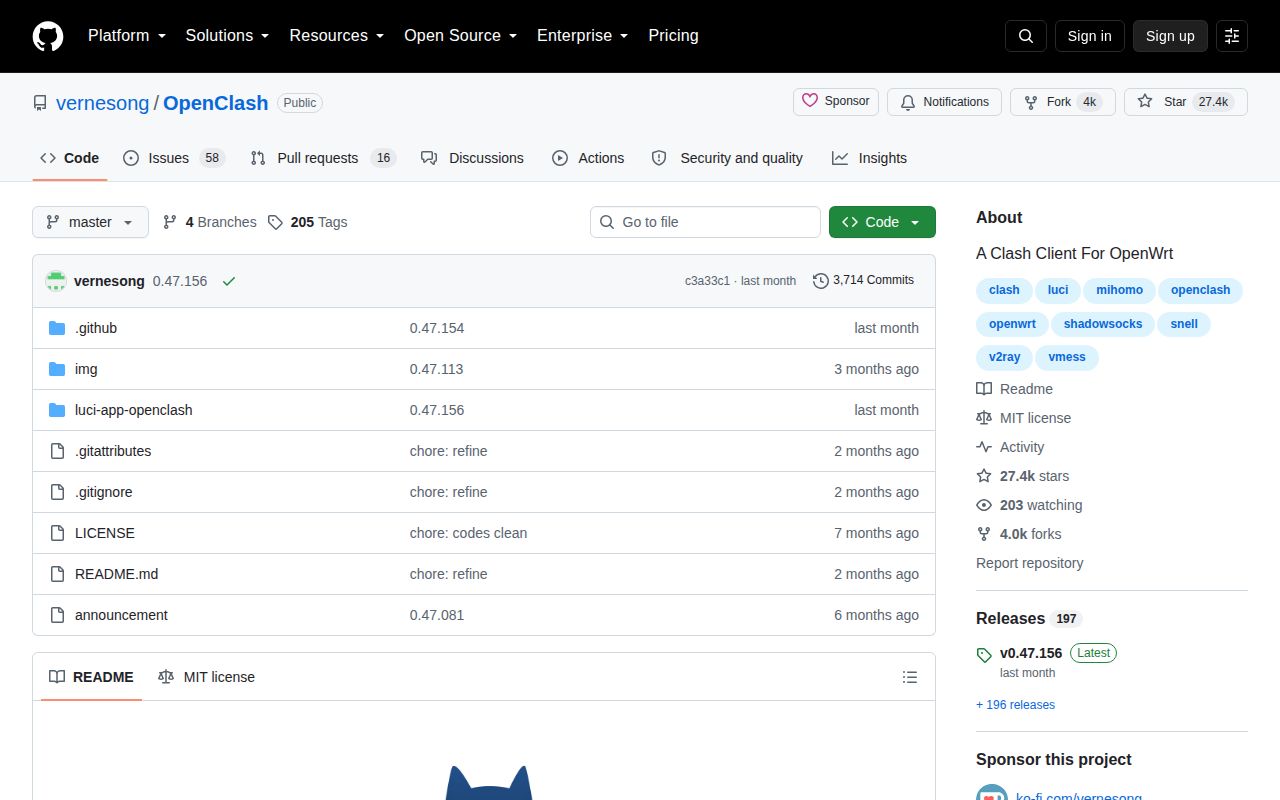
Lab card: what happened when we ran OpenClashScreenshot of OpenClash (github.com/vernesong/OpenClash)
Install✓ · 57s69 packages · 50 MB
Buildn/ano build script
Testsn/ano test script
Known vulns00 critical · 0 high · 0 moderate · 0 low (npm audit)
Repo224 files~16,542 lines of source · 23.2 MB · 9 CI workflows

Answers from our run

Does OpenClash build from source?

Dependencies installed in 57 seconds (69 packages), and the project has no separate build step. We cloned commit c3a33c1 into a clean Debian container with 3 CPUs and no project-specific setup.

Does OpenClash have tests you can run?

Not through a standard command: the project exposes no test script or target that our harness could run.

Does OpenClash have known vulnerabilities in its dependencies?

npm audit found none in the dependency tree at the time of our run.

Who should not use OpenClash?

Users on a general Linux host, NAS, or desktop rather than OpenWrt: OpenClash depends on LuCI, UCI, dnsmasq-full, and router firewall modules.

What are the alternatives to OpenClash?

Nikki, HomeProxy, Mihomo. Our OpenClash checkout installed 69 CodeMirror packages in 57 seconds, but it exposed no build or test target for the router application.

Setup2/557-second tool install; router setup spans DNS, firewall, and a core
Docs3/5Detailed Chinese guide, but no official English path
Community5/527,409 stars with issues and code moving in September 2026
Maturity3/5v0.47.156 is active, but router edge cases remain open

Who it’s for

OpenWrt administrators who want Mihomo policies applied at the router.
Chinese-reading operators comfortable debugging dnsmasq, nftables or iptables, TUN, and policy routing.
Households or small networks that want device-level proxy inclusion and exclusion from LuCI.
Users prepared to maintain a Mihomo configuration or subscription and check generated router rules.

Who it’s NOT for

Users on a general Linux host, NAS, or desktop rather than OpenWrt: OpenClash depends on LuCI, UCI, dnsmasq-full, and router firewall modules.
English-only administrators who need official setup and incident documentation: the repository has no English README or English user guide.
Operators unwilling to let a plugin rewrite DNS and firewall paths: OpenClash implements transparent proxying through dnsmasq, nftables or iptables, TPROXY, and optional TUN.
OpenWrt ARM64 snapshot users who require reliable unattended boot on v0.47.156: issue 5286 reports no automatic start after reboot until a manual restart.
Single-arm side-router deployments that access other services on proxy-node IPs: issue 5313 reports SSH traffic stalling under a specific nftables route arrangement.
UDP workloads that require proven redir-host behavior on OpenWrt 25.12: issue 5317 reports missing return traffic in that mode and a startup watchdog race.

Setup reality

Our sandbox entered luci-app-openclash/tools/codemirror, installed 69 npm packages in 57 seconds, and used 50 MB. There was no build script or target and no test script or target, so both steps were skipped. npm audit reported 0 known vulnerabilities. Commit c3a33c1 had 224 files, about 16,542 source lines, and a 23.2 MB checkout.

That run did not install OpenClash on a router. Real setup needs OpenWrt, LuCI, dnsmasq-full, Bash, curl, CA certificates, Ruby with YAML support, firewall packages, and mode-specific kernel modules. You also need a Mihomo core plus a usable YAML configuration or proxy subscription, which may contain provider credentials.

Choose the correct package and firewall family: IPK or APK, then iptables or nftables. TUN needs kmod-tun; firewall4 needs kmod-nft-tproxy. The release notes advise against IPv6 and tell users to disable browser secure DNS when diagnosing routing. English operators also face a translation burden because official instructions are Chinese.

OpenClash v0.47.156 makes an OpenWrt router the Mihomo gateway

OpenClash v0.47.156 is a LuCI control layer for running Mihomo on OpenWrt. It takes a proxy subscription or YAML configuration, changes the effective Mihomo settings, starts the core, and installs the DNS plus firewall rules that steer router and client traffic. The web interface covers proxy modes, device access controls, rule updates, dashboards, and core updates. Its job is network-wide routing, so mistakes affect more than one browser or workstation.

Protocol support in the README includes Shadowsocks, ShadowsocksR, VMess, Trojan, and Snell. Mihomo does the proxy work; OpenClash manages it and connects it to OpenWrt. The distinction matters when reporting bugs because the core, dashboard, subscription converter, and plugin are separate projects. OpenClash is attractive when one router should enforce policy for many devices. A laptop-only user gets less value and accepts much more network complexity.

What happened when we ran it

Our sandbox entered luci-app-openclash/tools/codemirror and installed 69 npm packages in 57 seconds, consuming 50 MB. npm audit found 0 known vulnerabilities. The subproject had no build script or target and no test script or target, so both steps were skipped. This measured the bundled editor toolchain at commit c3a33c1. It did not boot OpenWrt or send traffic through Mihomo.

The full checkout measured 23.2 MB, with 224 files and about 16,542 lines of source. We found 9 CI workflow files, no Dockerfile, and no tests directory. Those signals fit a router package made from LuCI pages and system scripts, but they leave no general sandbox test result for DNS interception, firewall rollback, subscription parsing, or reboot. A buyer should not read the clean npm audit as a health certificate for the router application.

Twenty documented dependencies stand before first routed traffic

The README lists 20 required or mode-specific packages, including LuCI, dnsmasq-full, Bash, curl, CA certificates, Ruby, Ruby YAML support, ip-full, unzip, and several firewall or kernel modules. OpenWrt's smaller dnsmasq build is insufficient for the documented DNS and IP-set behavior. TUN mode needs kmod-tun, while firewall4 uses kmod-nft-tproxy; older firewall3 paths need the matching iptables pieces.

Installation also branches by package system and firewall generation. Release v0.47.156 gives separate commands for IPK and APK packages, then separate dependency sets for iptables and nftables. After installation, the operator must confirm the Mihomo core build and place or download the clash_meta binary. A working proxy subscription or YAML file is still required. OpenClash does not provide proxy endpoints, accounts, or a safe policy for your particular network.

Six routing modes change the DNS and firewall data path

The user guide documents 6 combinations across redir-host, fake-IP, TUN, and mixed modes. Non-TUN modes use TCP redirect plus UDP TPROXY, full TUN modes send both through a tunnel, and mixed modes divide TCP and UDP. DNS can pass through dnsmasq before Mihomo or be redirected to the core directly. These are material changes to name resolution, connection tracking, and policy routing, not cosmetic toggles in LuCI.

OpenClash stores its own UCI settings, rewrites generated YAML, installs firewall chains, and starts scheduled updates plus a watchdog. Stopping the service is expected to restore firewall and dnsmasq state. That moving sequence is why the guide tells users to generate a debug log before diagnosing failures. Anyone deploying remotely should keep an out-of-band recovery path and a saved router configuration before changing the 6-mode routing setup.

Chinese documentation leaves English operators translating incidents

The repository tree at commit c3a33c1 contains one README and one large user guide, both written in Chinese. The guide is technically detailed, covering dependencies, startup order, UCI keys, generated YAML, firewall chains, DNS modes, diagnostics, and LuCI navigation. It is useful material for a Chinese reader. There is no official English README or English user guide in that tree, so an English-only administrator will translate both setup steps and failure messages.

That language gap matters more here than in a simple command-line utility. Release notes tell users that reported connection trouble often involves IPv6, browser secure DNS, modified host files, or stale dashboard assets. Each warning changes how traffic leaves an entire LAN. Machine translation can help with discovery, but incident response needs exact interpretation of a 3-way interaction among OpenWrt, OpenClash, and Mihomo. Teams should assign an operator who can read the source material confidently.

Three current issues show where router topology matters

Issue 5317 reports missing UDP return traffic with v0.47.156 in redir-host mode on OpenWrt 25.12.5, plus a watchdog check firing before one route table was ready. The reporter found the same traffic worked after switching to a mixed mode, but that single environment does not prove a general fix. Issue 5313 describes stalled SSH to a proxy-node IP through a single-arm nftables side router, tied to asymmetric routing and rule order.

Issue 5286 reports that v0.47.156 did not start automatically after reboot on an ARM64 OpenWrt snapshot and needed a manual restart. GitHub listed 74 combined issues and pull requests, while the last push was September 7, 2026, and pull request 5318 arrived September 8. That is active maintenance around an active problem queue. OpenClash is worth considering for an experienced OpenWrt operator, but the router topology and chosen mode need their own acceptance test.

Alternatives

ProjectWhat it isPick it when
NikkiAnother OpenWrt LuCI integration for managing a Mihomo-based proxy gateway.pick this instead when its package support, interface, and routing model match your OpenWrt build better.
HomeProxyAn OpenWrt proxy client built around sing-box with LuCI configuration.pick this instead when sing-box is your chosen core and you want an OpenWrt-native control surface.
MihomoThe proxy core OpenClash manages, usable without the OpenClash LuCI layer.pick this instead when you can operate the core directly or need it on a non-OpenWrt host.

What people are saying

  1. [velocity-scout] vernesong/OpenClash

Sources

  1. OpenClash README
  2. OpenClash repository facts
  3. OpenClash v0.47.156 release
  4. OpenClash Chinese user guide
  5. Issue 5317: UDP return path and watchdog report
  6. Issue 5313: single-arm side-router SSH report
  7. Issue 5286: ARM64 snapshot boot report

More self-hosted reviews

FlClash · zulip · mediamtx · toolhive · HAMi · filebrowser · the whole board →