Nixpkgs describes more than 140,000 package builds
The README defines Nixpkgs as a collection of more than 140,000 software packages for the Nix package manager. The same repository implements NixOS through modules and system definitions. Unlike a catalog that only stores download metadata, each Nix expression can describe sources, dependencies, build steps, patches, configuration, and outputs. Users can install an individual tool, construct a development shell, or evaluate an operating-system configuration from the same package universe.
That common model is the reason to adopt Nixpkgs. A pinned revision gives a project a precise package set instead of whatever a machine's mutable package database contains today. NixOS carries the idea to services, users, filesystems, boot settings, and other host configuration. The tradeoff is a language and evaluation model that new users must learn. The README links separate manuals for Nix, Nixpkgs, and NixOS because each layer has its own concepts.
Hydra builds packages that reach cache.nixos.org
Nixpkgs does not rely on GitHub Actions alone for its main distribution path. Hydra continuously evaluates and builds unstable master plus release branches. Successful artifacts are published to cache.nixos.org, allowing users to download binaries rather than rebuild every dependency. The README links current jobs for unstable and NixOS 26.05, along with their system-test sets. That infrastructure is part of the product, even though it lives outside the checkout we measured.
A cache hit and a local build have different operational costs, so pinning matters. An expression can evaluate successfully while a chosen platform lacks a cached artifact, leaving the local machine to compile it. Teams should choose an update cadence, retain known-good revisions, monitor store growth, and test garbage collection and rollback. Reproducibility reduces hidden machine drift; it does not remove storage, compute, upstream source availability, or package-maintainer decisions.
What happened when we ran it
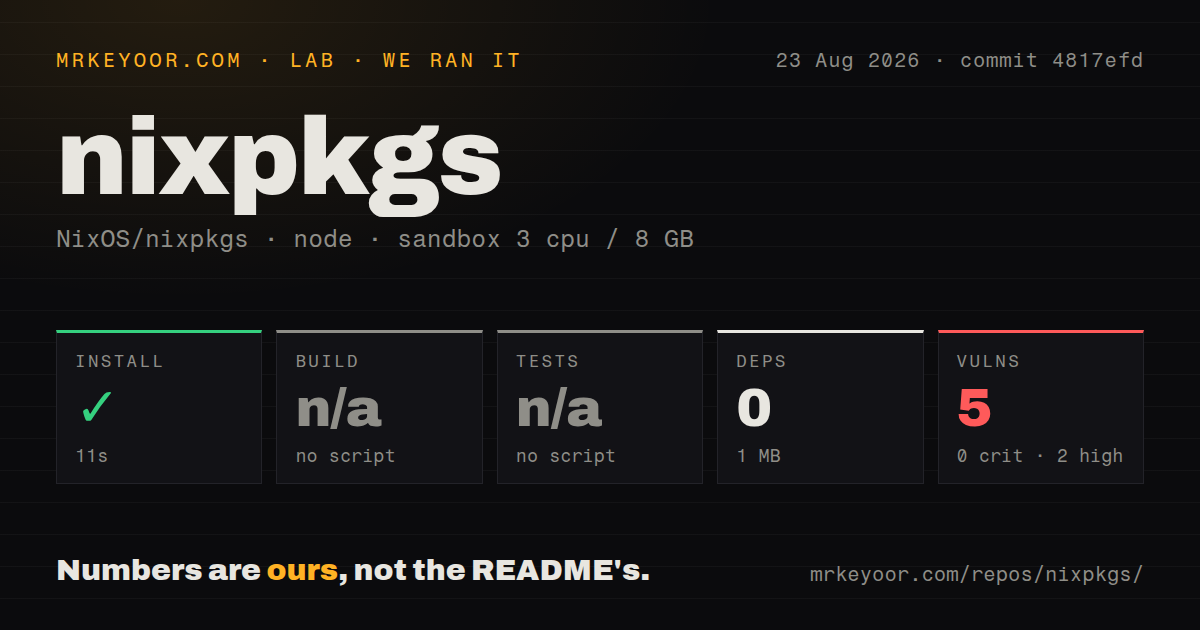
Our sandbox measured only the Node project in ci/github-script/ at commit 4817efd. Npm install completed in 11 seconds, added 0 packages, and used 1 MB on disk. The subproject had no build script or target and no test script or target, so we skipped both steps. Npm audit reported 5 known vulnerabilities: 2 high, 3 moderate, 0 critical, and 0 low.
Those results say nothing about whether 140,000-plus Nix packages build. We did not install Nix, evaluate NixOS, invoke Hydra, build a package derivation, fetch from the binary cache, or boot a system test. The lab targeted a small CI helper because it was the detected npm project. The correct finding is narrow: that helper installed quickly without adding dependencies, lacked build and test targets, and produced a non-clean audit report.
The checkout itself was substantial: 53,986 files, about 132,211 source lines by our scanner, and 194.8 MB. We found 17 CI workflow files, no Dockerfile, and no top-level tests directory. Nixpkgs checks live across package expressions, maintainer workflows, NixOS tests, and Hydra jobs rather than one conventional root suite. Contributors should run the checks named for the package or module they change and inspect Hydra results before merging.
Five helper vulnerabilities need a scoped reading
The npm audit result belongs to ci/github-script/, not to every binary distributed by Nixpkgs. It should neither be inflated into a NixOS security verdict nor dismissed because the helper installed 0 new packages. Two high-severity and 3 moderate advisories existed in the dependency state we measured. Maintainers should identify the affected dependency paths and whether the GitHub workflow can reach vulnerable behavior, then update or mitigate them.
Package security is a much wider system. Nixpkgs carries thousands of upstream projects with independent disclosure and patch cycles. An August 26 pull request, for example, removed a stale known-vulnerability warning while backporting to release 26.05. That sort of activity shows security metadata is maintained at package level. It does not guarantee that every package is current or appropriate for a given threat model. Users still need advisories and package-specific review.
MIT covers expressions, not every packaged program
The repository is MIT licensed, but the README immediately narrows that statement. MIT applies to Nix expressions, build scripts, NixOS modules, and similar repository files. Software built by those expressions retains its own license. Included patches may also carry terms derived from the upstream package. A compliance process therefore needs per-package license information and cannot stop after reading COPYING at the repository root.
This distinction matters when a team builds container images, appliances, developer workstations, or redistributed systems from Nixpkgs. The collection makes package selection reproducible, which can improve license inventory, but it does not make incompatible terms disappear. Record the exact revision and closure used for each shipped output, then review the licenses inside that closure rather than assuming one MIT umbrella.
Same-minute pull requests show scale and review pressure
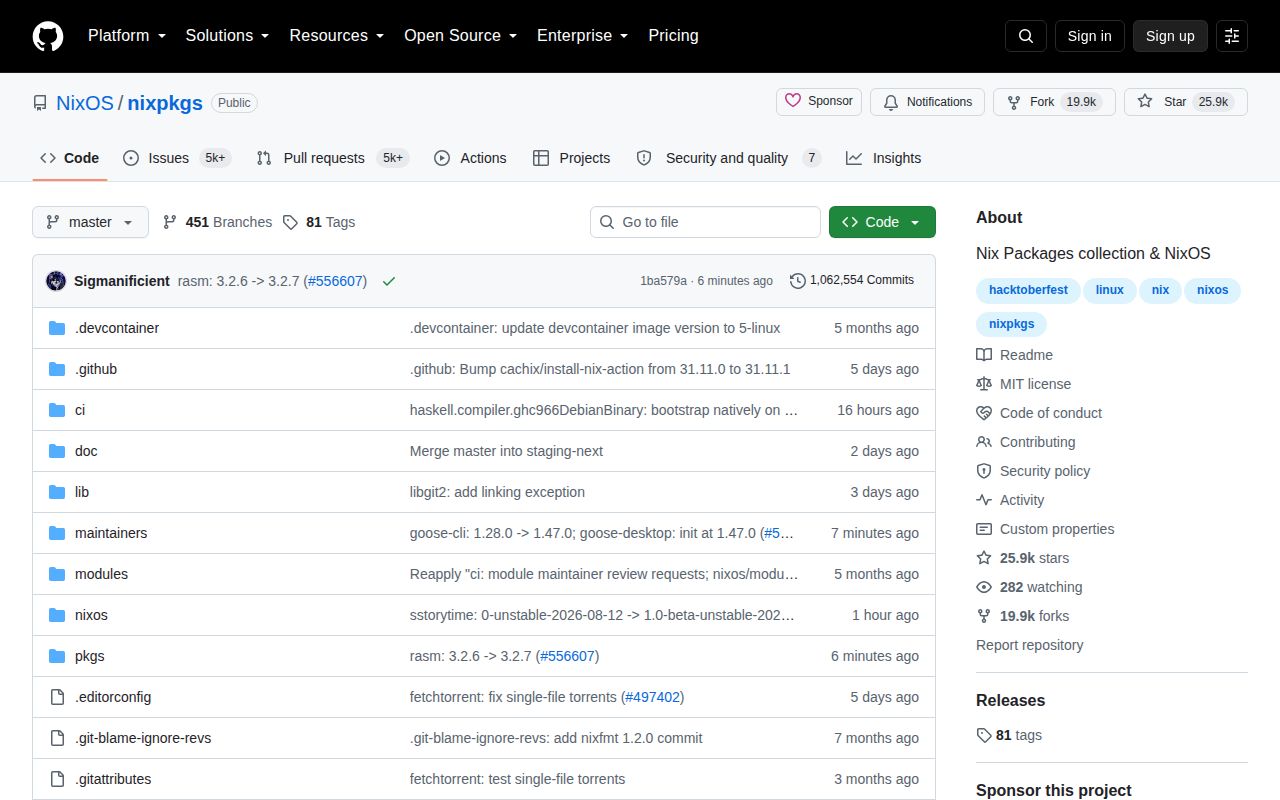
GitHub showed 25,949 stars, 20,860 combined issues and pull requests, and a last push on August 26, 2026. Several new and updated package pull requests appeared within the same minute of our fetch. GitHub returned no latest release because Nixpkgs distributes through branches, channels, Hydra, and caches rather than GitHub Releases. The huge open count reflects the collection's size and is not a count of broken packages.
Nixpkgs is the default choice when the organization has committed to Nix or NixOS. Its package breadth, binary cache, release branches, and active maintenance are hard to reproduce internally. The cost is learning Nix, managing revisions and stores, and qualifying the particular package closure you deploy. Our 11-second helper install is useful evidence about one workflow directory only; the upstream Hydra result and your own targeted evaluation should decide whether a system revision ships.