mrkeyoor.com_
Thu 13 Aug 15:42 UTC
Dataevaluationupdated 13 Aug 2026

nautilus_trader

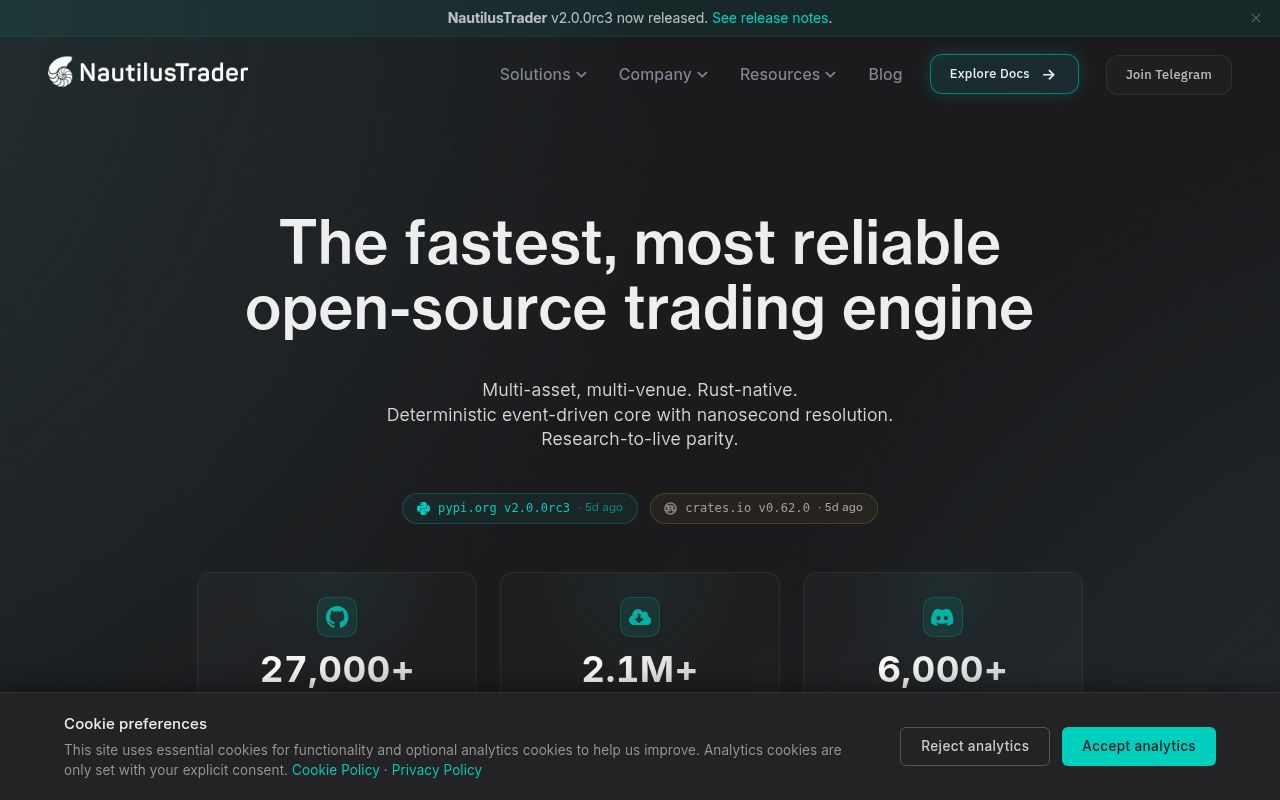
NautilusTrader is a trading engine for researching, backtesting, and running automated strategies against real markets from one event-driven system. It combines a Rust core with Python strategy authoring so traders do not have to rebuild a research strategy in a separate live-trading stack.

Verdict

NautilusTrader is one of the strongest open-source foundations for a small team determined to keep research and live trading in the same architecture. Its adapter breadth, deterministic model, documentation, and security work are convincing, but the v2 cutover and current execution bugs make careful staging non-negotiable. Use it if you can build venue-specific tests and operational safeguards around it; do not install it and point it at capital on the strength of the feature list.

Setup3/5Simple wheel install, demanding live-system configuration
Docs5/5Deep guides, examples, migration notes, and integration references
Community5/5Large audience with daily issue and pull-request activity
Maturity4/5Long-running engine in an important v2 stability transition

Who it’s for

Quantitative developers who want the same event model in backtests and live execution.
Python strategy authors who need a compiled engine underneath market data, risk, and order handling.
Small trading teams connecting one machine to several supported exchanges or data providers.
Rust developers building latency-sensitive strategies or custom venue adapters.

Who it’s NOT for

Teams that require a stable API today: the README says breaking changes can occur, v2 is still in release-candidate transition, and v1 now receives only critical security backports.
Firms needing built-in distributed backtesting, dashboards, or hyperparameter optimization: the roadmap explicitly puts all three outside the open-source project's scope.
Binance Futures hedge-mode operators who cannot validate restart state independently: issue #4738 reports one leg disappearing during startup reconciliation on current develop.
Python users dependent on custom portfolio statistics in standard reports: issue #4741 says v2 only accepts a fixed list of built-in Rust statistics.
Anyone treating an adapter's stable badge as a correctness guarantee: the README says bugs may remain, and current issues cover reconciliation and venue-specific execution failures.

Setup reality

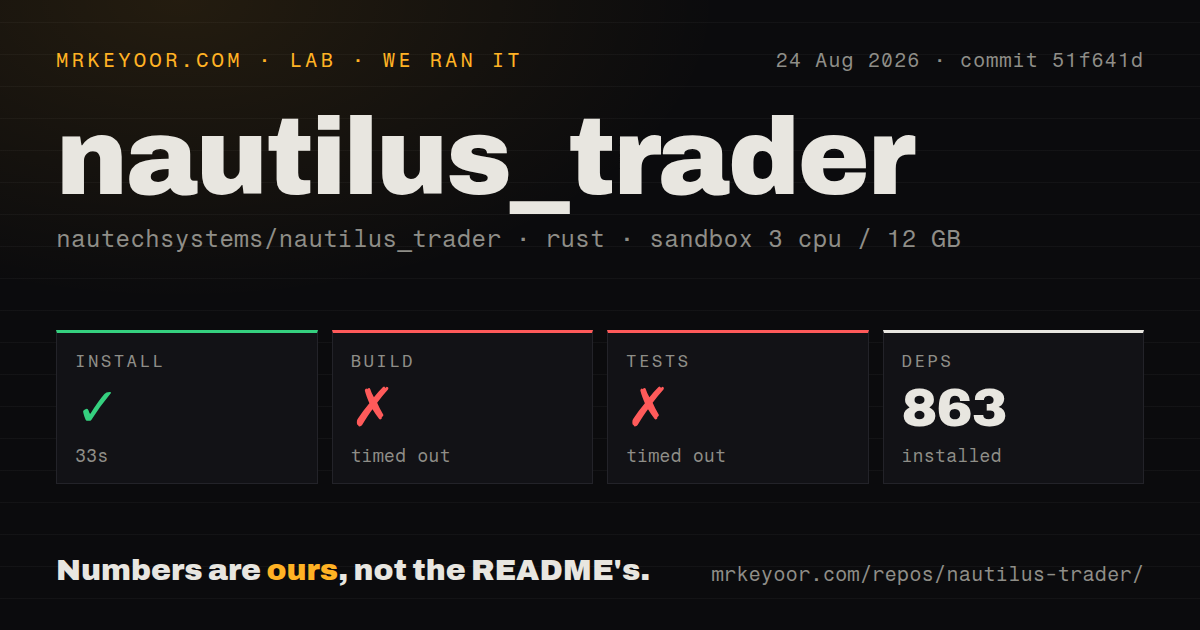
Trying the packaged engine is easy for a system this large: supported CPython users can install a prebuilt wheel with pip, and no Rust toolchain is needed. Linux wheels require glibc 2.35 or newer, Conda is not officially supported, and Python support is currently limited to 3.12 through 3.14. A credible live deployment takes much more work than installation: choose and configure an adapter, supply market data, model venue rules, persist state if needed, test reconciliation and risk behavior, and rehearse restarts. Building from source adds Rust, clang, uv, platform-specific compiler setup, PyO3 environment variables, and a large mixed-language test surface.

One engine from experiment to execution

NautilusTrader tackles a costly split in algorithmic trading. Researchers often test ideas with Python and historical data, then engineers rebuild successful strategies inside a different live system. That rewrite changes timing, order handling, and state, precisely where small differences can become expensive. NautilusTrader instead runs research, deterministic simulation, and live execution through the same event-driven architecture. Python remains the convenient control plane, while a Rust core handles the performance-sensitive machinery. Strategies can also be written entirely in Rust.

The scope is serious. Backtests can combine multiple venues, instruments, strategies, ticks, bars, order books, and custom data at nanosecond resolution. Live adapters cover crypto exchanges, Interactive Brokers, Betfair, prediction markets, and data providers. The order model includes less common time-in-force choices, conditional triggers, iceberg instructions, and linked contingency orders. Optional Redis persistence, a cache, and a message bus provide building blocks beyond a notebook library.

This breadth makes NautilusTrader compelling for a developer who already knows what a production trading system must do. It also makes it a poor shortcut for someone hoping the framework will supply a profitable strategy, data, or operating discipline. It supplies an engine, not an investment process.

Research-to-live parity is the product

The most valuable promise is consistent execution semantics between backtest and live operation. A strategy sees the same architecture and deterministic time model in both environments, reducing one common source of false confidence. Asset-class-neutral domain objects and adapter boundaries also let a cross-venue strategy reason in one vocabulary instead of directly absorbing every exchange's wire format.

That does not make a backtest equal to a market. Fill assumptions, data quality, queue position, latency, fees, and exchange behavior still decide whether results survive contact with live trading. NautilusTrader gives developers custom fill and fee models and detailed order-book data, but users must choose realistic inputs. The README's AI-training claim likewise means the engine is intended to run fast enough for agent training, not that built-in AI or optimization tools exist. The roadmap explicitly excludes integrated AI and hyperparameter tooling.

The adapter list deserves similar restraint. Every listed integration is marked stable, yet the project's own definition says bugs may remain. Recent reports show why that caveat matters. One Binance Futures issue says a hedge-mode account can lose one leg from framework state after restart reconciliation. Other current reports concern inferred fills, missing instruments, and Bybit reconciliation behavior. An adapter can be well developed and still need account-mode-specific acceptance tests.

Installation is the easy part

For supported systems, the first step is pleasantly ordinary: create an isolated environment and install nautilus_trader from a binary wheel. Prebuilt packages mean Python users do not need Rust. The compatibility window is narrower than many Python packages, however, with Python 3.12 through 3.14 listed, glibc 2.35 required for Linux wheels, and Conda not officially supported. A JupyterLab container offers a quick backtest demonstration, though the README warns that verbose logging can exceed Jupyter's output limit and hang a notebook.

Source development is a different commitment. It requires rustup, clang, uv, platform tooling, a recent Rust compiler, PyO3 configuration, and separate Rust and Python test workflows. The minimum supported Rust version generally tracks the latest stable compiler. Contributors also enter a large codebase with generated bindings and a contributor license agreement.

Live trading adds the work no package manager can solve. Credentials, data subscriptions, instrument definitions, clock behavior, state persistence, order reconciliation, kill procedures, observability, and restart drills all need validation for the chosen venue. Optional Redis can persist cache or message-bus state, but operators must design and test that configuration. NautilusTrader removes a rewrite, not operational responsibility.

The v2 cutover changes the buying decision

The latest release, v1.231.0 Beta on August 2, 2026, is intended to be the final normal v1 release. The Rust and PyO3 v2 runtime has reached release-candidate status for core workflows, while the legacy Cython branch is limited to critical security backports for roughly three months after cutover. The release notes list accepted behavioral differences, deferred features, schema migrations, removed hooks, and many breaking changes. Published tutorials still use v1, while generated stubs and Python examples show v2.

That candor is excellent, but it means new adopters should start on v2 in a disposable environment and migration teams should budget for real testing. Older catalog data may require regeneration or migration. Python-defined custom portfolio statistics are not yet integrated into v2's standard analysis path. Current issue #4726 also describes a panic when an execution algorithm submits an order during an event handler and the risk engine denies it. These are specific edge cases, not proof the whole engine is unsafe, but edge cases are exactly what trading infrastructure must contain.

Health and the final call

The repository was pushed on August 13, 2026, the same day as active issue and pull-request updates. Its open count of 102 combines issues and PRs, so it is an active engineering queue, not 102 confirmed defects. Release notes are unusually detailed, and the documentation covers concepts, adapters, installation, migration, development, and security. Signed releases, build provenance, dependency auditing, fuzzing, and a private disclosure process show more supply-chain care than most financial open-source projects.

NautilusTrader is the best fit for technically strong individuals and small teams that value one coherent system and will test it like critical infrastructure. LEAN is the more natural comparison for a broader hosted ecosystem, while Backtrader and Backtesting.py are easier choices for narrower Python research. Choose NautilusTrader for its architecture and live path, but pin versions, isolate the v2 evaluation, reproduce venue behavior with a paper or demo account, and verify every restart before real funds are involved.

Alternatives

ProjectWhat it isPick it when
LEANA C# and Python algorithmic trading engine with a broad asset and brokerage ecosystem.pick this instead when you want QuantConnect compatibility, cloud research options, or a longer-established C#-centered workflow.
BacktraderA Python framework focused on strategy backtesting and trading integrations.pick this instead when a smaller Python-first backtesting API matters more than a Rust-native live engine.
Backtesting.pyA compact Python library for testing trading strategies against historical data.pick this instead when you need approachable research and visualization, not a multi-venue production runtime.

What people are saying

  1. [github-trending] nautechsystems/nautilus_trader

Sources

  1. NautilusTrader README
  2. NautilusTrader v1.231.0 release notes
  3. NautilusTrader roadmap
  4. RiskEngine re-entry panic issue
  5. Binance Futures hedge-mode reconciliation issue
  6. Custom portfolio statistics in v2 issue