A respected object store with a closed chapter
MinIO provides an S3-compatible object-storage server with an embedded browser, command-line administration through mc, identity and policy controls, erasure coding, replication, and deployment options for machines or Kubernetes. It became a common way to give applications an S3 API without sending data to Amazon. The Go server is compact compared with many distributed storage systems, and its API compatibility lets existing SDKs and tools connect with few application changes.
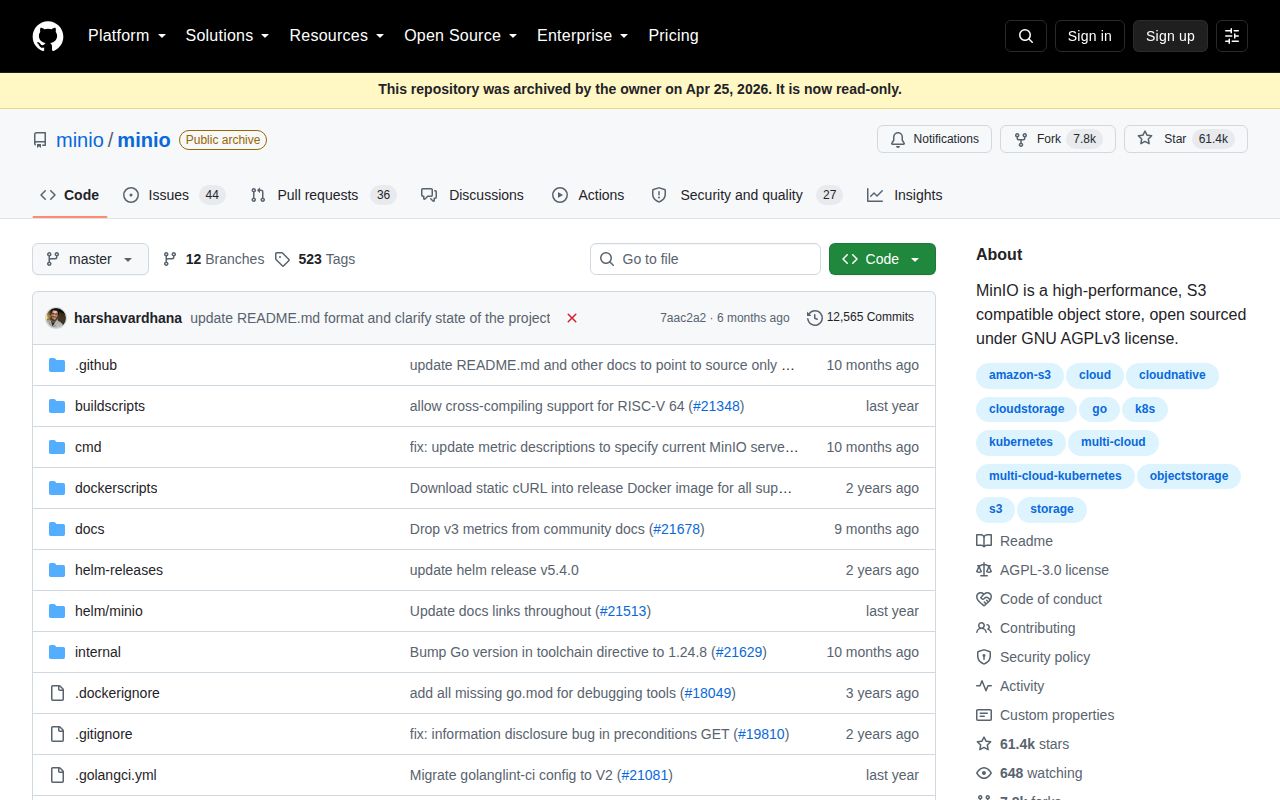
That history no longer describes a healthy new open-source choice. The README begins by saying the repository is no longer maintained, and GitHub marks it archived. MinIO now points users to AIStor Free for a standalone community edition and AIStor Enterprise for distributed deployments with commercial support. The old community server remains available under AGPLv3, but it is source you must own rather than an upstream you can expect to patch.
For an existing cluster, this is a migration and risk-management question. Replacing object storage can be expensive, especially when applications depend on versioning, policies, event notifications, replication, or MinIO-specific administration. Keeping the archived server may be reasonable for a controlled period. Starting a new durable-data system on it is harder to defend when active alternatives exist.
What happened when we ran it
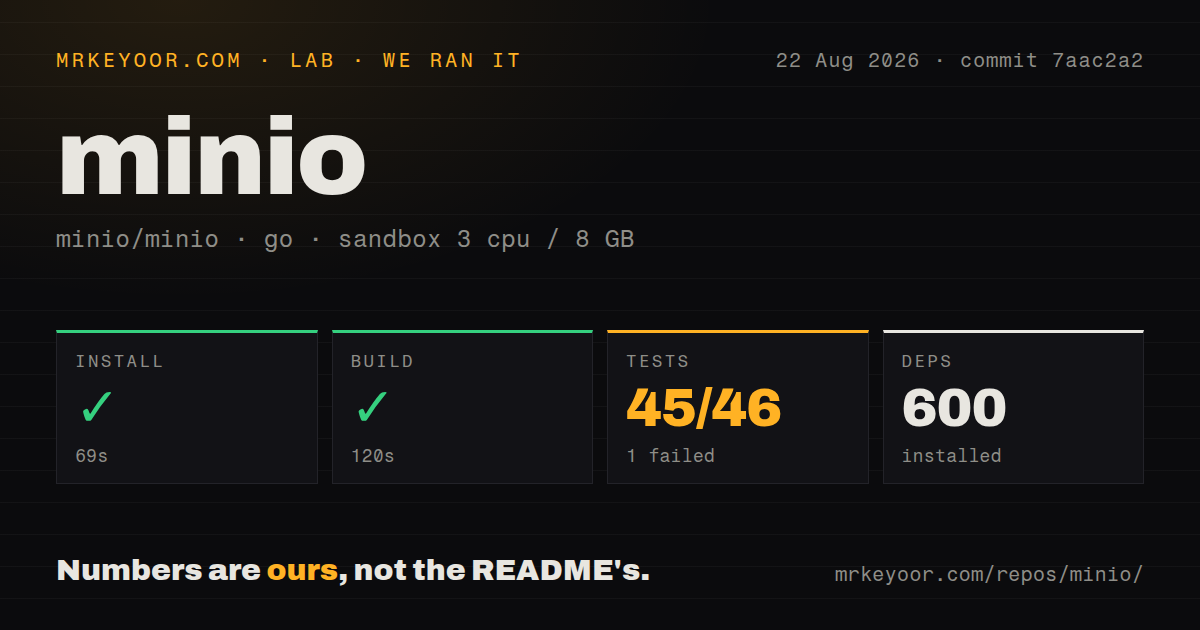
We cloned commit 7aac2a2 into a fresh unprivileged Debian container with three CPUs, 8 GB of RAM, and Go 1.24 on Bookworm. The repository held 1,329 files, about 352,680 lines of source, occupied 37.7 MB, and included 17 CI workflow files plus a Dockerfile. There was no top-level tests directory, though Go tests live beside their packages.
Installing 600 Go packages succeeded in 69 seconds. The build completed in 120 seconds. Tests then ran for 406 seconds and exited with failure: 45 of 46 packages passed and one failed. The supplied log tail lists successful packages under internal/s3select, internal/store, and nearby paths, then ends with FAIL. It does not show which package failed or the assertion, so no cause can be assigned from this evidence.
The practical reading is mixed. The source compiled cleanly in our sandbox, and nearly the entire package run passed. One package did not, and there will be no normal upstream maintenance cycle for this repository. A team considering a fork should reproduce the failure with the full log, then budget for future Go, dependency, security, and S3-compatibility work.
Source-only changes the setup calculation
The README says community binaries are no longer produced and old downloads will not receive updates. Its preferred route is Go 1.24 or newer with go install github.com/minio/minio@latest. A container now starts with compiling the binary and building the image locally. The final GitHub release likewise tells container users to clone the source, check out the security tag, and run the repository's Docker target.
A local demonstration remains short: point the server at an empty directory, open the API and console ports, and sign in. The documented default root credentials are only for that demonstration. Any shared environment needs unique secrets, TLS, restricted network exposure, separate administrative identities, logging, capacity alerts, and backups whose restore path has been exercised. Distributed storage also needs failure-domain planning; adding drives is not the same as surviving the loss of a host or site.
The source-only policy transfers release engineering to the operator. You must record the commit, compiler, build flags, base image, dependency inventory, and resulting digest. Security updates require a new build and rollout. If that is unacceptable, the decision is between AIStor's supported artifacts and another maintained project, not an old minio/minio image tag.
Compatibility is broad, not exact
S3 compatibility is MinIO's strongest application feature, but production clients often use obscure corners of S3. Open issue #21727 reports that an If-None-Match header containing a list of entity tags returns 200 even when one tag matches. Issue #21735 reports a s3:versionid policy condition blocking a delete request that omitted a version ID. Both affect designs where conditional requests or version protection carry correctness or recovery guarantees.
Treat compatibility as a test target. Run the actual SDK operations, multipart uploads, presigned URLs, policies, object-lock rules, version cleanup, notifications, and failure cases used by the application. Do the same against the proposed replacement before moving data. A successful PutObject says little about retention or authorization behavior.
The latest release is also a security boundary. Release RELEASE.2025-10-15T17-29-55Z fixes CVE-2025-62506, a high-severity flaw where restricted service or STS accounts could create a new service account with broader parent permissions. The advisory lists no workaround and recommends immediate upgrade plus an audit of service accounts and access logs. Any older installation should treat that as urgent.
Health, license, and the decision
The last repository push was April 24, 2026. Open issue activity visible through February included container behavior and S3 semantics, while GitHub lists 80 open issues and pull requests together. Those dates cannot offset the explicit unmaintained notice and archived state. Release age alone is not the problem; the maintainers have directly ended this repository's lifecycle.
AGPLv3 adds another decision point. The README warns commercial and proprietary users to validate obligations, especially when modifying or repackaging the server, and offers AIStor for commercial licensing and supported service levels. Get legal advice for the actual deployment rather than treating a compatible API as a license exemption.
SeaweedFS and Garage deserve the first tests for teams wanting an active open-source S3 store. Ceph is the heavier choice when object storage is only one part of a larger storage platform. Existing MinIO users have more switching cost, but they still need a dated exit or support plan. New users should start elsewhere.