Lore v0.10.0 is built for binaries that Git treats as an extension
Lore starts with the repository shape common in games: source code sits beside textures, audio, levels, and other files that do not merge line by line. Version v0.10.0 stores content in addressable chunks, reuses identical data across files and history, and lets a workspace fetch only selected material. A central server remains the source of truth, while staging, commits, branches, and diffs can work locally without a server round trip.
That combination puts Lore closer to Perforce in role and closer to Git in its use of hashes and immutable history. The 23 MB checkout we measured contained 1,293 files and about 543,361 source lines. It includes the Rust library, server, CLI, storage implementations, protocols, integration code, and C API. Separate repositories provide JavaScript, Python, C#, and Go bindings. This is a version-control platform, not a thin command-line wrapper around object storage.
Local demo mode uses 2 ports and no credentials
The quickstart downloads prebuilt binaries and starts a temporary single-node server. QUIC and gRPC listen on port 41337, while HTTP health checks use 41339. The tutorial server disables authentication, creates a self-signed certificate, and writes its store under the system temporary directory. That is sensible for learning the create, stage, commit, push, clone, branch, and merge loop without first building Rust or provisioning a cloud account.
A team deployment has different obligations. Lore's reference server can use AWS S3 for immutable data and DynamoDB for mutable pointers and metadata. Authentication, durable certificates, backups, monitoring, and capacity planning belong to the operator. Prebuilt binaries cover Windows, macOS ARM64, and Linux on x86-64 and ARM64. The zero-config path proves the workflow; it does not prove that a studio's identity model, disaster recovery, or multi-region traffic fits the server.
What happened when we ran it
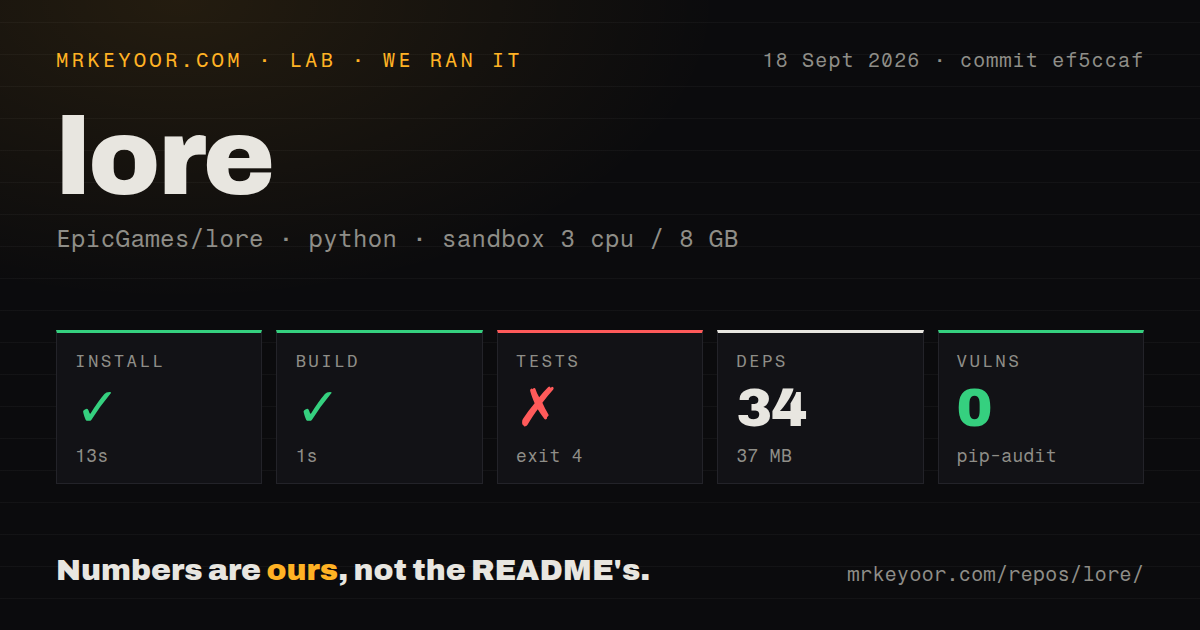
Our sandbox installed 34 Python packages in 13 seconds and used 37 MB on disk. We cloned commit ef5ccaf into an unprivileged Debian container with 3 CPUs and 8 GB of RAM. The build succeeded in 1 second. Pip-audit reported 0 known vulnerabilities in the installed Python environment. Those measurements cover the repository commands run by our lab, not Lore server throughput or large-asset transfer speed.
The test command failed with exit code 4 after 1 second. Pytest read the repository configuration, then rejected --dist as an unrecognized argument. The configuration expects that option for distributed execution, but the log does not establish why the running pytest process lacked it. No tests were collected or counted in our run. Our measurement setup also found 7 CI workflow files, no Dockerfile, and no tests directory at the scanned path.
The 2026 locking work still does not enforce one editor
Lore has file locking now, but the FAQ says it signals a conflict instead of preventing another user from editing the asset. The 2026 roadmap puts enforceable, cross-branch locking in progress, aimed at repositories with millions of files and thousands of concurrent users. Until that work lands and passes your own concurrency tests, an art pipeline that depends on exclusive checkout needs another control or its existing VCS.
The same distinction applies to other headline features. Sparse clones exist, while the virtual file system is still a 2026 roadmap item. The desktop client can be downloaded, but its source is not open yet because it uses proprietary Epic components. An open web client is listed for 2027. UEFN uses Lore internally, although the open-source tools cannot yet read hosted UEFN projects because those projects and the public implementation use incompatible compression formats.
One open merge report matters more than 8,652 stars
GitHub showed 64 open issues and 39 open pull requests, with the repository pushed on September 18, 2026. Release v0.10.0 was published the same day, and recent issue activity includes smoke-test intermittency, a dry-run side effect, and Windows retry stalls. That is a busy young project. It also means a buyer should search the issue queue for every workflow they intend to trust rather than reading the star count as a reliability score.
Issue 211 deserves a migration gate of its own. The report says --fast-forward-merge with more than 1 local commit can silently drop the other side's work. It was still open when checked. A report is not the same as a confirmed root cause, but the claimed outcome touches the core promise of version control. Reproduce that path, review the fix when one lands, and include merge, recovery, and corrupted-store drills in any Lore trial.
A 13-second install earns a trial, not a repository migration
Lore's design is unusually clear about the problem it wants to solve. Chunked binary storage, local work, a central authority, and an MIT-licensed specification make sense for studios unhappy with both Git LFS and closed servers. The docs are candid about pre-1.0 compatibility, incomplete locking, and clients that have not arrived. That candor makes Lore easier to evaluate. It does not lower the cost of losing history. Pin v0.10.0 in a disposable pilot, mirror real asset patterns, and keep the existing system authoritative until the pilot survives them.