Kronos treats candlesticks as a sequence of tokens
Kronos is designed around financial K-lines, the sequences commonly represented by open, high, low, close, volume, and amount. A specialized tokenizer converts continuous, multidimensional values into hierarchical discrete tokens. An autoregressive Transformer then predicts token sequences that can be converted back into forecast values. The authors describe training data from more than 45 global exchanges, though that is their dataset claim rather than a result from our sandbox.
The model family targets a narrower domain than general time-series foundation models. That can help when the data really is candlestick-shaped, but it also means evaluation should include simple market baselines and broader forecasting models. A specialized representation is only useful if it improves the exact horizon, asset universe, and decision rule a team cares about.
Three open checkpoints cover 4.1M to 102.3M parameters
The README lists Kronos-mini at 4.1 million parameters with a 2,048-token context, Kronos-small at 24.7 million, and Kronos-base at 102.3 million. Small and base use a 512-token context. Kronos-large is listed at 499.2 million parameters but marked unavailable as open-source weights. Users should not plan around that largest checkpoint unless its status changes.
Inference loads a tokenizer and model from the NeoQuasar Hugging Face account, then constructs KronosPredictor. Input data must contain open, high, low, and close; volume and amount are optional. Historical and future timestamps are separate inputs. The predictor truncates contexts beyond its configured maximum, so a long lookback does not automatically give small or base more than 512 usable steps.
What happened when we ran it
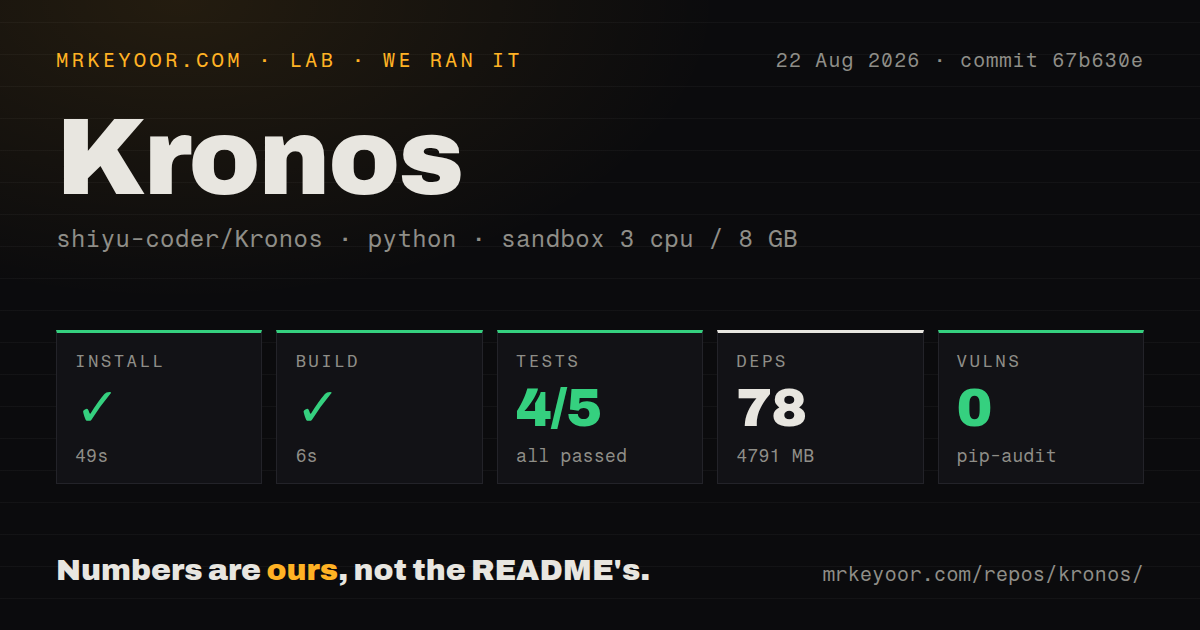
Our sandbox installed 78 Python packages in 49 seconds. The environment occupied 4,791 MB on disk, which is a large local cost for a repository whose checkout was only 16.8 MB. The build succeeded in 6 seconds. Pip-audit found 0 known vulnerabilities in the installed dependency set at commit 67b630e.
Pytest exited with code 1 after 113 seconds. It reported 4 passed, 0 failed, and 1 collection or setup error out of 5. The error came from finetune/qlib_test.py, where a parametrized test supplied a zip object. Pytest required a list or tuple instead. Because collection stopped that file, the result is not a clean suite even though no executed assertion failed.
The log also recorded 17 warnings, including a Hugging Face Hub deprecation notice for hf_xet.download_files(). Our run used Python 3.12 in a fresh unprivileged Debian container with 3 CPUs, 8 GB of RAM, and no secrets. The repository had 92 files, about 11,260 source lines, a tests directory, no Dockerfile, and 0 CI workflow files.
Basic inference is shorter than responsible evaluation
The example forecast path is direct: read a CSV, choose a lookback and prediction length, load the tokenizer and checkpoint, and call the predictor. Sampling temperature, top-p probability, and sample count control probabilistic output. Batch prediction accepts several series but requires the same historical and prediction lengths across the batch. It uses GPU parallelism and normalizes each series separately.
A generated DataFrame is only a forecast, not a trading decision. Market data has leakage traps, changing regimes, survivorship effects, and transaction costs that a few lines of inference do not address. The live demo shows a 24-hour BTC/USDT forecast, which is useful for understanding output shape. It is not a documented live trading record or a comparison against a baseline.
Fine-tuning assumes Qlib data and multiple GPUs
The provided pipeline uses Qlib with a Chinese A-share example. Users configure the Qlib data path, processed dataset directory, checkpoint location, pretrained model names, instrument, time ranges, epochs, and batch size. Data preparation creates train, validation, and test pickle files. Separate torchrun commands fine-tune the tokenizer and predictor, and both are presented as multi-GPU jobs.
That workflow is useful source material for researchers already operating Qlib. It is not a portable data pipeline for every exchange. The README says other formats require changes to QlibDataset. It also warns that many comments in the fine-tuning directory were generated by Gemini 2.5 Pro and may be inaccurate, naming the code itself as the source of logic. Read the implementation before trusting an explanatory comment.
The included backtest is explicitly a demonstration
The final example converts forecasts into signals and runs a simple top-K strategy. The project plainly says this is not a production-ready quantitative system. It calls out portfolio optimization, factor neutralization, position sizing, risk management, transaction costs, slippage, and market impact as missing concerns. That warning should travel with any screenshot or return curve produced by the script.
A serious evaluation needs chronological splits, repeated market regimes, fees, liquidity constraints, and comparisons with naive forecasts. It should measure whether the model improves a decision after costs, not whether predicted candles look plausible. Financial losses are possible even when forecast error improves, so model selection and trading validation must remain separate steps.
April activity and no releases call for pinned research use
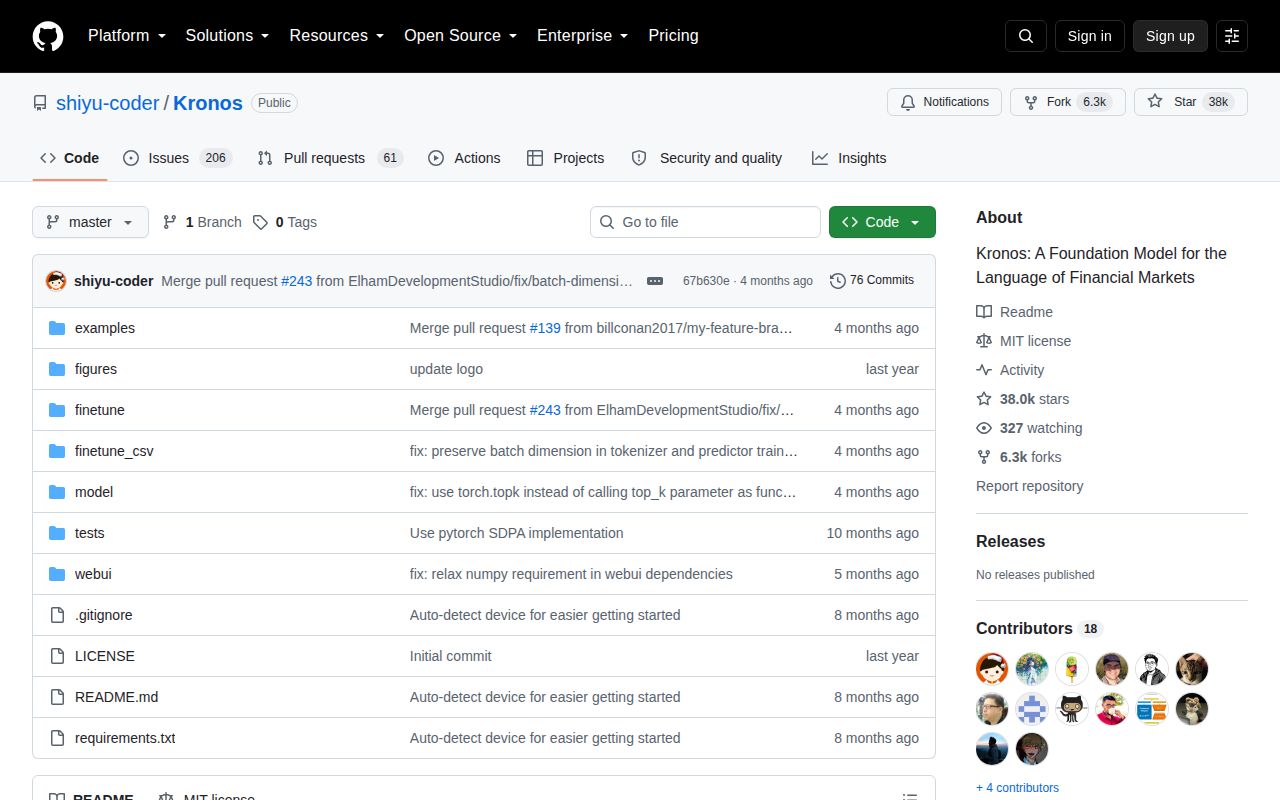
GitHub showed 37,973 stars and 267 combined issues and pull requests. The last push was April 13, 2026. No GitHub release has been published, though the README records fine-tuning scripts from August 2025 and paper acceptance at AAAI 2026. Users should pin a commit and the exact Hugging Face checkpoint revisions they evaluate.
Kronos is an interesting research artifact with clear domain choices and unusually direct warnings about production trading. The 4,791 MB environment, missing CI workflows, unavailable largest model, and pytest collection error keep it below plug-in maturity. Try it beside Chronos, TimesFM, statistical baselines, and your current signal process, then keep it only if out-of-sample evidence survives costs.