Kargo changes Git while Argo CD deploys it
Kargo solves a specific gap in GitOps. CI produces an image, chart, or commit. Argo CD can reconcile a cluster to whatever Git declares. Neither one decides how that artifact should move through test, UAT, and production. Kargo watches artifact repositories, names a discovered combination of artifacts as Freight, and moves it through Stages by running promotion steps that update desired state. Argo CD or another GitOps agent still performs the deployment.
That separation is the reason to consider Kargo. A promotion can clone a repository, update a Kustomize image, render manifests, commit the result, push it, and tell Argo CD which revision to use. Verification can prevent the next Stage from accepting the Freight. The result is easier to inspect than a chain of CI jobs because Kargo records the artifact, target Stage, promotion run, and health in one model.
Five custom resources separate discovery from promotion
The main concepts are Kubernetes resources. A Project provides the boundary. A Warehouse watches Git, image, or chart repositories. Freight is a versioned set of artifacts found there. A Stage represents a promotion target, while a Promotion records work performed against it. These names take a few minutes to learn, but they make a useful distinction between discovering an artifact and deciding that it may advance.
The quickstart demonstrates 3 Stages: test, UAT, and production. It creates stage branches, writes updated manifests, and lets Argo CD sync them. Kargo does not require a branch per Stage, and its FAQ also supports a directory layout on one branch. Monorepos work when paths separate services clearly enough for Kargo to select or ignore relevant commits.
What happened when we ran it
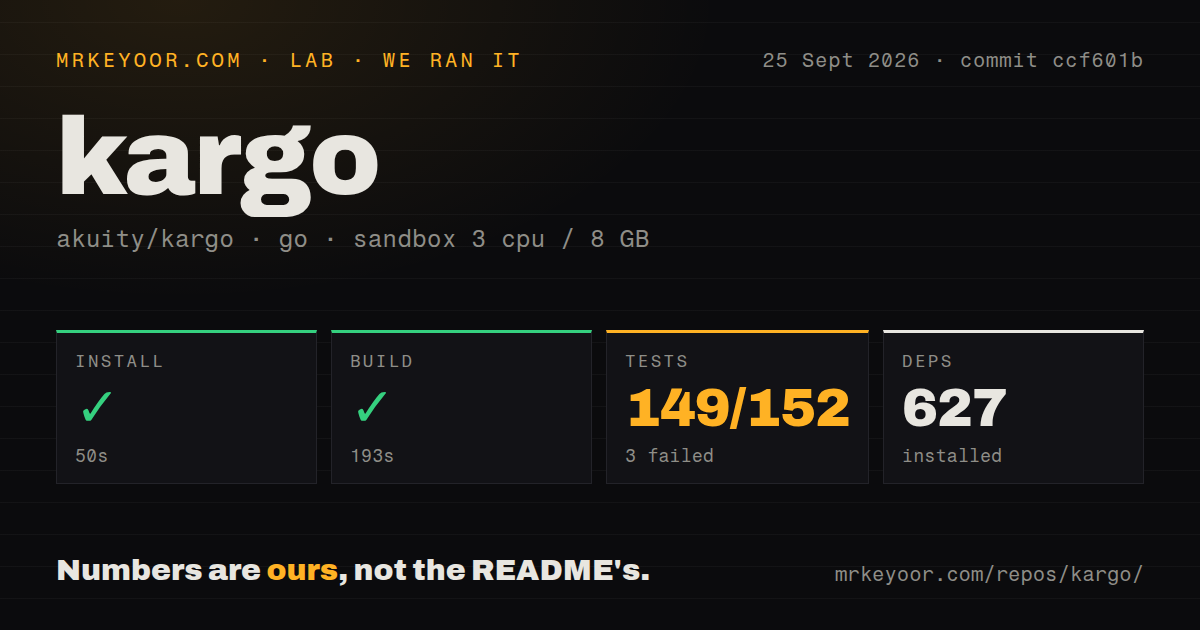
Our sandbox installed 627 packages in 50 seconds. The build completed successfully in 193 seconds. That is a substantial build for a 59.6 MB checkout containing 3,091 files and roughly 445,511 lines of source, but the repository includes the controller, API, web UI, CLI, charts, and integrations rather than a single binary-sized utility.
The test command failed with exit code 1 after 106 seconds. Go reported 149 passed and 3 failed out of 152. The provided tail shows successful packages for Kubernetes webhooks and YAML, then a final FAIL. It does not show the names or error messages for the 3 failures, so we cannot assign a cause. The fair conclusion is limited: commit ccf601b built, yet its complete test command did not pass in our fresh 3-CPU, 8 GB Debian container.
The repository scan found 6 CI workflow files and a Dockerfile. There is no top-level tests directory, which is normal for Go projects that keep test files beside package code. Those signals matter less than the command result: teams evaluating Kargo should reproduce the suite on their target toolchain and inspect the full failing output before promoting this commit.
The local install needs four cluster components
Kargo's quickstart installs cert-manager, Argo CD, Argo Rollouts, and Kargo into a local Kubernetes setup. Helm 3.13.1 or newer is required there. The demo also asks for a GitHub token with write access because the promotion process commits generated configuration back to a fork. This is a realistic introduction to the product, though it is much more infrastructure than running a standalone automation binary.
The basic production path needs deliberate security work. Kargo's own installation guide says the default configuration is only for a local cluster that is not exposed to the internet. Operators must supply an admin password hash and signing key, then handle TLS, OpenID Connect, access control, repository secrets, and monitoring. The architecture includes an API server, controller, garbage collector, admission webhooks, management controller, and an optional external webhook server.
Large installations can distribute controllers across clusters while retaining a central control plane. A controller is normally paired with at most one Argo CD control plane. That limits privileged cross-cluster access, but provisioning service accounts, tokens, and controller configuration across many clusters is described by the project as non-trivial. This is platform work, not an afternoon Helm install that can be forgotten.
Open-source users must stay near the latest release
GitHub recorded a push on September 25, 2026, and listed 151 open issues plus 59 open pull requests when we checked. Release v1.11.4 arrived on September 3, 2026, with a fix for a Dockerfile Helm build problem involving charts with a kubeVersion constraint. That mix of recent code, a current patch release, and active issue traffic points to a maintained project.
The queue also contains operational edges. Issue 7272 reports an HTTP 500 when AnalysisRun logs are requested during a metric's initial delay, even though the underlying state is a routine not-found condition. Issue 6151 asks for a way to mark known-bad Freight as rejected so it cannot be promoted again. Both are concrete reminders to test failure and rollback procedures, not only the happy path.
Akuity's support policy draws a firm line around the community build. Open-source users receive fixes in the latest release, with no time-bound promise to backport them to older lines. Commercial builds have stated windows for security backports. If your change process freezes platform versions for long periods, budget regular Kargo upgrades or buy the support arrangement that matches that policy. Teams that cannot track the latest release should rule out an unsupported community deployment.